Guwahati: In a landmark conservation milestone, forest departments of Assam and Madhya Pradesh have launched India’s longest-ever wildlife translocation, moving endangered Asiatic wild water buffalo from Kaziranga Tiger Reserve to Kanha Tiger Reserve—a journey of over 2,000 km aimed at restoring a species lost from central India for more than a century.
A species returns home after a century
The Asiatic wild water buffalo (Bubalus arnee), classified as Endangered on the IUCN Red List and protected under India’s Wildlife Protection Act, has a global population of fewer than 4,000—nearly 99% of them in Assam.
Once widespread across central India, the species disappeared from Kanha decades ago, with the last confirmed sighting in 1979.
Now, in a carefully planned rewilding effort, the animals are being brought back to their historic grassland habitat—where they are expected to play a crucial ecological role as “grassland engineers,” naturally managing vegetation and boosting biodiversity.
PREMIUM STORIES FROM EASTMOJO
2000+ readers have backed us to keep journalism free. You can too.
SUPPORT US
The initiative has been driven at the highest level, with Assam Chief Minister Himanta Biswa Sarma and Madhya Pradesh Chief Minister Mohan Yadav backing the inter-state collaboration.
मध्यप्रदेश के लिए आज का दिन ऐतिहासिक है।
कान्हा टाइगर रिजर्व में विलुप्त हो चुके जंगली भैंसों का सफल पुनर्स्थापन किया गया है। इस महत्वपूर्ण परियोजना के साथ मध्यप्रदेश और असम के बीच वन्यजीव आदान-प्रदान का एक नया अध्याय जुड़ रहा है। नए वन्य मेहमानों के आगमन से जैव-विविधता में… pic.twitter.com/zo6S5RQSdr
— Chief Minister, MP (@CMMadhyaPradesh) April 28, 2026
A feasibility study by the Wildlife Institute of India identified Kanha’s meadows as ecologically similar to Kaziranga, paving the way for a phased reintroduction of 50 buffaloes over the next year.
Inside the high-stakes operation
The complex field operation has been led by Dr. Sonali Ghosh, Field Director of Kaziranga, with on-ground capture and logistics coordinated by Arun Vignesh CS, DFO and Deputy Director.
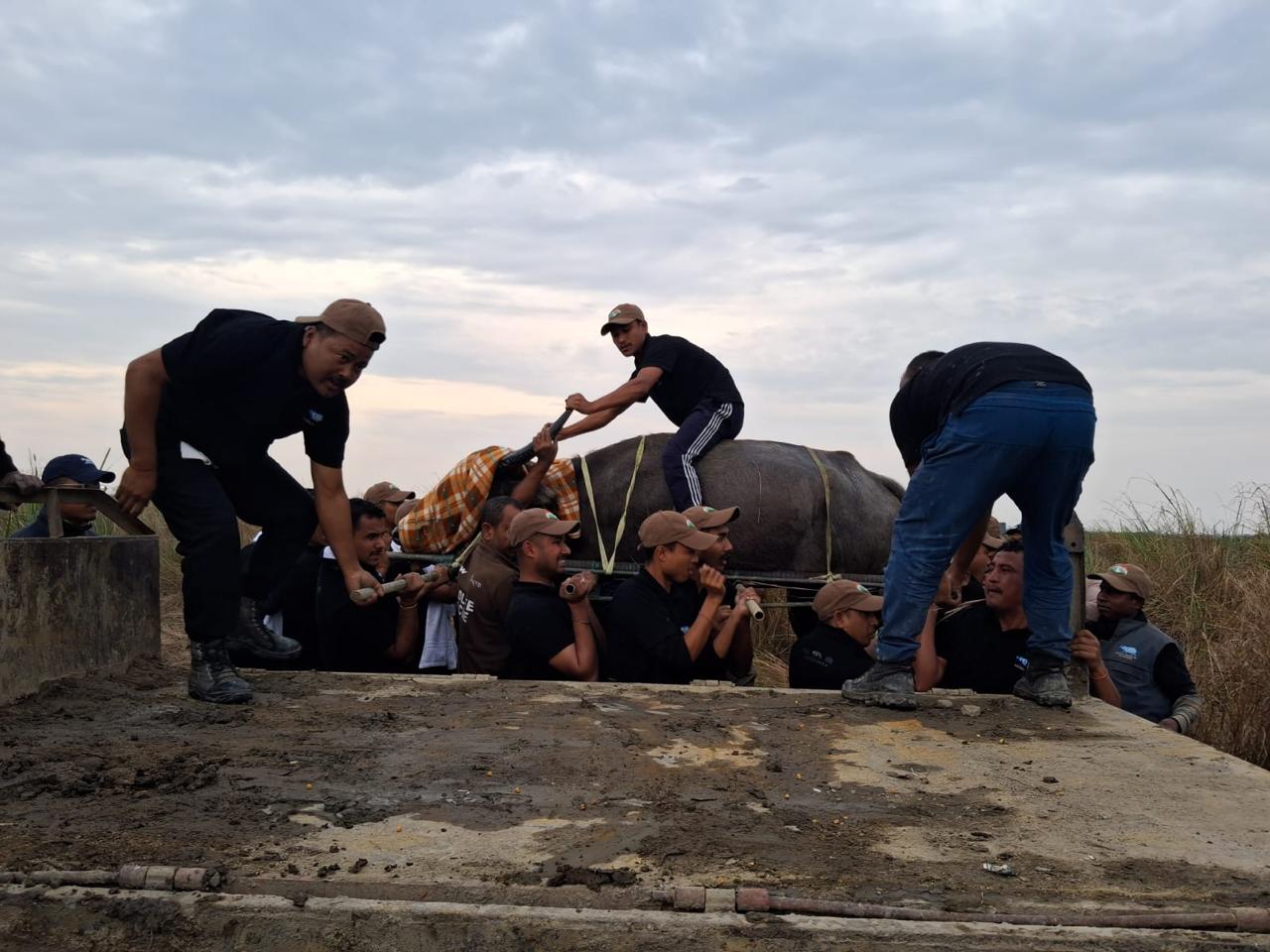
Veterinary teams led by Dr. Bhaskar Choudhury and Dr. Saurabh Buragohain, along with experts from the Centre for Wildlife Rehabilitation and Conservation and the Assam State Zoo, ensured safe chemical immobilisation, quarantine, and health monitoring.
Between March 19 and April 10, seven sub-adult buffaloes were captured from Kaziranga’s Central and Eastern ranges. The animals were housed in specially constructed one-hectare “bomas” to acclimatise them to human presence, feeding routines, and transport conditions—reducing stress during relocation.
Observers, including Kaushik Barua, member of the Assam State Board of Wildlife, and local stakeholders monitored the process.
On April 25, the first batch of four buffaloes (one male and three females) was flagged off from Kaziranga. The convoy—equipped with veterinary teams, fodder, and water—completed the three-day journey to Kanha on April 28.
At Kanha, the animals were received under the supervision of Sameeta Rajoria, PCCF and Chief Wildlife Warden of Madhya Pradesh, before being placed in a holding enclosure for acclimatisation ahead of a planned soft release. The release was carried out in the presence of Chief Minister Mohan Yadav and senior officials.
A second batch is scheduled to follow, marking steady progress toward establishing a viable population.
This translocation is more than a logistical feat—it is a test case for large-scale species recovery in India. It restores ecological balance, as buffalo grazing helps maintain open grasslands; secures the genetic future by reducing over-concentration in Assam; and builds conservation capacity by strengthening wildlife handling and inter-state coordination.
In a reciprocal conservation gesture, Madhya Pradesh has expressed willingness to support Assam with future reintroduction of gharials (Gavialis gangeticus), pointing to a broader model of collaborative conservation.
From the floodplains of Kaziranga to the forests of Kanha, this unprecedented operation—powered by political backing, scientific planning, and field expertise—marks a decisive step in bringing a lost species back to its historic range.
Also Read: Aizawl 1966 to Manipur 2026: India’s long habit of looking away