As April 24 has passed and Armenians have once again ascended the heights of Tsitsernakaberd, new and often contradictory theses continue to shape public and political discourse. These discussions revolve around the concepts of “historical” versus “real” Armenia, the idea of closing the chapters of memory, and establishing friendships with neighbors without preconditions.
For the Armenian people, the Armenian Genocide has never been merely a historical event; it is an existential foundation upon which modern identity is anchored. However, in recent years, rhetoric from the highest state podiums has taken sharp and contradictory turns, forcing society to question the steadfastness of its value system. The Weekly spoke with ethnographer Hranush Kharatyan about these developments, the transformations in the perception of the Genocide, and regional challenges.
2020 to 2025: A sharp decline in rhetoric
My journalistic observations reveal a remarkable and concerning transformation in the head of state’s discourse. Looking back to April 24, 2020, we see a completely different picture. Addressing Armenians from the heights of Tsitsernakaberd, Prime Minister Nikol Pashinyan delivered firm and demanding messages. He emphasized that Turkey had not yet answered for the crime it committed and that the Republic of Armenia remained committed to the principle of “I remember and I demand.” At that time, Genocide recognition was viewed as a critical component of national security.
However, only five years have passed, and the image has changed diametrically. In March 2025, during a meeting with Turkish journalists, a statement was made that shook Armenian public and academic thought. The prime minister said the issue of international recognition of the Armenian Genocide is no longer among the priorities of Armenia’s foreign policy. This shift was perceived by many as a unilateral concession and an abandonment of the struggle for historical justice.
Observations by ethnographer Hranush Kharatyan
Hranush Kharatyan is an ethnographer, Caucasologist and doctor of historical sciences. As a prominent public figure, she is the author of numerous monographs and articles on Armenian ethnic traditions, religious life and, most importantly, the mechanisms of Armenian survival following the Genocide.
Advertisement
Kharatyan said Armenians are living through a phase of shifting evaluations dictated by objective political realities; however, these dictates cannot always quickly alter popular memory. She noted that the perception of the Genocide has moved beyond purely historical frameworks.
“The Genocide is not historical; it is very much of today. Witness Sumgait, Baku, Maragha. Furthermore, it is present today not only against Armenians. Over the last 10 to 15 years, from Sinjar to Gaza, this has been a continuing phenomenon worldwide,” she said.
According to Kharatyan, political reservations regarding the Armenian Genocide directly encourage new atrocities. Consequently, the April 24 march is not only a tribute but also a way of saying “no” to genocidal policies.
The impossibility of “closing the page”
Referring to the ideas voiced by government circles about “closing the pages of history” for the sake of peace, the ethnographer said it is simply impossible. This is not only an issue for the Republic of Armenia but a global ethno-cultural reality.
“We can never close that page. Even if a solution is found through certain agreements, that is not the closing of a page; perhaps it is the full opening of that page. Regardless of whether a particular power or legal means speaks of closing the page, I believe it opens several other pages that have not yet been unfolded.”
Kharatyan said that even if the Armenian government decides to maintain neutrality or remain silent, the issue of the Armenian Genocide will continue to be on the international agenda, as it serves as a classic example for the world.
The depatriation of Artsakh as a new act
Speaking about the forced displacement of the population of Artsakh, the ethnographer said it fits within the Lemkinian definition and the framework of the U.N. Convention. According to her, depatriation — depriving a group of people of their cultural and historical heritage and collective existence — is an act of genocide.
“Whether the authorities want it or not, April 24 will also be a day to commemorate the deportation and depatriation of the Armenian population of Karabakh. It will be a march of rebellion against the genocidal acts that have taken place over the last 30 to 35 years.”
Friendship or relations?
When asked whether it is possible to become friends with the Turks, Kharatyan responded with caution. She distinguishes between the concepts of “friendship” and “relations.”
“People do not decide in their minds whether to be friends. If we see that Armenophobia is part of Turkish and Azerbaijani political programs, then speaking of friendship is very difficult. But this does not contradict the fact that there can be diplomatic relations between countries. Those are inevitable,” Kharatyan told the Weekly.
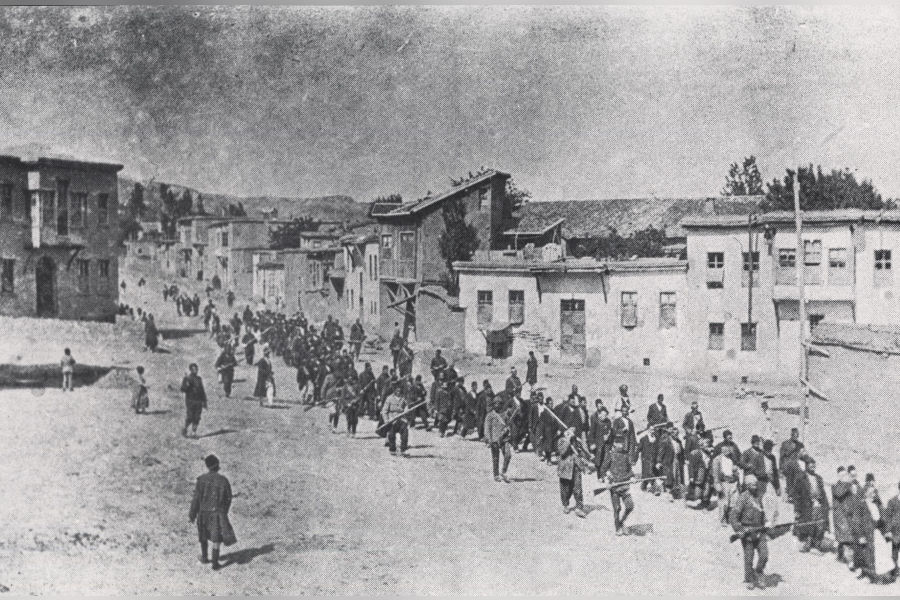
In summary, the ethnographer said the Armenian Genocide has not ended — neither as an action against Armenians nor as a perception. Meanwhile, international silence only gives a green light to further violence. The conversation shows once again that history is not the past but a present that knocks on our door every time we attempt to forget it.