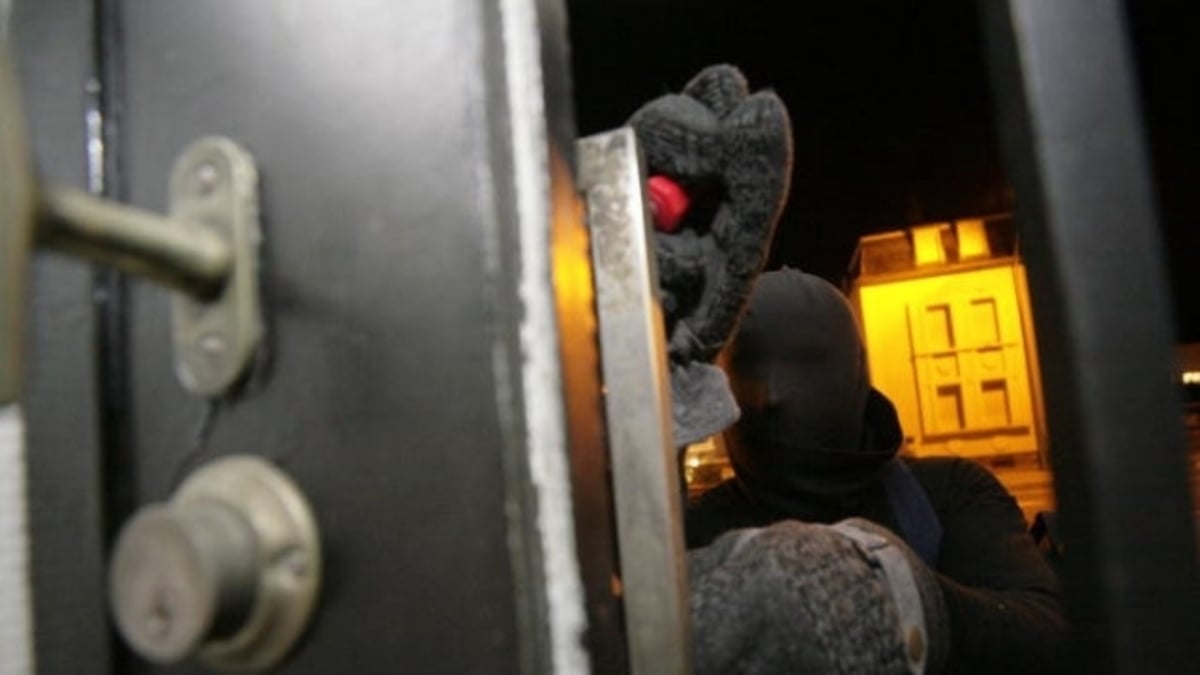
Acid attacks on door locks are among the newer burglary methods encountered by Luxembourg police, who warn that perpetrators are increasingly using corrosive substances to silently disable lock cylinders before forcing entry.
Alongside this emerging tactic, authorities report a broader shift in burglary techniques, with more than ten incidents recorded daily nationwide last year and a growing use of sophisticated methods such as cylinder attacks and adhesive threads to detect unoccupied homes.
Burglary remains one of the crimes most closely linked to the public’s perception of safety and it featured prominently in the recently published 2025 annual police report.
The number of successful burglaries in residential properties rose slightly by 2.4% compared to the previous year, while a “significant decline” of 7.46% was recorded for unoccupied buildings, according to police data.
Burglar who scaled drainpipe to enter Bonnevoie flat given two-year prison sentence
While the overall picture shows relative stability – authorities registered a total of 3,808 attempted and completed burglaries, just nine fewer than the previous year – this still represents more than ten incidents per day on average nationwide.
At the same time, police report a clear shift in modus operandi. In particular, they highlight so-called cylinder and acid attacks, forced entries via patio or balcony doors, and climbing into upper floors. Investigators are also increasingly observing the use of fine adhesive threads placed on doors to determine whether homes are occupied.
Cylinder attack
A “cylinder attack” refers to a method in which perpetrators deliberately manipulate or destroy a door’s lock cylinder to gain access to a property. Techniques include pulling, breaking, or drilling out the cylinder. The aim is to bypass the locking mechanism quickly and with minimal noise.
Acid attack
In an acid attack, corrosive substances are introduced into the lock cylinder to damage or block internal components, making the lock easier to force or completely inoperable. This method is also intended to remain discreet and time-efficient.
Adhesive threads on doors
To determine whether residents are away, perpetrators stretch fine threads coated with liquid adhesive between the door and the frame. If the thread remains intact for a prolonged period, this indicates to the perpetrator that the flat or house is unoccupied.
The report also pointed to the emergence of specialised criminal groups from South America as a growing trend. These groups reportedly travel through several European countries under the guise of tourism, committing a series of burglaries before returning to their countries of origin.
Police additionally continue to record so-called “daytime burglaries” carried out by itinerant groups. According to the report, these include offenders from parts of South-Eastern Europe, particularly from states of the former Yugoslavia. A recurring tactic involves the use of minors to carry out offences in order to reduce legal risks. Other travelling groups are also regularly active.
In 2025, authorities recorded a total of 3,900 thefts involving vehicles. In 3,278 cases, items were stolen from cars, while 622 involved the theft of entire vehicles, including 279 private cars. All three figures represent record highs. Ten years ago, the total stood at 1,644 cases, meaning a 2.4-fold increase over the decade.
Luxembourg’s South Asian community feels it is being targeted by burglars
193 suspected offenders arrested
In response to the rise in thefts, police said they are increasingly relying on a proactive and preventive approach aimed at identifying active offenders early and preventing further crimes. This includes continuous real-time analysis of offences and trends.
In total, 193 suspected burglars were arrested in 2025, including 132 caught in the act and 61 detained under warrant. A further 223 suspects were identified. Police attribute these results to improved responsiveness and close cooperation with international partners.
In June 2025, the public prosecutor’s office announced that a large-scale investigation into organised crime had led to several arrests. In connection with at least 48 burglaries in Luxembourg causing losses exceeding €700,000, four suspects were arrested in France and one in Luxembourg, followed by further searches abroad, it said.
How organised crime gangs appear to be targeting Luxembourg bike shops
(This article has first been published by the Luxemburger Wort. AI translated, with editing and adaptation by Lucrezia Reale.)