More than 110 million people were affected by 358 reported disasters in 2025, according to the annual report by the Emergency Events Database. The year was consistent with a typical year of disaster impacts, with no mega-disasters recorded. The report looked at nine different types of disasters and only found above-average impacts from storms.
The new report, published April 20 by the Centre for Research on the Epidemiology of Disasters at the Catholic University of Louvain in Belgium, calculated at least 16,607 fatalities and nearly $170 billion in economic losses as a result of disasters in 2025. The disasters included earthquakes, as well as climate-related events such as droughts, extreme temperature, floods, wildfire and storms; the latter were the only disaster category whose number exceeded the last 25-year average.
The study found there were 44% more storms, 156 in total, compared to the annual average from 2005 to 2024 of 108.
“Notably, 2025 was also marked by the absence of any mega-disaster,” the report’s authors wrote, noting that the most significant earthquakes of 2025, in Myanmar and Afghanistan, were less deadly than major earthquakes of other years.
“Nevertheless, in 2025, the cumulative impact of multiple concurrent hazards, including earthquakes, storms, and floods, resulted in a global disaster burden consistent with that of a typical year,” they added.
The earthquakes in Myanmar and Afghanistan were the two deadliest disasters of 2025, the report notes. In March 2025, a major magnitude-7.7 earthquake hit central Myanmar, causing 3,820 deaths. In August 2025, a strong magnitude-6.0 earthquake in eastern Afghanistan killed 2,200 people.
Asian nations suffered the most disasters, and nearly 73% of the subsequent human deaths: 175 disasters were recorded in the region, compared to 93 in the Americas, 63 in Africa, and 22 in Europe.
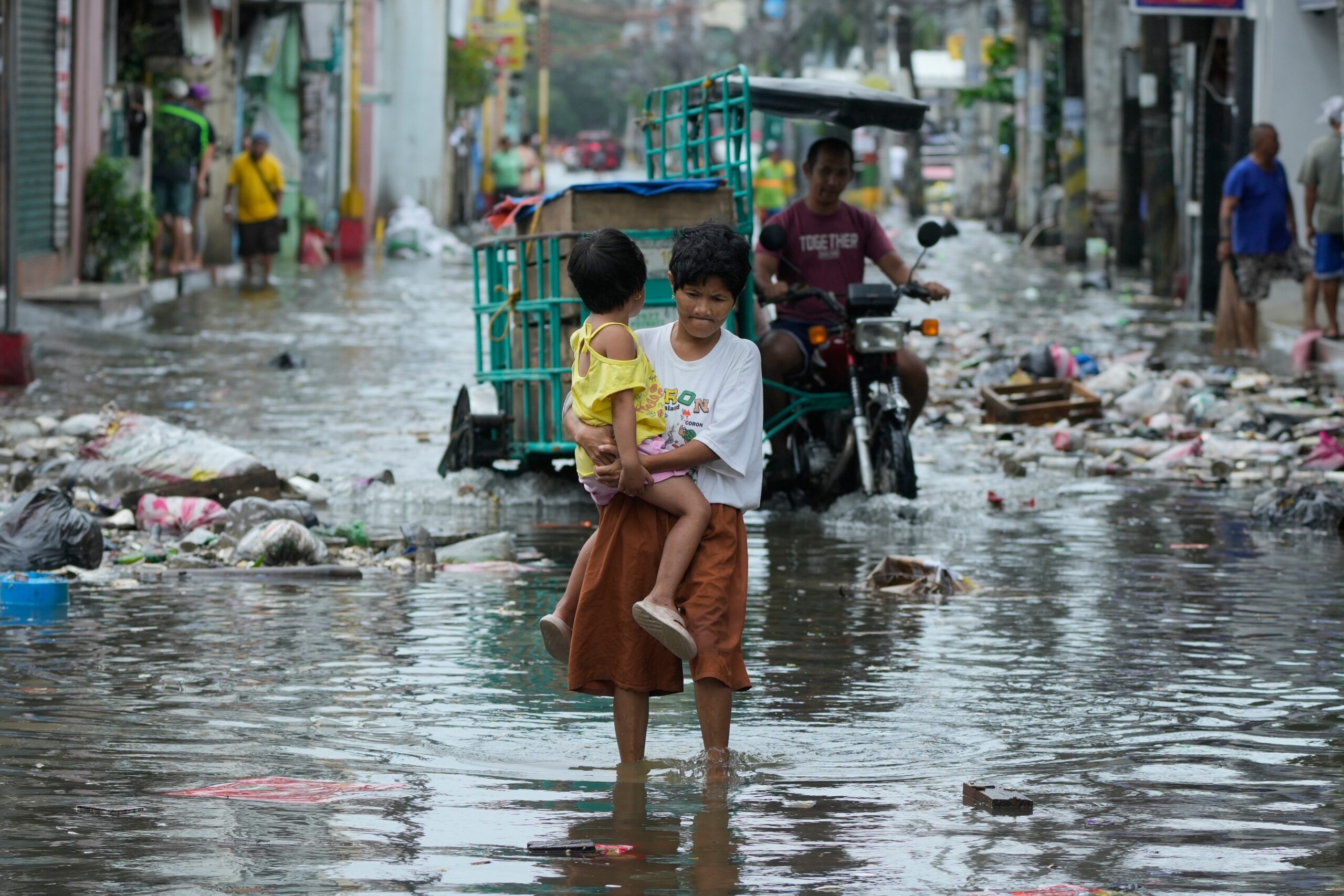
An ongoing drought in Syria affected an estimated 16 million people. Several strong typhoons in the Philippines cumulatively affected around 30 million people in 2025.
According to climate scientists, typhoons are becoming more frequent due to climate change.
The report notes that the 2025 impact figures are evolving and may be revised as new data become available.
Banner image: A woman and child cross a street flooded due to Typhoon Fung-wong in November 2025, in Navotas, Philippines. Image © Aaron Favila/AP Photo.