Iran will respond decisively to any renewed hostile action, senior commander warns
Iran’s armed forces are ready to deliver an “immediate and decisive response” to any renewed hostile action by its adversaries, Ali Abdollahi, commander of the Khatam al-Anbiya Central Headquarters, was quoted by the Tasnim news agency as having said.
He said Tehran had the upper hand militarily, including in the management of the strait of Hormuz, and would not allow Donald Trump to “create false narratives over the situation on the ground.”
Though Iran had briefly opened the strait of Hormuz on Friday, it closed it again (to “hostile” countries at least) on Saturday because the US would not lift its counter-blockade.
The commander’s comments come after the Iranian parliamentary speaker, Mohammad Bagher Ghalibaf, who is expected to head the Iranian delegation if peace talks take place in Pakistan, said yesterday evening that his country would not attend negotiations while under threat – and warned they were “prepared to reveal new cards on the battlefield”.
Trump, who sees the resumption of shipping levels in the strait of Hormuz to pre-war levels as a priority, has threatened to resume bombing if an agreement is not reached by Wednesday’s deadline.
Share
Updated at 03.42 EDT
Key events
Show key events only
Please turn on JavaScript to use this feature
China’s ambassador to Pakistan, Jiang Zaidong, has expressed his “full support” of Pakistan’s mediation efforts between the US and Iran.
In a post on X, Pakistan’s foreign ministry said talks between the country’s deputy prime minister Ishaq Dar, who also serves as foreign minister, and Zaidong focused on the “latest regional developments”.
“Amb Zaidong conveyed China’s full support for and appreciation of Pakistan’s continued efforts to facilitate engagement between US and Iran for sustained peace and stability in the region and beyond,” the ministry said.
During a phone call with Saudi Arabia’s Crown Prince Mohammed bin Salman on Monday, Chinese President Xi Jinping said that “normal traffic” through the strait of Hormuz “should be maintained” and, according to state media, said China “advocates for an immediate and comprehensive ceasefire”.
China is widely seen to have benefited from the US-Israel war on Iran as it has enabled Beijing to boost its diplomatic power and the country’s fossil fuel stockpiles and diversified energy mix insulated it from the worst of the oil shock, as my colleague notes in this analysis piece.
The Chinese yuan has also been used by ships that have paid tolls to Iran for safe transit across the strait of Hormuz, according to reports.
Share
Updated at 06.37 EDT
The internet blackout in Iran has entered its 53rd day, according to internet monitoring group NetBlocks. It said in a post on its website:
double quotation markThe Iran internet blackout is now in its 53rd day after 1248 hours of disconnection from global networks.
As authorities work to develop tiered access for select users and businesses, the human impacts and economic harms of this digital censorship measure continue to spiral.
A select number of officials are still able to use the internet and post regularly on social media about the war. There was an earlier internet shutdown in January during nationwide protests, which helped obscure extreme violence against Iran’s population.
Share
Updated at 06.14 EDT
Belgium’s foreign minister Maxime Prevot has described Israel’s military actions in Lebanon as “totally unacceptable”.
“Israel’s conduct is completely unacceptable. Of course, we must firmly condemn Hezbollah’s initial attacks, which, in seeking to show solidarity with Iran, dragged Lebanon into a war it did not want, as well as Israel’s disproportionate and indiscriminate response,” Prevot said ahead of a meeting with EU foreign ministers in Luxembourg.
He also said Belgium is calling for at least a partial suspension of the EU’s Association’s Agreement with Israel, adding that Belgium is “aware that a full suspension is probably out of reach given the positions of the various European countries” ( see post at 09.19 for more details).
Israel started a war on Lebanon on 2 March when Hezbollah, the Iranian backed Lebanese militant group and political party, launched rocket fire at Israel after US-Israeli airstrikes killed former Iranian supreme leader, Ali Khamenei, in Tehran.
The aftermath of Israeli warplanes launching intense airstrikes on a residential neighbourhood in Tyre, southern Lebanon, before a ceasefire took effect. Photograph: Abdul Kader Al Bay/ZUMA Press Wire/Shutterstock
The IDF responded with a wave of intense strikes across Lebanon, targeting what it claimed was Hezbollah infrastructure, though many civilians were killed (over 2,290, according to the health ministry), homes destroyed and over 1.2 million people displaced across the country.
During the war, Israel also launched a ground invasion several kilometres into Lebanese territory, with a stated goal to push Hezbollah back from the border in order to stop the ability of the group to fire rockets into communities in northern Israel. Israeli officials now say Israel will stay in control of dozens of towns and villages as part of what it describes as a security buffer zone – but from the ground this looks like a prelude to long term occupation.
The US state department will host new talks on Thursday between Israel and Lebanon, an American official told the AFP news agency, after a previous meeting saw the start of a 10-day ceasefire that took effect on 16 April.
Hezbollah is of the view that direct peace talks are a form of national humiliation and are about trying to pressure the group into laying down its weapons. The Lebanese president, Joseph Aoun, who wants to end the Israeli occupation of southern areas of his country and stop future Israeli attacks, is in favour of engaging in the talks.
Share
Updated at 05.22 EDT
No Iranian delegation has departed for Pakistan yet – state TV
Iranian state TV is reporting that no Iranian delegation has yet departed for Pakistan to attend peace talks with the US. It is not clear yet if they will attend the talks today despite pressure from mediators to do so.
The country’s state broadcaster wrote in a post on Telegram that “no delegation from Iran has travelled to Islamabad, neither a primary nor a secondary, neither initial nor follow-up.”
Axios, meanwhile, is reporting that the US vice-president JD Vance is due to leave for Islamabad by Tuesday morning for talks with Iran, a day before the ceasefire expires.
Steve Witkoff, Donald Trump’s special envoy who often acts like a de facto secretary of state, and Jared Kushner, the president’s son-in-law and adviser, are also expected to travel to the Pakistani capital for the talks.
Iran has been stalling because of possible pressure from the Revolutionary Guards on the negotiators to adopt a firmer line and insist there cannot be diplomacy while the US is blockading the strait of Hormuz, according to the Axios report.
Iran holds a deep mistrust of the US as it has been attacked before during previous negotiations.
Security forces take extensive measures ahead of a possible second round of talks between US and Iranian delegations in Islamabad, Pakistan, on 21 April, 2026. Photograph: Muhammed Semih Ugurlu/Anadolu/Getty ImagesShare
Updated at 05.34 EDT
You can keep up with the latest developments on the EU and from around the continent in our Europe live blog:
ShareJakub Krupa
Spain’s foreign minister José Manuel Albares has just confirmed that Spain, Slovenia and Ireland have requested a discussion on suspending the EU’s association treaty with Israel at today’s meeting of the bloc’s foreign ministers.
He said the process was about the EU’s “credibility” on all other issues, as the bloc is expected to stand “for the same principles” everywhere.
He said that if the EU is “not capable to say today to Israel” that it is expected to respect human rights and international law, and not make war a foreign policy tool, “we are going to lose that credibility.”
“We have to say the same thing that we say to Russia concerning Ukraine, and that we say in other scenarios, and since the last time we brought this same position, things have worsened,” he said.
double quotation markEuropean Union has to say today very clearly to Israel that that change is needed. That’s not the right path, and that while Israel continues in that path of a permanent perpetual war, we will not be able to [run our relations] in the same way.
He said that if suspending the association treaty in full is unacceptable for some members, the bloc should consider suspending at least the trade element of the deal.
José Manuel Albares said Spain, Slovenia and Ireland have requested a discussion on suspending the EU’s association treaty with Israel. Photograph: Virginia Mayo/APShare
Israel is continuing its attacks on Gaza, where the humanitarian situation remains dire despite a ceasefire.
At least four Palestinian people have been killed by Israeli attacks in the southern and northern parts of the Gaza Strip so far today, Palestinian news agency Wafa is reporting.
In its latest update, Gaza’s health ministry said at least 72,560 Palestinian people have been killed and 172,317 others injured in Israeli attacks on Gaza since 7 October 2023.
At least 784 Palestinian people have been killed in Israeli attacks since a ceasefire came into effect in October 2025, according to the ministry, whose figures the UN generally find reliable.
Most of the people killed have been civilians and the true death toll is likely much higher given the number of people still buried under rubble across the territory.
People walk past homes destroyed by Israeli airstrikes on 20 April 2026 in Gaza City. Photograph: Ahmad Hasaballah/Getty Images
Aid groups say broken infrastructure and inconsistent electricity have turned untreated sewage into a growing public health risk, and there is a view that the US and Israeli war on Iran has resulted in even higher prices for food and other essentials.
Share
Iran will respond decisively to any renewed hostile action, senior commander warns
Iran’s armed forces are ready to deliver an “immediate and decisive response” to any renewed hostile action by its adversaries, Ali Abdollahi, commander of the Khatam al-Anbiya Central Headquarters, was quoted by the Tasnim news agency as having said.
He said Tehran had the upper hand militarily, including in the management of the strait of Hormuz, and would not allow Donald Trump to “create false narratives over the situation on the ground.”
Though Iran had briefly opened the strait of Hormuz on Friday, it closed it again (to “hostile” countries at least) on Saturday because the US would not lift its counter-blockade.
The commander’s comments come after the Iranian parliamentary speaker, Mohammad Bagher Ghalibaf, who is expected to head the Iranian delegation if peace talks take place in Pakistan, said yesterday evening that his country would not attend negotiations while under threat – and warned they were “prepared to reveal new cards on the battlefield”.
Trump, who sees the resumption of shipping levels in the strait of Hormuz to pre-war levels as a priority, has threatened to resume bombing if an agreement is not reached by Wednesday’s deadline.
Share
Updated at 03.42 EDT
The US-Israel war on Iran is creating the worst energy crisis ever faced by the world, the head of the International Energy Agency (IEA), which advises 32 member countries on energy supply and security, said.
“This is indeed the biggest crisis in history,” Fatih Birol told France Inter radio in an interview broadcast this morning.
“The crisis is already huge, if you combine the effects of the petrol crisis and the gas crisis with Russia.”
Birol has said it will take about two years to recover the energy output lost in the Middle East from the war there.
Fatih Birol, the IEA’s executive director, said earlier this month that he viewed the current crisis in global energy markets as worse than the previous ones in 1973, 1979 and 2022 combined. Photograph: Yves Herman/Reuters
In response to US-Israeli attacks on Iran in late February, Tehran effectively closed the strait of Hormuz to vessels, only allowing a relatively small number of ships from “friendly” countries like China, Malaysia and Pakistan through.
The effective closure of the strait, via which about 20% of the world’s oil and liquefied natural gas is usually transported through, and damage to regional infrastructure have produced the largest disruption to the global oil market in its history, the IEA said.
It has lead to fears of a global recession and sent global energy prices soaring, prompting countries to implement fuel rationing and restrictions on electricity consumption.
The US continues to blockade the strait after seizing an Iranian-flagged cargo ship on Sunday, only prolonging the economic pain felt around the world, especially for poorer countries that rely on energy imports.
Share
Updated at 03.11 EDT
The UN security council has condemned the killing of a French peacekeeper and the injuring of three others in an attack in southern Lebanon.
The UN interim force in Lebanon (Unifil) said on the weekend that a patrol clearing explosive ordnance along a road in Ghanduriyah village to re-establish links with isolated Unifil positions came under “small-arms fire from non-state-actors”.
The UN statement on Monday said:
double quotation markThe members of the security council condemned in the strongest terms the attack … [and] reaffirmed their full support for Unifil.
France has blamed Hezbollah for the attack on Saturday, but the Lebanese militant group and political party denied involvement.
Hezbollah called for “caution in making judgements and assigning blame regarding the incident, pending the Lebanese army’s investigation to determine the full circumstances”.
Share
Here are some of the latest images coming in from around the Middle East in the ninth week since the US-Israel war on Iran began.
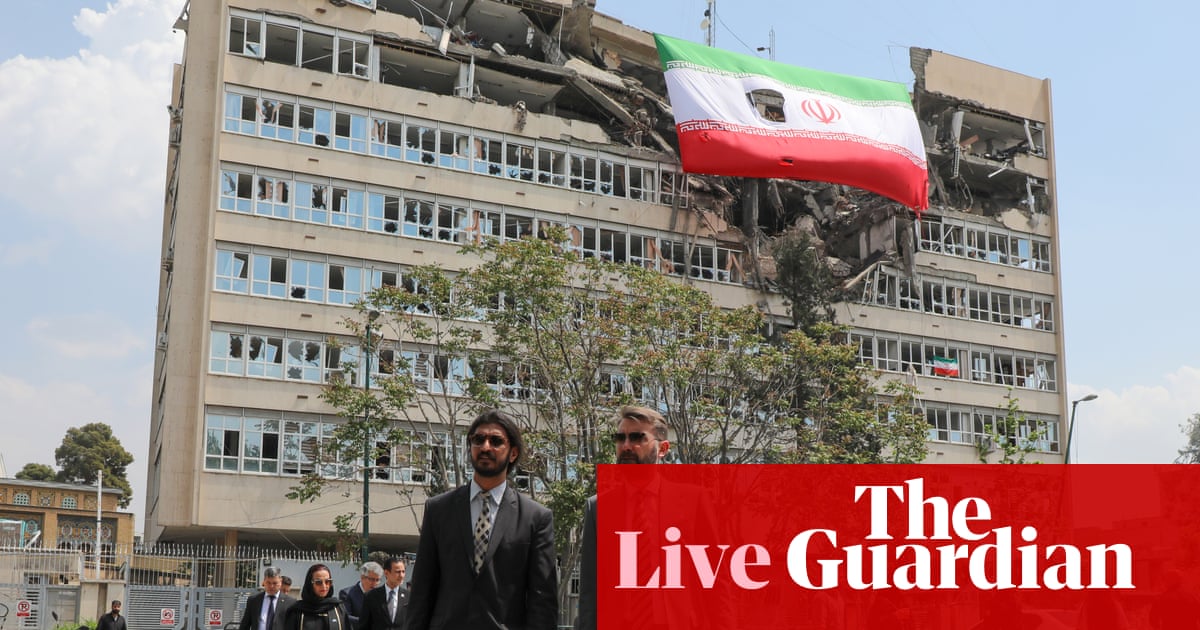
Representatives from more than a dozen foreign diplomatic missions, UN offices and the media tour damage to sites targeted by US-Israeli strikes in Tehran. Photograph: Majid Saeedi/Getty ImagesA commercial vessel is seen off the coast of Dubai amid Iran’s closure of the strait of Hormuz after a brief opening. Photograph: AFP/Getty ImagesAn Israeli soldier places a flag with a black ribbon on the grave of a fallen soldier ahead of the country’s annual memorial day (Yom Hazikaron) observances in Tel Aviv, Israel. Photograph: Amir Levy/Getty ImagesMourners carry the flag-draped caskets of Hezbollah members killed in southern Lebanon during their funeral in the Kafaat area in Beirut’s southern suburbs. Photograph: Fadel Itani/AFP/Getty ImagesA man drives children on an electric bicycle past an election campaign banner showing candidates for the Jericho governorate ahead of municipal elections in the Israeli-occupied West Bank city of Jericho. Photograph: Marco Longari/AFP/Getty ImagesA woman passes next of a poster of Iran’s late supreme leader Ayatollah Ali Khamenei in front of a destroyed building in Dahiyeh, Beirut’s southern suburbs. Photograph: Hussein Malla/APIsraelis visit the graves of fallen soldiers at Mount Herzl in Jerusalem on national memorial day. Photograph: Erik Marmor/Getty ImagesA man feeds stray cats in a park in Tehran amid the US-Iran ceasefire. Photograph: AFP/Getty ImagesShare
Updated at 02.23 EDT
Hannah Ellis-Petersen
Continued from last post:
The Iranian side had sought to portray the talks as simply a first step. However, actions taken by Trump in the aftermath – including a US naval blockade on the strait of Hormuz and inflammatory claims made in social media posts – had led the Iranians to push back from suggestions of further negotiations under the threat of “force”.
Last week, Pakistan’s army chief spent three days in Tehran, in an attempt to salvage the negotiations and get a second round of Islamabad talks back on track.
While both sides initially agreed to returning to negotiations this week, the Iranians then reversed their decision over the weekend after the US navy seized an Iranian ship, an act they called “piracy” that would have “grave consequences”. By Wednesday morning, it was still unclear if Iran would be sending their team back to Islamabad as hoped.
Speaking on Tuesday night, Trump said Iran would have to negotiate or “face problems like they’ve never seen”.
Share
Updated at 02.25 EDT
Hannah Ellis-Petersen
For Pakistan, much is riding on the success of this second round of talks.
Pakistan’s government and military have been intricately involved and invested in bringing about a ceasefire between the US and Iran for weeks, and have been credited with pushing both sides to the table.
It was efforts led by Pakistan’s army chief, Field Marshal Asim Munir, that helped finalise a temporary ceasefire on 8 April, bringing US president Donald Trump back from the brink after his threat to annihilate Iran’s entire civilisation.
It was seen as a diplomatic triumph for Pakistan when both sides turned up for the first round of talks in Islamabad on 11 April, even as mistrust ran high between their negotiating teams. Iran sent two planeloads of senior officials to attend, which was seen as a sign of their seriousness to bring about a permanent end to the war.
Motorcyclists ride past a billboard featuring Pakistani PM Shehbaz Sharif (centre) and army chief Field Marshal Syed Asim Munir (left) in Islamabad on 20 April. Photograph: Asif Hassan/AFP/Getty Images
The talks started indirectly through Pakistani mediators, and then moved to face-to-face talks, led by US vice-president JD Vance on the US side and parliamentary speaker Mohammad Bagher Ghalibaf on the Iranian side.
The negotiations took place over 21 hours, during which time Vance was said to have phoned president Donald Trump more than a dozen times.
But as Vance boarded a flight back to Washington on 12 April, it was empty handed, having claimed the Iranians would not reach a deal on their nuclear programme.
Continued next post
Share
Updated at 02.27 EDT
Tehran denounces US seizure of Iranian ship
Iran has condemned what it labelled the “maritime piracy” of the US seizing an Iranian-flagged container ship and says it is a “further complication” of the Middle East situation.
The US military attacked the ship on Sunday as it attempted to get past an American blockade near the strait of Hormuz – the first such interception since the blockade of Iranian ports began last week.
Iran’s foreign affairs ministry called for the immediate release of the vessel and its sailors, crew and their families, saying the seizure not only violated international law but was another “clear violation” of the ceasefire agreement with the US.
The ministry’s statement on Tuesday – which Iran’s semi-official Tasnim news agency posted on X – said Iran had drawn the UN’s attention to the incident and called for a “serious condemnation and response from international institutions and responsible governments”.
US Central Command said marines had departed the USS Tripoli assault ship by helicopter and rappelled on to the Touska on Sunday.
The weekend news threw into question Donald Trump’s announcement that US negotiators would head to Pakistan for another round of talks amid the expiry of the US-Iran ceasefire on Wednesday.
Trump said the ship was under US treasury sanctions because of a “prior history of illegal activity”.
Share
Updated at 03.33 EDT
Trump says recovering Iran’s uranium will be ‘long and difficult’
Donald Trump has said retrieving uranium from Iran will be a “long and difficult” process in the wake of the US bombing of Iranian nuclear facilities last year.
“Operation Midnight Hammer was a complete and total obliteration of the Nuclear Dust sites in Iran,” the president posted on his Truth Social platform overnight to Tuesday.
double quotation markTherefore, digging it out will be a long and difficult process.”
Trump has used nuclear dust to refer to Iran’s stockpile of enriched uranium but also to nuclear materials left from the June strikes.
The US president claimed after the bombardment that it had “obliterated” Iran’s nuclear program, but as Peter Beaumont reported, it soon became apparent this was not true. The bombs had wreaked extensive damage but deep underground sites – burrowed beneath mountains in two sites in particular, Isfahan and Natanz – could not be destroyed.
A satellite picture of Iran’s Fordow fuel enrichment plant, north-east of the city of Qom, after the US airstrikes in June last year. Photograph: Satellite image ©2025 Maxar Technologies/AFP/Getty Images
In Trump’s latest post he also hit out at news outlets, saying:
double quotation markFake News CNN, and other corrupt Media Networks and Platforms, fail to give our great aviators the credit they deserve – Always trying to demean and belittle – LOSERS!!!”
The future of Iran’s nuclear material has become a key sticking point between the US and Iran in their ongoing standoff. Trump last week claimed Iran had agreed to hand over its enriched uranium to the US, prompting Iran to say it hadn’t.
Share
Updated at 01.31 EDT
Hannah Ellis-Petersen
On Tuesday morning, Islamabad sat poised and ready to host a second round of talks – even as uncertainty reigned over whether both sides would even turn up.
Pakistani officials remained optimistic that the second round of negotiations would happen, even as Iranian ministers said they would refuse to come to the table under the threat of “force” and it remained unclear exactly when US vice-president JD Vance planned to depart Washington for Islamabad.
Roads were shut down around Islamabad’s five-star Serena hotel, where the first round of negotiations took place over a tense 21 hours, but failed to strike any deal.
Police stand guard on a road leading to the Serena hotel in Islamabad as Pakistan prepares to host a second-round of US-Iran talks, despite uncertainly over the meeting will occur. Photograph: Akhtar Soomro/Reuters
Over the past few days, Islamabad and other major cities have been grappling with blackouts lasting more than seven hours, as the country faces a grave energy shortage due to the ongoing blockade of the strait of Hormuz – bringing home the economic gravity of these talks for south Asian countries.
Neighbouring Bangladesh warned this week that its mobile network would soon face a shutdown as they were running out of fuel to run the power stations.
Islamabad’s electricity board released a statement on Monday night making assurances there would be enough electricity to ensure that US and Iranian negotiators were not plunged into darkness for the duration of their meeting.
Share
Opening summary
Hello and welcome to our live coverage of events in the Middle East.
Iran is considering attending peace talks with the US in Pakistan, a senior Iranian official said on Monday, after moves by Islamabad to end a US blockade of Iran’s ports – a key obstacle to Tehran rejoining peace efforts as the end of a two-week ceasefire nears.
But the official also stressed to the Reuters news agency that no decision had been made, while Iranian foreign minister Abbas Araqchi said “continued violations of the ceasefire” by the US were a major obstacle to continuing the diplomatic process.
On Monday night, Iranian chief negotiator Mohammad Bagher Ghalibaf accused Donald Trump on social media of increasing pressure on Tehran through the blockade and ceasefire violations, saying Iran rejected negotiating under threat and warning that “we have prepared to reveal new cards on the battlefield”.
The two-week ceasefire – set to expire on Wednesday – had appeared to be in jeopardy after the US said it seized an Iranian cargo ship on Sunday that tried to run its blockade and Tehran vowed to retaliate.
In other developments:
-
Trump said a deal with Iran would happen “relatively quickly”. He also said on Truth Social the US would not lift its blockade until Iran had agreed to a deal and that he believed the nuclear deal the US was negotiating with Tehran would be better than a 2015 international agreement to curb Tehran’s nuclear program.
-
US vice-president JD Vance remained in the US on Monday, a source told Reuters, denying reports he was already on his way to Pakistan, in comments adding to the uncertainty over a second round of talks. In Islamabad, however, preparations for the talks appeared to be going ahead.
-
Oil prices fell on Tuesday while most stocks rose on lingering hopes for a deal to end the US-Iran war and reopen the strait of Hormuz, despite Tehran not saying if it would attend.
-
Iranian foreign minister Abbas Araghchi and Russian foreign minister Sergey Lavrov discussed the conflict by phone. Lavrov reportedly reiterated the need to uphold the ceasefire and continue diplomatic efforts, while Araghchi said Tehran would to try to ensure the uninterrupted passage of Russian ships and cargo through the Hormuz strait.
-
The toll of Palestinians killed in Israeli strikes in Gaza on Monday has risen to at least five, according to Palestinian health officials, while witnesses said Hamas fighters clashed with gunmen from an Israeli-backed militia.
Share