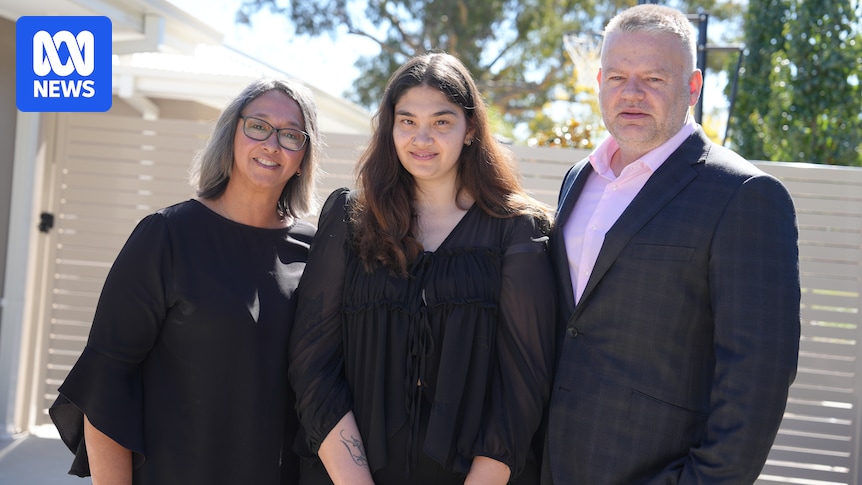
For Canberran Chantelle D’Arcy, being a home owner used to be a dream.
Now it is a reality thanks to an organisation helping people with intellectual disabilities live independently.
Not-for-profit Project Independence utilises residents’ disability support pension to help them transition from renters to owners at one of its purpose-built housing facilities.
Ms D’Arcy said signing the deed to her unit at the organisation’s development in Phillip made her feel more independent.
Chantelle D’Arcy’s mother Sharon Giles says her daughter genuinely loves living at Project Independence in Phillip. (ABC News: Caitlin Maloney)
Ms D’Arcy’s mother, Sharon Geiles, said since moving into Project Independence housing her daughter was always smiling.
“She’ll ring me and tell me amazing stories about what’s been going on,” Ms Geiles said.
“There’s not a day that goes by where she’s upset, or she doesn’t want to be here.
“She genuinely loves it — and that’s all you want as a parent.”
Ms D’Arcy said her favourite thing about living at Project Independence in Phillip was the other residents.
“[There’s] more people to keep me company so I won’t get lonely,” she said.
Chantelle D’Arcy says her favourite thing about living at Project Independence is the other residents. (ABC News: Caitlin Maloney)
Ms D’Arcy is one of four Canberrans living with intellectual disabilities that became home owners through the organisation’s model at a deed signing event on Monday.
Participants in the program purchase a share in a property, giving them legal ownership of their home and allowing them to build equity over time.
Each of the organisation’s three developments include small clusters of units where residents live independently alongside peers with similar life experiences.
Each development has an assistant support coordinator that residents can go to for help in connecting with services they need.
Speaking at the event, Project Independence founder Glenn Keys said people with intellectual disabilities have the lowest rate of home ownership of any sector in Australia.
Project Independence co-founder Glen Keys says the deed signing is a historic moment for the organisation. (ABC News: Caitlin Maloney)
He said the residents signing their equity deeds was a “historic moment” for both the organisation and for people with an intellectual disability.
“Despite all the barriers that have been put in front of them, in front of their families, they have overcome them,” Mr Keys said.
“They are living rich and full lives here, they’re having all the joys and ups and downs that we have, and they are proving that the Project Independence model works.
“And they are proving it because they are strong, they are seeking their independence, and they are supported by their families and their communities to do that.”
‘Supported but not smothered’
Chantelle D’Arcy’s father Stephen says the deed signing represents his daughter having real ownership of her own future. (ABC News: Caitlin Maloney)
Ms D’Arcy’s father Stephen D’Arcy said along with giving his daughter the independence of home ownership, Project Independence had given him something just as important — peace of mind.
“I know Chantelle is safe, I know she is supported but not smothered, I know she is part of a community that genuinely cares, and that is an amazing gift for any parent,” Mr D’Arcy said.
“Today’s deed signing is not just paperwork — it represents security, dignity, and real ownership of her future.
“It gives families like ours something we rarely get, and that’s certainty. Chantelle’s life has been changed for the better forever, and so has ours.”
Mr Keys first started Project Independence to provide a home for his son, Ehren.
Project Independence co-founder Glenn Keys started the organisation so his son Ehren Keys could own a home. (ABC News: Nick Haggarty)
The organisation now houses 30 people in its three Canberra locations — Harrison, Latham, and Phillip.
“We would not be here without the support of the ACT government which provided us the land in three sites across Canberra to do what no other model has done in Australia, which is to build housing for people with an intellectual disability to buy their home,” Mr Keys said.
“We now have 30 residents who are on the home ownership ladder. And we have over 15 people who have been through housing and moved out.”
Mr D’Arcy said he would like to see Project Independence’s model expanded across Australia — something the organisation is already planning to do.
“In Melbourne we have a property we’re raising the funding on, to do the refurbishment work on,” Mr Keys said.
“We have over 200 people on the waitlist in Melbourne.”