Kagwel, Kenya — Rhoda Ongoche Akech still remembers the whispers that followed her to the water’s edge in 2002. At 39 years old, the mother of seven was about to break one of Lake Victoria’s oldest taboos: a woman stepping into a fishing boat.
“People were alleging that when women go into the waters accompanied by men, they would engage in sexual intercourse,” the now 61-year-old said. But after they realised she was going there just to learn, and would not stop because of the stigma, “they kept quiet”.
Recommended Stories
list of 3 itemsend of list
Prior to that, things were very different in Akech’s community in Kagwel, a lakeside village in Kisumu County’s Seme subcounty.
For decades, she had worked as a fishmonger in the village where fishing – only done by men – had sustained families for generations. But her income was dwindling. The cost of buying fish from male fishermen, combined with expenses for firewood, frying oil, and bus fare to markets, was becoming unsustainable.
Then in 2001, some women from neighbouring Homabay County arrived in Kagwel and did something unthinkable: they went fishing. Akech watched them and was inspired.
“I sought the help of two young men by then to assist me with fishing as I learned,” she said. Despite warnings from community members who insisted women had no place on the water, she persisted. Her family depended on it.
The cultural prohibition against women fishing in Lake Victoria communities stems from beliefs deeply woven into the social fabric of fishing villages. According to William Okedo, a 57-year-old Kagwel village elder, the traditions were particularly strict regarding menstruation.
“It was believed that if women went into the lake while on period, they would scare away the fish and that would cause losses to people who are fishing,” Okedo explained.
The discrimination extended even to male fishermen, who were forbidden from engaging in sexual relations with their wives the night before fishing expeditions, lest it diminish their catch.
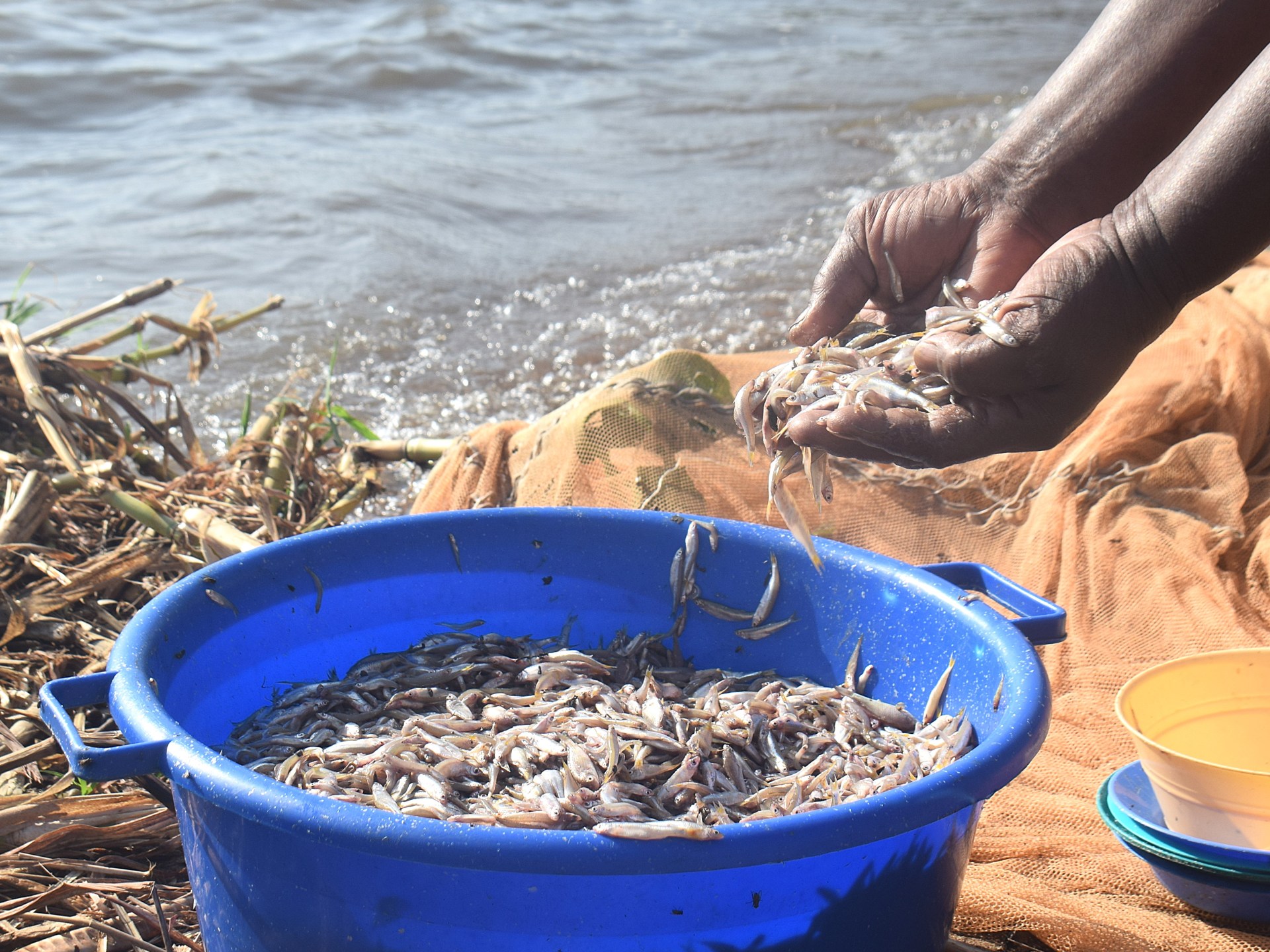
Rhoda Ongoche Akech, 61, holds one of the fish varieties found in Lake Victoria at Kagwel Beach, Kisumu, Kenya [Daniel Kipchumba/Al Jazeera]
A team of women
Although Akech’s bold move in 2002 broke through the taboos, it was more than a decade before another woman joined her.
For 16 years, Akech fished alone, a solitary figure among several male fishermen. Then in 2018, Faith Awuor Ang’awo, a 37-year-old mother of four, went to the water herself.
For years, Ang’awo had worked as a fishmonger at the nearby Luanda market, where the same economic pressures were mounting.
“My husband refused the idea at first,” Ang’awo said, out of fears about resistance from the fishing community, “but later on allowed me to join Rhoda”.
Two years later, in 2020, Dorcas Awiyo, a 22-year-old mother of three and housewife, joined the team. Her husband, himself a fisherman, initially resisted.
“At first, my husband was not receptive to the idea, but later on allowed me,” Awiyo said. She needed additional income to complement her husband’s earnings.
By 2022, the sight of women fishing had become common enough that Janet Ndweyi, a 42-year-old mother of two, faced no resistance when she joined Akech’s team.
“I didn’t face any challenge or receive any warning when joining them because the community around was used to seeing Rhoda and Faith fishing,” Ndweyi said. With no husband to support her and her fishmongering business facing challenges, fishing offered a viable alternative.
On productive days when fish are plentiful, boat owners at Kagwel Beach can earn between 6,000 and 8,000 Kenyan shillings (approximately $46 to $62). Crew members earn between 500 and 800 shillings ($3.88 to $6.20), and traders, including fishmongers, can earn up to 1,000 shillings ($7.75), according to Wilson Onjolo, Seme subcounty fisheries officer. This represents substantially more than the 500 shillings the women earned daily as fishmongers buying fish from male fishermen.
Meteorologist Chris Mutai attributes the dwindling fish populations to climate change impacts on the lake’s ecosystem [Daniel Kipchumba/Al Jazeera]
Economic necessity drives cultural change
Village elder Okedo has watched the transformation with mixed feelings.
He recalls seeing women fishing in Suba, a region bordering Lake Victoria, where fishing is the main economic activity, several years before Akech started. But the practice was never as prominent as it has become.
“This is all because of economic hardships that the community is facing; it is pushing women to break the taboo,” Okedo said.
He acknowledges there is no longer any barrier preventing women from fishing because Akech, inspired by the women from Homabay, provided a living example that challenged long-held beliefs.
Dalmas Onyango, a 35-year-old fisherman and father of three, confirmed that attitudes among male fishermen have shifted.
“The majority of my fellow fishermen now support their decision to fish,” Onyango said. Economic difficulties, he explained, have pushed women towards decisions that were once unthinkable.
The women’s success comes at a time when Lake Victoria’s fishing communities face mounting environmental challenges. Akech has noticed a gradual decline in her catch compared to when she first started fishing in 2002.
Chris Mutai, a senior meteorologist in charge of the Kisumu meteorological station, attributes the dwindling fish populations to climate change impacts on the lake’s ecosystem. Rising water temperatures have encouraged algae growth and reduced oxygen levels, directly affecting fish populations.
“To reverse this, people should keep off riparian land to allow undergrowth that will serve as the breeding ground of fish, and avoid pollution of the lake that traps more heat than plain, clear water,” Mutai said.
He warned that water temperatures are expected to rise by an additional 0.5C (0.9F) over the next 10 to 20 years, reaching between 29.5C and 31C (85.1-87.8F). Without pollution control measures, protection of riparian zones, regulated fishing, and alternative livelihoods like farming, Lake Victoria will experience further reductions in fish quantities.
Mutai’s station disseminates five-day weather forecasts across the region, distributed to fishing communities through WhatsApp groups and the Kisumu County government. This information enables fishermen – and now fisherwomen – to take proper precautions before venturing onto the water.
Lake Victoria supports more than 42 million people who depend on it for food, employment and drinking water. The lake faces mounting pressures from overfishing, pollution, invasive species and climate change that have reduced per capita catch rates despite annual harvests of about one million tonnes.
Pelicans fly over Lake Victoria in Kisumu, Kenya [James Keyi/Reuters]
In a legal limbo
Despite their achievements, Akech and her team exist in a state of official limbo. Susan Claire, acting director of fisheries and blue economy for Kisumu County, denies women fishing in Lake Victoria in any official capacity.
“We have women who own boats and women traders, but they are not involved in night fishing or as boat crew members,” Claire told Al Jazeera. Her statement leaves Akech’s team without official recognition comparable to their male counterparts. Even as the women perform identical work, they do not get support because of their state of legal limbo.
However, Christopher Aura, director in charge of freshwater research at the Kenya Marine and Fisheries Research Institute, said in 2023 that “Lake Victoria has over 47,000 fishermen, including 1,000 women”, suggesting the current county administration’s data may be incomplete.
Claire acknowledged that declining fish stocks remain a significant challenge. The county is working closely with the meteorological department and Tembea Youth Centre to sensitise fishermen on accessing climate information. They are also collaborating with Beach Management Units – community-based organisations that co-manage fisheries resources alongside the government – to strengthen governance and take action against illegal fishing in the lake.
According to Onjolo, there are 35 Beach Management Units in Kisumu County, with approximately 1,500 to 2,000 fishermen operating in Seme subcounty alone.
Ndweyi, who first joined Akech in 2022, now uses her fishing income to pay college fees for both her children, something her previous earnings as a fishmonger could not cover.
“Through fishing, I am able to cater for my household’s basic needs and also pay for children’s school fees that are in college,” she said.
But the livelihood Akech pioneered is becoming harder to sustain. She says she has watched the lake change over 23 years, and her catches have declined steadily over the decades.
Still, the four women continue to row out each morning before dawn. On days when fish are scarce, their earnings drop below what they made as fishmongers. On good days, they still earn enough to justify the physical labour and the risks of working on open water.
“A man without land is a man without life,” Akech said, adding that the parallel truth remains unspoken: a fisher without fish faces the same fate.
This story was published in collaboration with Egab.