Public works projects marked 100% complete by the Department of Public Works and Highways (DPWH) were alleged substandard projects, according to photos and documents obtained by Rappler, and corroborated by an insider source privy to those projects.
The information we gathered exposes a modus operandi of how public works end up being substandard. The kickbacks and profit shares add up per player on the project, according to our source, so that only a dismal 40% of the budget is left for the structure.
The insider source showed Rappler documents that indicated the DPWH awarded a ₱66-million flood control project to a contractor, who then subcontracted it for only ₱26.5 million. This means that only 40% of what was budgeted from taxpayers’ money actually went to the project.
“50% of the budget being spent is already high,” said the source who agreed to speak to Rappler on the condition that we withhold identities for security reasons.
Where does the DPWH budget go?
Based on insider source’s account
DPWH
BUDGET
60%
Profit shares and ‘SOPs’
(euphemism for kickbacks)
40%
Actual budget for subcontractors
to build the project
This story will discuss in detail two other projects in Tarlac and Cavite, and which implicate big names of contractors like the Discayas and the Romeros.
“Ang turo naman sa atin as Catholic, hindi lang ‘yung sin of commission, ‘yung omission isa ring part ng kasalanan. Dun ko nakikita ‘yung kasalanan ko, kapag hindi ako nagsalita nang ganito,” the source said.
(We’ve been taught as Catholics that there’s not only a sin of commission, but also a sin of omission. That’s my sin if I don’t speak up.)
The involved offices in DPWH denied that the projects which will be mentioned here in this story were substandard. They also denied knowledge of any subcontracting that happened.
The DPWH said it will continue to watch out for corrupt practices.
“Secretary Vince Dizon, has initiated, instituted, and implemented measures and reforms, and continues to advance these efforts, to curb and address possible corrupt practices within the Department’s Implementing Offices, including enhancing monitoring mechanisms and minimizing discretionary authority, where feasible,” DPWH Undersecretary Ricardo Bernabe said in a statement sent to Rappler.
Flood control in Gerona, Tarlac
Project 21CJ0008 or Phase III of flood management program along Tarlac River in Gerona, Tarlac. Marked 100% complete. Video taken on March 18, 2026.
The source said they’ve been losing sleep over a flood control project in Gerona, Tarlac, which you see above, guilty that if they do not speak up about the substandard project, it could put residents in the area at risk.
The project is Number 21CJ0008, awarded by the DPWH Tarlac 1st District Engineering Office (DEO) on March 21, 2022 to R-II Builders Inc, which is the company of Reghis Romero II, according to corporate filings with the Securities and Exchange Commission (SEC) and on the company website. Romero is the father of former 1-Pacman Partylist Mikee Romero. The original contract cost was ₱41.89 million.
Multiple documents show that the project was subcontracted to the company Arconic Inc. R-II and Arconic are connected by another Romero son, Nathaniel L. Romero. Nathaniel was the CEO of RMR Capital, the former R-II Holdings, as of 2025, according to its SEC filings. Nathaniel was also one of the founders of Arconic Inc., according to incorporation papers filed with the SEC, although he is no longer a listed owner as of 2025.
R-II Builders subcontracted this project to Arconic, making them the first subcontractor. Arconic subcontracted the project a second time to the company SMM Construction. This means there was double subcontracting, and the second subcontract to SMM was inked on April 25, 2022, or just a month after the original DPWH contract.
The Tarlac 1st DEO said “they have no knowledge of, nor did they consent to or allow, any subcontracting arrangements,” according to DPWH’s Bernabe, who came under the leadership of Vince Dizon and was brought in to “clean” the department.
Arconic confirmed to Rappler that they “helped R-II Builders Inc. manage the implementation of the same as its project manager,” the company’s president Greg Ignacio said in a response letter to us.
Arconic also provided Rappler with DPWH certificates of completion, but these documents were addressed to R-II Builders, not Arconic. We followed up about its second subcontract to SMM, but we no longer received a response.
R-II Builders told Rappler the same, saying in a response to us on Monday, April 13, that: “For the Tarlac Project, RBI engaged Arconic, Inc. (“Arconic”) as its Project Manager and not as a sub-contractor.” Like Arconic, R-II Builders also did not respond to the question about SMM’s involvement.
“May mga bata-bata na itong mga kompanyang ito. So alam na nila kung sino ‘yung kukunin nilang mga subcontractor.”
— Insider source
The source said subcontractors are already lined up as early as the bidding. “May mga bata-bata na itong mga kompanyang ito. So alam na nila kung sino ‘yung kukunin nilang mga subcontractor,” said the source. (These companies have their favored subcontractors. They already know which subcontractors they are going to get.)
The source said that based on their experience, contractors who have connections with top-level officials are notified if a budget has been made available by a proponent from either the House or the Senate. When the contractor agrees to take on the project, documents are then prepared.
“Even before the bidding, a contractor already knows the project is theirs,” said the source in Filipino.
The subcontract to SMM was worth only ₱28.156 million, or only 67% of the ₱41.89-million original cost in the DPWH contract. Subcontracting is generally allowed in government infrastructure projects for certain works only.
But, by comparing the bill of quantities — or a document listing down the scope of work including the quantity of materials — in the original DPWH contract and the subcontract to SMM, we found out that the project was subcontracted in its entirety. Even so, the whole subcontract constituted only 67% of the budget.
The Bills of Quantities are virtually identical – the entire project subcontracted?
The result is a substandard project, because they cut cost on materials to make the slashed budget work, said our source.
Photos of the site before repair, and documents we obtained support the claim that the project was substandard. Documents showed that the construction was completed on December 22, 2022, but upon inspection by the DPWH on September 22, 2023, there were “considerable damages (sic)…. such [as] cracks and collapsed embankment.”
The DPWH Tarlac 1st DEO said “damage to the slope protection was attributed to external factors, including significant water flow and vibrations from ongoing construction activities above, which disturbed the embankment materials and affected approximately ten (10) spans of the slope protection.”
Video of the substandard Gerona flood control project. Obtained by Rappler.
However, Rappler saw one document that points to substandard work, rather than external factors contributing to damage.
In an exchange of letters between the two subcontractors over who should shoulder the cost of repair, SMM said: “May we also emphasize that Arconic itself is not following what has been given under the original plan.”
Letter of SMM to Arconic. Obtained by Rappler.
SMM claims, according to the document, that Arconic “instructed” them to bury sheet piles for 6 meters only, and not 7.5 meters underground as should be the case. There were also fewer sheet piles. What should have been 5,543 meters of sheet piles per the original bill of quantities, became 4,463.95 meters only.
DPWH Tarlac 1st DEO maintained that sufficient sheetpiles were used.
“With respect to the sheet piles, the concerned Project Engineer confirms that the specified length, as provided in the Program of Works, was utilized and that the sheet piles were installed at the appropriate depth, based on inspection and monitoring,” said the office.
R-II Builders said they have a DPWH document from March 6, 2024 “certifying that the project is free from defects and failures which are traceable to poor workmanship, use of poor-quality material and non-compliance with plans and specifications.”
The source insisted the project was substandard, pointing to collusion between DPWH personnel and the contractor. The source said they continue to worry for the nearby community.
“If this [substandard work] continues, the village there would bear the consequences,” said the source in Filipino.
Arconic said “we are constrained to put on record that we are currently unable to comment on the same, either due to lack of privity, or on account of litigation we are currently pursuing.”
The rest of the budget went to SOPs, or a euphemism for kickbacks, according to the source even though they made a disclaimer that they have no direct knowledge about any deliveries of kickbacks, or who the recipients are.
“Kickbacks are discussed during meetings, that they are calling officials, who’s giving the approvals, but you don’t know their names, the only thing you know is how much is slashed from the project’s budget,” the source said in Filipino.
“Allegations in your letter appear to emanate from sources aimed at besmirching our reputation or linking us to anomalous business practices, despite our successful and satisfactory completion of these projects,” said Arconic.
Rappler reached out to SMM beginning March 24, and called multiple times since then to follow up, but our calls to them were unsuccessful. We dropped off letters to two listed addresses, which we were told by the staff, were the residence and office of SMM and its president. We will update this story once they respond.
Hospital at Naval Station, Cavite
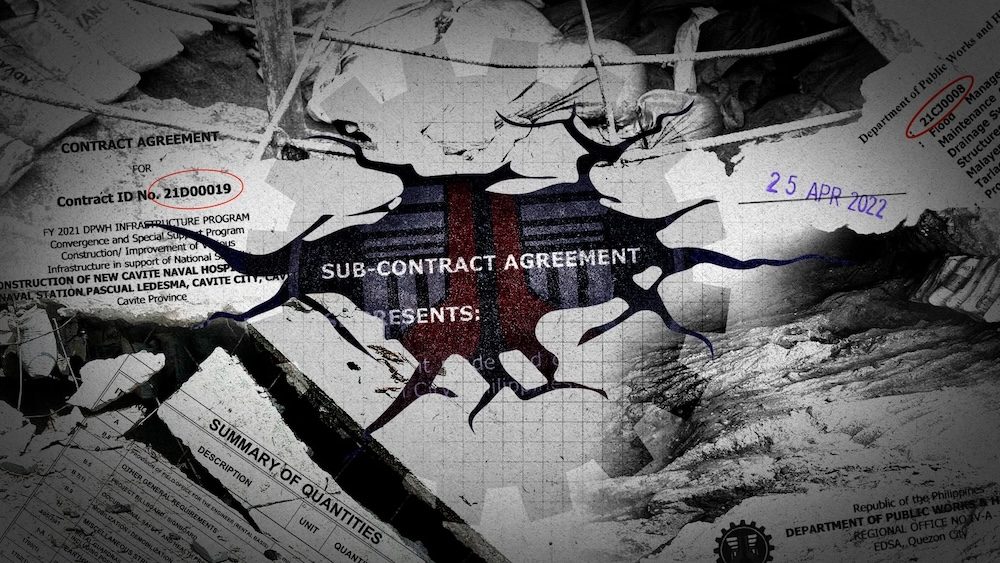
The second project is a public hospital inside the Naval Station in Cavite City. Project Number 21D00019 is a contract to build two structures — the nurses’ quarters, and portions of the main hospital building. DPWH Region IV-A awarded the contract to Pacifico “Curlee” Discaya’s St. Gerrard Construction on July 19, 2021 for ₱98.158 million. The project was supposed to be completed in 300 days, or on May 16, 2022.
According to a payment demand letter we obtained, St. Gerrard subcontracted the project to Arconic Inc. Discaya’s lawyer Cornelio Samaniego told Rappler in a text message on March 29 that his client “declined your request” for an interview or response.
Just like the first project, the DPWH Region IV-A office denied knowledge of the subcontracting arrangement, adding that “all documents related to the implementation of this contract were duly signed by the authorized representative of St. Gerrard Construction Gen. Contractor & Development Corp,” the office said.
Arconic did not respond to the question about whether it was St. Gerrard’s subcontractor that was tapped for this specific segment of the project.
The source said two DPWH personnel were directly in touch with the subcontractor Arconic throughout the project.
“The mere fact na may official sila sa site, may inspector, kung sino ang kinakausap nila maliwanag ‘yun. ‘Bakit hindi main contractor kausap ko? Bakit ang subcontractor ang kausap ko?” said the source. (The mere fact that they have an official on site, there’s an inspector, it should be clear to them when they talk to someone. Why weren’t they talking to a main contractor? Why were they talking to a subcontractor?)
The project was suspended in September 2021 because of “poor and narrow access to the site,” according to DPWH suspension orders we obtained, but the regional office confirmed it resumed but was terminated on April 18, 2023 “due to the expiration of the FY 2021 and prior years’ appropriations for infrastructure capital outlay.”
The regional office said they terminated it “for [the] convenience” of the government since their appropriations or their budget already expired.
The DPWH portal marks the project only 51.63% complete.
It actually reached 69.25%, according to DPWH Region IV-A, and the office said St. Gerrard was paid for what they completed. “No penalties were imposed on St. Gerrard since prior to the issuance of Termination the project did not incur any slippage, with the Actual Accomplishment ahead of the Planned Accomplishment,” said the regional office.
Our source told a different story. According to the source, the project was severely delayed, and reasons were “made up” to suspend it and cover the delay, ultimately “terminating it” just so they would not have to return the funds.
“Because they already paid in advance even though the project is not finished yet, or none has been constructed on site,” said the source in Filipino.
The source added that the construction continued, but was off the records.
A document we obtained showed that upon inspection by June 2024, some deficiencies were observed on the structure like incomplete plastering, concrete turning into honeycombs (or the construction slang for when concrete has a defect resembling a beehive), and exposed rebars.
Deficiencies observed upon inspection
Swipe to see more · Photos obtained by Rappler
The DPWH regional office said there was no investigation into this project since there were “no warrants” for it, but that they “continuously monitor these contracts since they are still within the warranty.”
R-II builders and Arconic, as a joint venture, snagged a parallel project at almost the same time as the St. Gerrard contract.
Project Number 21D00016, a contract to build other structures of Level 1 of the Naval Station hospital, was awarded to R-II and Arconic on July 9, 2021 for ₱138.96 million. This, too, was delayed.
On the DPWH portal, what should have taken only 300 days was also terminated at 59.16%. R-II Builders and Arconic were paid correspondingly.
“We confirm that in the implementation of the said project, several delays were encountered arising mostly from this project being pursued at a time when quarantine protocols were still in place on account of the Covid-19 Pandemic,” said Arconic.
Even this project needed some rectification, according to the source.
R-II Builders denied the allegation that this work was substandard, saying they have a DPWH acceptance letter dated April 22, 2024 “certifying that the project is free from defects and failures which are traceable to poor workmanship, use of poor-quality material and non-compliance with plans and specifications.”
The source showed an exchange of messages dated June 2024 saying that the contractors were going to be provided “an advance copy of Quality Assurance Unit findings for acceptance” for the project, also asking if the contractors can “provide rectification photos for every finding.” This, the source said, proves collusion.
On March 24, 2022, a new contract, or Project Number 22D00017, was awarded to the joint venture of Arconic Inc. and EGB Construction for ₱93.12 million. This has been marked 100% complete.
Rappler has confirmed that this project, which was Phase III to build seven buildings of the hospital, is being investigated by the Office of the Ombudsman as part of their inquiry into EGB Construction. The company is owned by Erni Baggao of Isabela.
EGB is among the top 15 flood contractors on President Ferdinand Marcos Jr.’s list, and Rappler recently reported that Erni’s brother Glen Baggao is a health undersecretary, raising conflict of interest questions about EGB’s contracts covering building public clinics and hospitals — like the one at the Naval station.
The hospital was not operational when we visited in March.
The DPWH said none of the projects in this story are being investigated “as there are no existing complaints indicating any irregularity.”
“Nonetheless, we welcome any complaint, information, and/or evidence that may be provided on this matter to enable the Department to promptly conduct the necessary investigation and, where warranted, initiate appropriate administrative and/or criminal proceedings,” said the DPWH.
‘Eyes shut, mouths shut’
Subcontracting and downgrading an infrastructure project is done in plain sight, said the source. There’s no earnest effort to hide it on site.
“The culture on site is the subcontractors make sure the inspectors eat well, which is normal. Sometimes they give cash. So instead of inspectors focused on the work on site, they’re far away, eating. Subcontractors can do whatever they want to do because inspectors cannot see. Worse, they work at night because there are no inspectors. In the morning you’d see it’s done. Who can now say the work was substandard? None,” said the source in Filipino.
The source said that sometimes, inspectors flag a work done right.
“The inspectors would even give instructions on how to do it wrong.”
— Insider source
“The inspectors would even give instructions on how to do it wrong. They’d ask, ‘Why are you putting more steel? Why is it thick? Can you still profit from it?’ I was thinking, maybe if we do it right, they wouldn’t get a kickback,” said the source in Filipino.
Asked to describe the corruption in DPWH, the source said it’s like “stage 4 cancer.”
“Why are you speaking out now, some may think maybe you did not get your cut in one project, that’s why you’re speaking out,” I asked the source.
“They can say that. But I have a clean conscience, whatever I saw, that’s what I will disclose,” the source said in Filipino.
Are they willing to help government investigators? “100% willing,” the source said. – with reports from Lance Ariel Bustos/Rappler.com
Lance Ariel Bustos is a Rappler intern. He is a third year Political Science student at De La Salle University-Manila, and is the Intermedia editor of The LaSallian.
Edited by Chay Hofileña
Videos by Franz Lopez
Visualizations by David Castuciano and Don Kevin Hapal