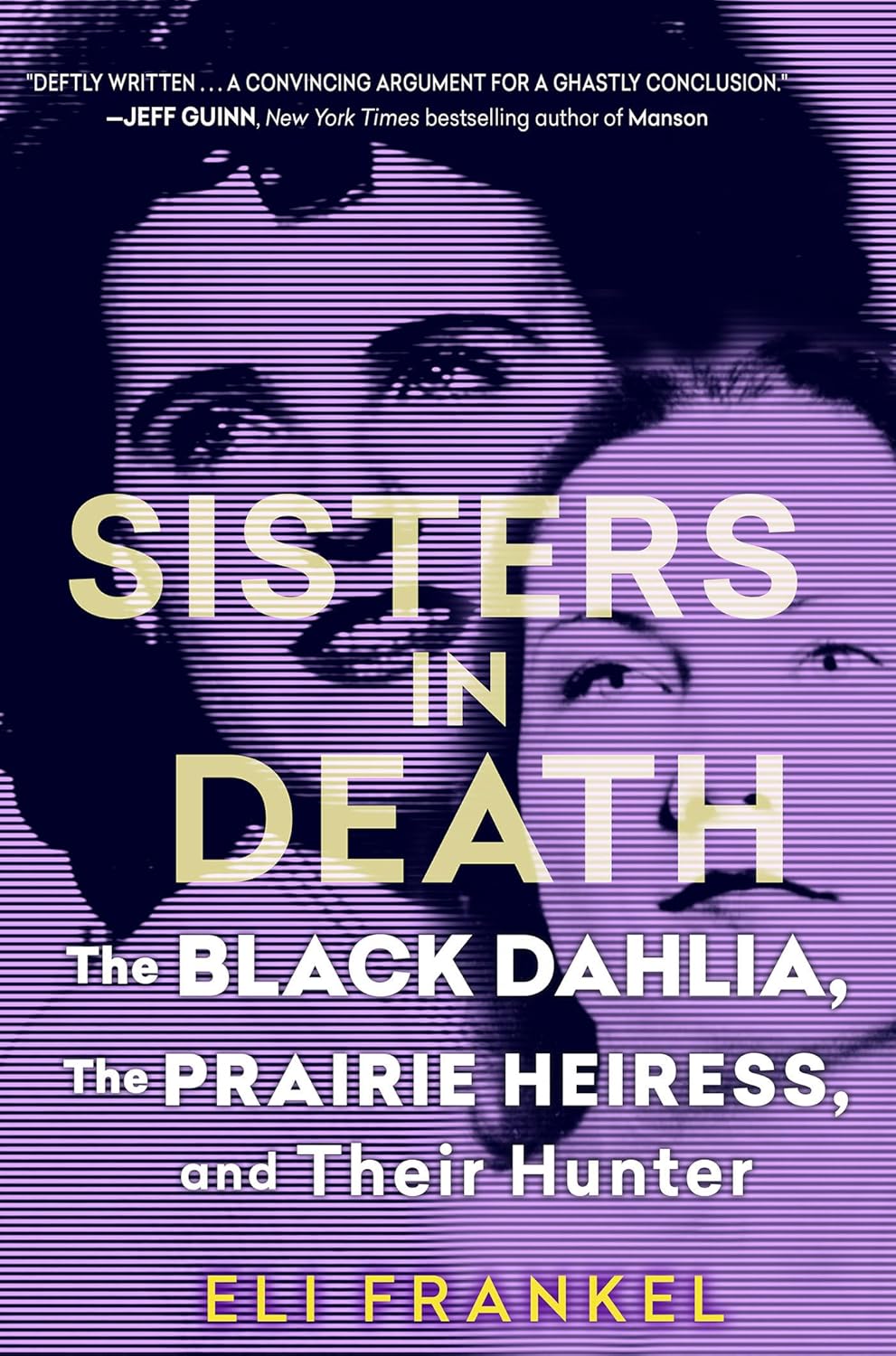
Eli Frankel, a television and documentary producer in Los Angeles, is emphatic that after three years of research he has solved the particularly savage murders of Leila Welsh in 1941 and Elizabeth Short in 1947, two investigations that stumped huge police manhunts and are among the greatest cold cases in American criminal history. One man killed them both, six years and hundreds of kilometres apart, and that man was Carl Balsiger, Frankel asserts.
Unsolved killing number one was Welsh, 24, dubbed the “Prairie Heiress”, a teacher, horribly mutilated, almost decapitated in her bed in Kansas City on March 9, 1941. Unsolved slaying number two was Short, 22, a drifter, known forever as the “Black Dahlia”, her tortured body, bled dry, cut in two and dumped on waste ground in Los Angeles on January 15, 1947.
Carl Balsiger beyond all reasonable doubt? Circumstantial? Supposition? No confession? Readers will be judge and jury as they sift through the evidence, lies, missed clues and blind alleys that baffled detectives. Welsh is largely forgotten now but Short has remained the subject of speculation in innumerable films, television shows, books, articles, podcasts and internet websites. Various strong suspects for both have been named over the decades but author Frankel is unequivocal that it was Balsiger who should have faced Death Row.
Frankel looks first at Welsh and credits her with beauty, grace, intelligence, popularity and wealth. He calls her the “Prairie Heiress” because of the family wealth built up in real estate in Kansas City, in the Midwest state of Missouri. The Balsigers had a grocery store there and the two family homes were just 13 blocks apart. Leila and Carl were in the same graduating class at the University of Kansas City, knowing the same people and attending the same social events. But her sorority defied his fraternity’s drinking, carousing and sexual advances.
Welsh was beyond Balsiger’s reach. “Though their lives were spent in near-constant intersection, Carl and Leila were polar opposites,” Frankel writes. “While he stumbled and failed at nearly every turn, her confidence and self-reliance took her from achievement to achievement.” The vicious slaying would thus be an act of rage and destruction.
The killer entered the sleeping woman’s bedroom through an open window. Her mother and brother were asleep in nearby rooms. He hit her with a nearly 2-kilogram railroad hammer and tried to decapitate her with a 30-centimetre butcher’s knife but couldn’t separate her spine. He would have spent 45 minutes waiting for her blood to drain, cutting a chunk of flesh from her thigh and inscribing a bloody letter S or G on her calf. When he finally fled he left the hammer at the foot of the bed, the knife stuck in the ground outside the bedroom and the piece of flesh on a lawn a few blocks away. He also dropped his gloves nearby.
Only a series of lucky accidents saved Balsiger from identification and arrest. For instance, the specific use of a butcher’s knife could indicate the experience of a hunter, and he was an avid lifelong hunter, stalking, killing and field dressing deer so that the meat would not be spoiled. He was used to cutting and processing meat in his father’s store.
Chief Lear Reed and his police were baffled because they could not establish a motive for the brutal slaying. “What Reed did not understand,” Frankel surmises,”was that the motive was right in front of him: the total destruction and desecration of the perfect woman.”
In an astonishing section of the book, Frankel recounts a travesty of justice fuelled by corruption in Kansas City, where the political machine of “Boss Tom” Pendergast and his brother before him had a 40-year stranglehold by doling out patronage, kickbacks and special favours. The police and sheriff’s department fought over the case, a conviction became imperative and a stacked grand jury indicted Leila’s brother George, accused of killing her to obtain her inheritance. His legal team exposed the sham trial and he was found innocent.
The author turns to Elizabeth Short, dubbed the “Black Dahlia” because of her jet black hair worn high: “The reverse image of Hollywood glamour, the story of her sojourn through Southern California has remained a specter, a haunting reminder that behind the beautifully lit façade of Los Angeles is darkness.” By now, Balsiger too had moved to Los Angeles.
Frankel notes that she avoided drink and drugs and was not highly sexual, though some reports seem to suggest she was promiscuous. “The myth of Beth’s partial culpability in her own murder became an intrinsic part of Black Dahlia lore,” he writes. Rather, here was a young woman whose abandonment from her father and loss of a fiancé in a plane crash left her adrift and emotionally distant, wanting to connect with others but also somewhat hesitant to develop deeper bonds. She was naïve and too trusting in some ways.
Short’s good looks and poise had drawn her to Hollywood and its beauty pageants but she lived a precarious hand-to-mouth existence on the verge of homelessness, with no real friendships or romantic relationships, constantly scrambling for someone to help. Here was an enigmatic woman of mysterious associations, random travel and desperate movements, “a whirlwind of chance encounters, short-lived friendships, come-and-go acquaintances, first and second dates, and roommates at motels, apartment buildings and houses”.
Frankel is unrelenting in his depiction of Balsiger, the scion of the prominent grocery and bakery family from Kansas City, but who despite his background was a failure in many ways. Tall, gangling, filled with character flaws, he only experienced success in World War II in developing a baking system that provided bread and nourishment to soldiers in the Pacific.
Otherwise, it seemed like every other opportunity he had in America was wasted and he could never live up to his father’s expectations. He may have participated in violence against women and family members. His sister died in a mysterious drowning when they were children, and the implication here is that Balsiger could have been responsible as there was no real investigation into the incident. Further, he was involved in strange paddling (ritual spanking) incidents at university, thus showing a proclivity for violence.
After Short’s murder the largest investigation in the city’s history involved the entire homicide squad plus 700 police, sheriff’s deputies and highway patrol. An anonymous letter to the police contained some of her cards, photos and an address book. One name in it was Carl Basinger. His connection with Welsh was discovered and the two murders had obvious similarities. But the Kansas City police withheld the crucial reports requested by Los Angeles – Balsiger’s father was an important local businessman with influence in city government.
Vigorously investigated, Basinger offered lies and half-truths, later admitting he had been with Short for three days in December 1946 including staying together at the Candle-Lite Motel in Camarillo, California. He helped her with money. Police never discovered that he had a remote house in the wilderness of Benedict Canyon where no one would hear screams. As with Welsh, hundreds of suspects emerged but no one was ever charged.
Balsiger knew the two victims personally and both died in eerily similar ways. Experts determined an abnormal psychology of failure, lies, fraud, theft, stalking and violence. He passed a lie detector test in 1950, when early equipment could be unreliable. Coincidence? Inconclusive? Beyond doubt? Whatever, here is a compelling read for true crime aficionados.
Balsiger died aged 61 on February 2, 1977, officially of a heart attack, with suicide rumoured.