
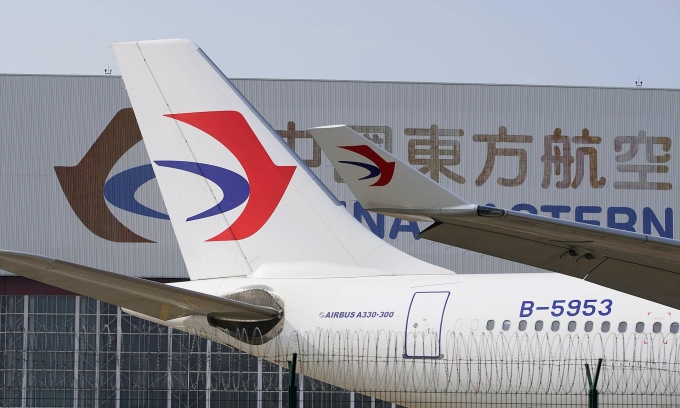
According to Singapore’s Lianhe Zaobao, Chinese flight-tracking app Flight Manager shows that services to and from Changi Airport from Beijing, Shanghai, Wuhan, Chongqing and other Chinese cities have been pulled between late April and early May.
Juneyao Airlines and China Eastern Airlines are among the carriers cutting Singapore routes.
CNN has reported that several Chinese state-owned airlines, including China Eastern and Sichuan Airlines, have begun mass cancellations on routes to Southeast Asia and Australia, describing the cuts as “policy adjustments.”
The trigger is the Iran war, which began on Feb. 28 when the U.S. and Israel launched joint airstrikes on Iranian military and nuclear infrastructure. Iran’s retaliation and the de facto closure of the Strait of Hormuz, through which about 20% of the world’s oil and a similar share of liquefied natural gas normally transit, have shaken global energy markets, according to the U.S. Congressional Research Service. The U.K. House of Commons Library has described the resulting disruption as the “greatest global energy security challenge in history.”
The fuel price data tracks that shock closely. According to the IATA Jet Fuel Monitor, a joint initiative between IATA and S&P Global Platts, the global average price of aviation jet fuel reached $209 per barrel in the week ending April 3, the highest reading since the Iran war began. The price eased 5.3% to $197.83 per barrel in the week ending April 10 but still sits roughly double the $99.40 per barrel recorded in the week ending Feb. 27, the last full week before the war. IATA had initially forecast jet fuel would average $88 per barrel across 2026.
Chinese business publication Securities Times, citing civil aviation experts, reported that because international airfares have not risen in tandem with the fuel spike, carriers on many routes are losing more money the more they fly, forcing the kind of capacity cuts now hitting Singapore.
A marketing manager at a Singapore travel agency told Zaobao that the cancellations are following no clear pattern, with airlines offering to move passengers onto flights departing a few days earlier or later, or rerouting them through alternative Chinese cities. A vice president at a second agency said several tour groups already in Wuhan or Beijing had received cancellation notices, including one group that had to return to Singapore via Shanghai instead of Wuhan. Airlines typically offer free rebooking or refunds, but do not cover the additional ground transport costs that rerouting triggers, a China market manager at a third agency told Zaobao. Travel agencies and their Chinese partners have generally absorbed those costs.
The frustration is spilling onto Chinese social media. One passenger who had booked Air China flight CA975 from Beijing to Changi, departing in the early hours of April 24, posted on Xiaohongshu on April 8 that she had received an SMS cancellation notice and had not been refunded.
The Singapore disruption is part of a wider Asia-Pacific capacity retreat. Hong Kong’s Cathay Pacific will cancel about 2% of its scheduled passenger flights between May 16 and June 30, while its budget arm HK Express will cut around 6% from May 11, CNBC reported, with both carriers citing fuel costs. Air New Zealand has scrapped roughly 1,100 flights, about 5% of its schedule, through early May, according to TTG Asia.


