SALT LAKE CITY — Devon Dampier’s first season at Utah answered one question.
Can he produce at a high level in the Big 12? His response: 3,325 total yards, 34 total touchdowns, 11 wins.
Dampier wasn’t just good in 2025, he was one one of the top producers in the Big 12.
He brought a confidence and swagger to an offensive unit— which had been fairly dormant the previous two seasons— that became one of the best attacks in the country.
But the question this offseason centers around whether or not he can elevate his game enough to make this 2026 version of Utah football a genuine Big 12 title contender. Essentially, can he become a complete quarterback?
Your new favorite gif just dropped 🕷️ @itsGundy x @Devonddampier https://t.co/GT9neDy4Li pic.twitter.com/SjYkrwtCa2
— Utah Football (@Utah_Football) April 14, 2026
The foundation is already there — now comes the challenge
Dampier already proved he can elevate an offense. He finished the year completing 211-of-337 attempts, a 62.6-percent completion rate. He threw 24 touchdowns to just five interceptions, a huge improvement from his 13:13 ratio the previous season.
He finished with the sixth-lowest turnover worthy play rate at just 2.8-percent, and finished tied with Sorsby for the lead in average depth of target at 10.6 yards (meaning he pushed the ball down the field).
Dampier finished the season as the third highest graded quarterback (minimum 100 drop backs) according to Pro Football Focus— only Brendan Sorsby and Noah Fifita graded out higher.
All of this before highlighting how dynamic he was running the ball— specifically, 878 yards and 10 touchdowns on the ground. Dampier proved to be one of the most productive quarterbacks in the country last season. But more will be required of him with this 2026 squad.
But what Utah is asking of him now is different — and more demanding. It’s not just about production anymore. It’s about processing the game at a higher, more complete level.
Expanding command, expands the passing attack
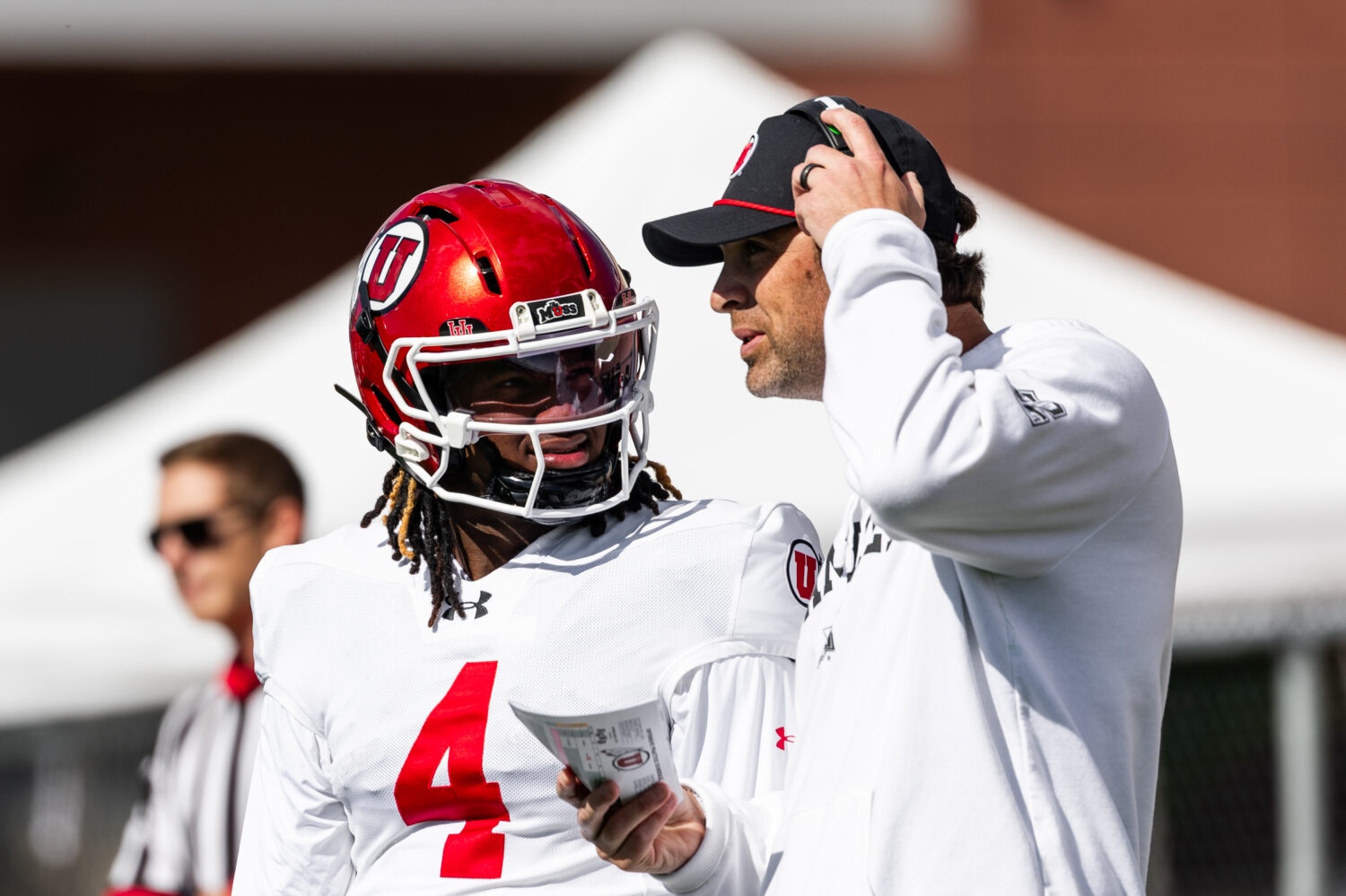
In week one of spring ball, offensive coordinator Kevin McGiven laid out his vision of what they’re trying to accomplish at the quarterback position.
“Developing the complete quarterback… developing their decision making, developing their processes,” McGiven said.
Where Dampier’s growth has to show up is not just in production — but whether he gets to the right read and how quickly and why he gets there. Because the next step in his development is layered:
- Understanding defensive structures pre-snap
- Knowing when to work full-field vs. half-field
- Recognizing when to trust the design vs. when to create
That’s the difference between executing a play and having full command of an offense. And one of the more notable areas of emphasis this offseason has been Dampier’s role within the full structure of the passing game.
On Wednesday, McGiven shared his perspective, and the experience Dampier has gained was evident from day one.
“I’ve been really impressed with Devon’s command of the offense,” McGiven shared. “Early on, his experience was evident — he’s been exposed to a lot and has been in a starting role for a long time.”
That experience allowed him to hit the ground running. As installation and new concepts were being taught, the focus seems to be less on isolated decision-making, and more on operating within the complete framework of the offense.
“This spring was really about applying the new concepts, making decisions pre-snap and post-snap, and handling all the moving parts that come with the system,” McGiven explained. “The command he’s developed, especially over the last couple of practices, has been really impressive to see.”
That’s going to be important given the potential that Utah’s collection of receivers showed in camp. Each of Braden Pagen, Larry Simmons, Kyri Shoels, Ricky Johnson, Creed Whittemore, Daidren Zipperer, and Nate Johnson had stretches of brilliance over the last five weeks.
Maximizing the impact of that group is going to boil down to the execution level of the quarterback. That’s where Dampier’s next step in his development is so important.
“At quarterback, the more you understand the game, the better you can play. Knowing what’s happening on each play — where your answers are, where you’re hot — it leads to cleaner decisions and puts you in a better position overall.” – Devon Dampier on improving his progression process
Progressions, reads, and playing faster by thinking slower
If there’s one word that defines the change at quarterback this offseason, it’s “progressions.” Quarterbacks assistant Ryan Gunderson has been intentional about how that development happens.
“We want to give them tools so they don’t have to work through long progressions every time,” Gunderson said. “They can simplify things and cut those progressions down.”
Progressions aren’t one-size-fits-all — and that’s been a major point of emphasis this spring. Rather than asking Dampier to only work through reads post-snap, the emphasis is on identifying leverage, coverage indicators, and likely outcomes before the play begins.
“At times, we’ll ask them to read the full field, but there are different types of progressions,” he said. “It’s not always as simple as just going ‘no, no, no, yes-throw.’ It’s about understanding what kind of progression it is, when to use it, and when not to.”
That approach allows him to narrow the field, eliminate unnecessary options, and operate with more clarity once the ball is snapped — a process that should lead to quicker decisions and more consistent timing within the structure of the offense.
“The way I phrase it is: play slow pre-snap so you can play fast post-snap,” he said. “A big part of our focus has been giving them tools to eliminate things before the snap.”
The quarterback is responsible for navigating different types of concepts depending on coverage and situation. That pre-snap understanding of what you’re doing vs what you believe the defense is doing is often what separates good from great quarterbacks.
“He’s had a huge impact on my development. I feel like I’m learning something every day. He’s demanding and wants me to be great. He asks me all the time if I want to play in the NFL, and when I say yes, he pushes me to fix the things I need to improve. He’s been a big help, and I feel like I made a lot of strides this spring.” – Devon Dampier on quarterbacks assistant Ryan Gunderson
It’s also about access & execution to different levels of the passing attack
The evaluation isn’t just about the grasp of the overall structure of the offense, it is still about the ability level or arm talent to execute on the field.
Keep in mind that Dampier played through two sports hernias last season. That impacted his ability to execute certain throws. Now, fully recovered, he’s not suddenly ripping throws on a rope, but there has been a more consistent ability to push the ball vertically in camp.
Where Dampier found the most success last season:
- Intermediate (10-19): 42-of-82 for 723 yards, 12 touchdowns, one interception, 90.4 passing grade (PFF)
- Short (0-9): 112-of-137 for 894 yards, five touchdowns, 72.8 passing grade
- Deep (20+): 17-of-54 for 577 yards, six touchdowns, four interceptions, 67.1 passing grade
Beyond the context of the injuries Dampier played through, he also started the season 1-of-14 on deep attempts. He didn’t complete his first throw of at least 20 yards until the West Virginia game, but then finished the rest of the season 16-of-40, which is right in line with the other top deep ball completion rates in the conference.
Reaching that consistency will be important and through spring ball, McGiven has grown confident in what he’s seen from Dampier in that regard.
“I think both Dev and Byrd have a really complete inventory ,” McGiven said of quarterbacks ability to throw to all areas of the field. “With both of them, there’s really nothing we’d shy away from.”
In practical terms, no area of the passing attack is eliminated. The short game, intermediate windows, and vertical shots all remain viable options within the same framework, depending on coverage and situation.
“They can get the ball out quickly on the perimeter, fit throws into tight windows on the intermediates, and push the ball down the field,” he continued. “They have the arm strength and ability to access every area of the field.”
The next step is consistency — and not just making those throws, but doing so within the timing and structure of the play. And that’s not just on the players, it’s also on the coaches to identify what suits their signal callers best.
“Everything’s tailored to them,” Gunderson said. “A lot of it is me having the conversations with Coach McGiven, and then taking those conversations and structuring them in a way to where I can sequentially feed that information to the quarterbacks so that I’m not overloading them with information, but still allowing them to play fast.”
That balance — expanding the offense while maintaining clarity for the quarterback — is central to Dampier’s development this offseason, particularly as Utah continues to build a system that relies on both execution and decision-making across all levels of the passing game.
With all of this new emphasis, coaches are still mindful of Dampier’s natural instincts and ability, and they do not want to take that away from him.
“You want the wild mustang to be a wild mustang, but we also wanna kinda keep him on that path,” Gunderson shared. “So, don’t take the playmaker out of the playmaker, that’s my goal.”
“We’ve grown a lot. The offense is getting more creative each week, and as guys get more comfortable, everything becomes cleaner. That’s allowed us to add small wrinkles to make plays more effective.” Devon Dampier on the offensive development over spring.
The Bottom Line
Devon Dampier’s 2025 season established a high baseline — both statistically and structurally. He was one of the most productive quarterbacks in the Big 12, accounting for nearly 2,500 passing yards, 34 total touchdowns, and over 800 rushing yards while limiting turnovers.
That level of production is already good enough to win a lot of games. The question now is whether he can can go from good to great and lead Utah to wins at the highest level of the conference.
Dampier showed clear growth as a passer throughout spring. He consistently flashed improved ability to make throws to all levels of the field. While there were still some up-and-down stretches — the overall trajectory pointed in the right direction, with a more confident and controlled quarterback emerging by the end of camp.
What Utah is asking of him this offseason is not a dramatic overhaul, but a refinement. This next stretch between spring and fall will be critical. The next three months — May, June, and July — is where Dampier has to take ownership of his development, with a focus on refining mechanics, mastering the playbook, and building his knowledge through film work.
If Dampier can pair his existing playmaking ability with greater processing and command, to become that complete quarterback, Utah’s offense becomes much more dangerous. And if that’s the case, despite the all of the change Utah experienced this offseason, Dampier is capable of leading the Utes in the fight for the top spot in the Big 12.
Steve Bartle is the Utah insider for KSL Sports. He hosts The Utah Blockcast (SUBSCRIBE) and appears on KSL Sports Zone to break down the Utes. You can follow him on X for the latest Utah updates and game analysis.
Take us with you, wherever you go. Download the new & improved KSL Sports app from Utah’s sports leader. You can stream live radio, video and stay up to date on all of your favorite teams.