by J.C. Hallman, Oklahoma Watch
April 11, 2026
Sometimes they say it’s a billion dollars. Sometimes $1.4 billion. Sometimes $2 billion.
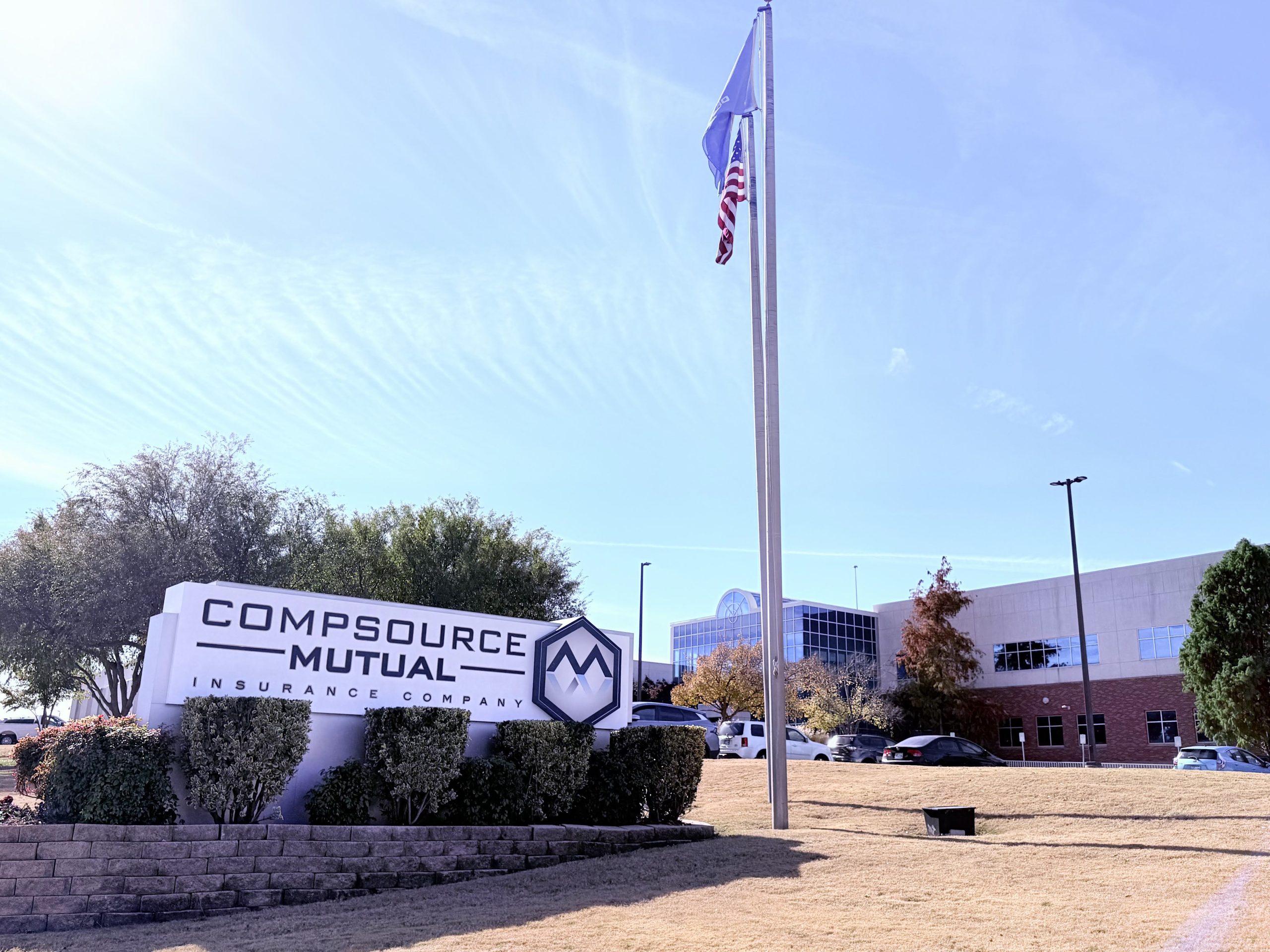
In August of last year, CompSource Mutual — formerly Oklahoma’s insurer of last resort for workers comp insurance — launched an effort to convert into a larger stock company that sells many forms of insurance across the country. Since then, a protracted legal battle has erupted of baffling complexity, legal obfuscations and embarrassing corporate flubs. The battle, at heart, is over CompSource’s surplus assets.
A billion dollars. Or more, depending on which court filing you consult.
On Wednesday, a temporary restraining order hearing in a Noble County courtroom threw a wrench into the conversion process, ensuring additional litigation and confounding CompSource’s conversion timeline.
CompSource and its attorneys refused comment after Wednesday’s proceedings. But in public statements and arguments in court, they characterized the interruption of the plan as a derailing of an effort to bring value to policyholders by growing the company. Critics disagree, and characterize the effort to transform CompSource Mutual into a stock company — mutual companies are supposed to be owned by their policyholders — as an attempt to loot its reserve cash.
In August, when the conversion plan was abruptly announced, Oklahoma City attorney and longtime CompSource policyholder Bob Burke suggested that at least half of what the company had in cash could be stripped away from those who rightly owned it.
“In other words, nearly half a billion in assets could be owned by outside stockholders,” Burke said.
The months-long CompSource litigation, in which Oklahoma City law firm Whitten Burrage, representing policyholders, was seeking the temporary restraining order to delay the conversion process, has been running parallel to another complex and newsworthy lawsuit from Whitten Burrage: the State Farm roof claim saga, which last week elicited a dire response from none other than President Donald Trump.
The fact that the two cases bear similarities — portions already taken to the Oklahoma Supreme Court, a representative from the attorney general’s office at plaintiffs’ table on Wednesday and a sitting Supreme Court judge who formerly represented the company under scrutiny — was not lost on Whitten Burrage attorney Hannah Whitten, who after Wednesday’s hearing offered a concise take on what was at stake.
“People are afraid that CompSource is going to take policyholder money and start a new State Farm,” Whitten said.
A Very Convoluted Case
An unasked question lurked behind the CompSource hearings that stretched back to January. Where did CompSource’s cash assets come from? Strictly speaking, mutual companies should not accumulate large liquid reserves; rather, excess funds should be returned to policyholders through dividends or lowered premium rates.
The answer may lie in a separate class action lawsuit against CompSource that has been in litigation for more than five years. Whitten Burrage asserts that since 1978, CompSource has collected $100 million or more in premiums on a portion of coverage that has never paid out on a claim.
With compound interest over four decades, that $100 million could account for the $1 billion that CompSource has on hand, according to company documents obtained by Oklahoma Watch.
Not long after CompSource announced its conversion plan, Whitten Burrage filed a separate motion to stop or delay it. On Wednesday, Whitten Burrage attorney Randa Reeves presented evidence of the many public documents related to the conversion plan that the law firm sought at that time.
The battle over the restraining order began in the Kay County courtroom of District Court Judge Lee Turner, who was quick to note the complexity of the proceedings.
“This is a very convoluted case,” Turner said in court.
The contest began with a fight over whether Turner’s courtroom was the right venue in which to pass judgement. Whitten Burrage argued that their clients resided in Kay County; CompSource argued that the proper venue was Oklahoma County, where the company’s corporate headquarters are located.
Thomas Wolfe, of Oklahoma City law firm Phillips Murrah, representing CompSource, made the peculiar argument that the venue should change because if fraud had taken place, then it had taken place in Oklahoma City.
“I hate to say it on the record, but if their claim is fraud, then where did the fraud take place?” Wolfe said.
The judge declined to relinquish the case, either for venue or because it was dauntingly complex.
“When I took this job, I said I would never run from a tough case, and I won’t do that today,” Turner said.
A ‘Stop the Steal Sort of Thing’
After it was submitted for public commentary in August, the CompSource conversion plan required the approval of Oklahoma Insurance Department Commissioner Glen Mulready. In March, well past the 60-day statutory deadline for a response, Mulready approved the plan. A date of April 17 was set for materials to be sent to CompSource’s thousands of policyholders, who would then vote on the plan, with a two-thirds majority required for approval.
Before then, the courtroom tactics of the opposing law firms became clear: Whitten Burrage hoped to hurry proceedings along to interrupt the process before April 17; CompSource sought to slow things down so that April 17 would arrive before a restraining order could be granted.
In a hearing in early March, when proceedings moved to Noble County but remained with Judge Turner who hears cases in both Noble and Kay counties, Turner appeared to recognize that the tactics had devolved to a legal standstill.
“The argument now is who gets to talk first at our next meeting,” Turner said.
Subsequent hearings would often return to the question of whether the conversion plan was fair and equitable to policyholders who were also the company’s owners. That is, if the plan proceeded, would policyholders be properly compensated for the loss of assets or would their stake in the company be diluted or dissolved as a result?
Three witnesses would be called to court: two former heads of CompSource and a former Oklahoma Tax Commissioner and lifelong insurance industry expert.
At a subsequent March hearing, lawyers for CompSource asked for an additional delay because their witness, one of the former CompSource heads, Jason Clark, was unavailable because he was vacationing in the Bahamas.
The other former CompSource head, Michael Clingman, testified as an expert for Whitten Burrage and the policyholders, explaining at length that he had been troubled by what he had seen at the company over the last eight years, in particular the accumulation of a large cash reserve without returning those funds to policyholders.
“It’s my opinion that if you were going to put together a conversion plan that was not fair and equitable, this is how you would do it,” Clingman said.
During a court recess, Clingman was more direct in characterizing the effort to object to the conversion plan.
“It’s kind of a ‘Stop the Steal’ sort of thing,” Clingman told Oklahoma Watch.
Clingman’s cross-examination did not end until early during Wednesday’s hearing. He was replaced on the stand by Charlie Prater, the former tax commissioner who also had decades of experience working for insurance companies that acquired other insurance companies.
In large measure, Prater echoed Clingman in asserting that policyholders would be damaged if the conversion plan was realized and that Mulready had erred in determining that the plan was fair and equitable when he approved it.
“I’m not impressed with the commissioner’s order,” Prater said. “I’d tell him to his face.”
Prater’s testimony continued for another hour before the dramatic twist that brought the proceedings to an abrupt close.
CompSource attorney Wolfe attempted to introduce into evidence, for Prater’s opinion, a draft of the more than 30-page document that CompSource intended to send to policyholders on April 17, presumably to encourage them to vote in favor of the conversion.
Attorney Joe White, of Oklahoma City law firm White & Weddle, representing policyholders alongside Whitten Burrage, objected at once and delivered an impassioned speech: the eleventh-hour introduction of a document that the witness had not had time to review before taking the stand was evidence of dirty tactics. Whitten Burrage attorney Reeves presented evidence showing that she had made a formal request for that same document seven months earlier.
Turner appeared visibly shaken that a crucial document had been withheld.
“I don’t make threats very often,” Turner said, seeming to consider sanctions against CompSource’s attorneys. “I believe in due process, giving both sides an opportunity to be heard. But this is very troubling, to say the least. The only question I have now is do I just stop the whole thing.”
After a brief recess, that’s exactly what Turner did, granting the temporary restraining order requested by Whitten Burrage.
“I have signed the order,” Turner said. “It can be filed.”
CompSource refused interview requests as the hearing dispersed. Whitten Burrage attorney Hannah Whitten said later that CompSource would likely appeal to the Oklahoma Supreme Court, as they had with another portion of the case that was argued before the Court’s referee on Tuesday — another delaying tactic, Whitten said.
The battle over the CompSource conversion will continue, Whitten said, but CompSource’s plan to hurry the policyholder vote had been stopped.
“I am extremely grateful to Judge Turner,” Whitten said. “Plaintiffs are thrilled that Judge Turner granted an order to stop a plan that is to the detriment of policyholders we represent.”
This <a target=”_blank” href=”https://oklahomawatch.org/2026/04/11/compsource-conversion-plan-dealt-blow-with-restraining-order/”>article</a> first appeared on <a target=”_blank” href=”https://oklahomawatch.org”>Oklahoma Watch</a> and is republished here under a <a target=”_blank” href=”https://creativecommons.org/licenses/by-nd/4.0/”>Creative Commons Attribution-NoDerivatives 4.0 International License</a>.<img src=”https://i0.wp.com/oklahomawatch.org/wp-content/uploads/2019/10/okwatch-icon.png?fit=150%2C150&ssl=1″ style=”width:1em;height:1em;margin-left:10px;”>
<img id=”republication-tracker-tool-source” src=”https://oklahomawatch.org/?republication-pixel=true&post=758385&ga4=G-6G6K9FYSH8″ style=”width:1px;height:1px;”><script> PARSELY = { autotrack: false, onload: function() { PARSELY.beacon.trackPageView({ url: “https://oklahomawatch.org/2026/04/11/compsource-conversion-plan-dealt-blow-with-restraining-order/”, urlref: window.location.href }); } } </script> <script id=”parsely-cfg” src=”//cdn.parsely.com/keys/oklahomawatch.org/p.js”></script>