On April 1, Anna Walker was following a federal agent’s unmarked pickup truck through a Target parking lot when the vehicle suddenly came to a stop.
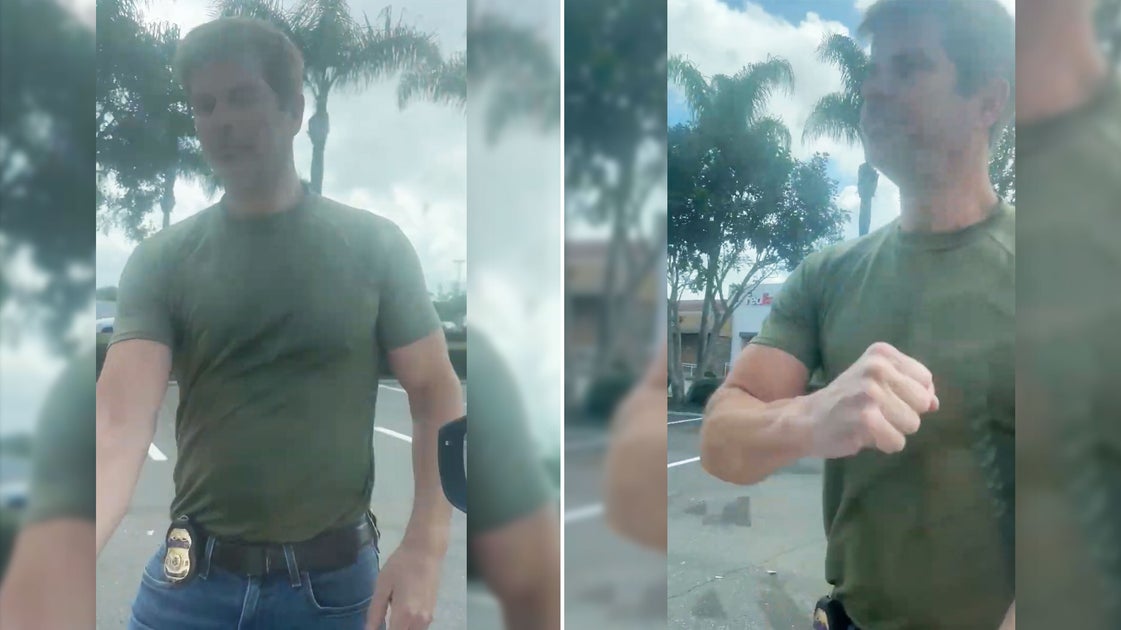
The pickup started backing up toward Walker’s Volkswagen EV just as an unmarked SUV pulled up behind her, boxing her in. The agent stepped out of the pickup, approached Walker and tried to open her locked door. When that failed, he pounded his closed fist on her window hard enough that she thought it might crack.
“You’re not going to keep following us or we’re going to arrest you,” the plainclothes agent said through the closed window, flashing his identification showing Homeland Security Investigations, which is part of Immigration and Customs Enforcement. “That’s your last warning. Keep doing that and you’ll be arrested for impeding.”
Walker, 31, used her cellphone to record portions of the encounter, which took place in San Diego. According to her own video (below) and those of witnesses, she never stepped out of her car and was never arrested. The agents left the scene after about 15 minutes, but Walker had a feeling the story wasn’t over.
Over the next few days, she periodically logged in to the government’s Trusted Traveler website, believing they might revoke her Global Entry privileges, which allow for expedited arrival to the U.S. On Monday, five days after her encounter with the agents, she received an email notifying her of a “recent change” to her status. She was no longer certified as a low-risk traveler.
“I knew when they were taking videos of me and my [license] plates, I was like, ‘There goes my Global Entry,’” said Walker, who had read about activists losing their approval for the program after run-ins with federal agents during President Donald Trump’s immigration crackdown.
“I fully understand it’s a travel perk or privilege, not a constitutional right,” she added. “But it becomes a very slippery slope when you begin retaliating against people for exercising their First Amendment rights and taking away something.”
U.S. Customs and Border Protection, which oversees the Trusted Traveler programs, did not tell Walker why she lost her Global Entry status. Walker said she hasn’t had any legal troubles that would otherwise explain the change.
On Wednesday, HuffPost asked the Department of Homeland Security what the basis was for revoking Walker’s Global Entry. On Thursday, an agency official responded and asked for Walker’s full name and date of birth, which HuffPost provided with Walker’s permission. On Friday, Walker received an email notifying her that her Global Entry was restored.
DHS has not commented on her case as of this posting.
Walker is one of three people HuffPost has interviewed who believe their Global Entry was revoked due to lawful observation of agents. A Minnesota woman lost hers in January after tailing a Border Patrol agent and being told she was “impeding” their work, and a South Carolina woman lost hers in November after filming officers outside a CBP facility and being told she was trespassing. As with Walker, both women were threatened with arrest but never charged.
HuffPost revealed last month that CBP planned to review recommendations to revoke people’s Global Entry based on recent “encounters” with its officers, many of whom have been diverted from their normal duties to assist ICE in inland immigration operations. The agency routinely takes away people’s Global Entry privileges but usually due to criminal charges or customs violations, like getting caught with restricted plants when returning from overseas.
HuffPost readers: Did you lose your Global Entry after an encounter with federal agents? You can find our reporter on Signal at davejamieson.99 or email him here.
The possibility of the Trump administration or DHS agents using Global Entry revocation as a means of retribution has alarmed civil rights advocates. Sara Robinson, a staff attorney with the American Civil Liberties Union’s National Security Project, recently told HuffPost this issue was about “more than convenience at the airport.”
“It’s about whether the government is punishing speech it dislikes and seeking to deter people from exercising their fundamental freedoms,” Robinson said.
Like the women in Minnesota and South Carolina, Walker said she was trying to act as a legal observer when she was stopped. She had learned the agents were at her local Target from an Instagram livestream by Arturo Gonzalez, a San Diego activist who draws attention to ICE operations with his large social media following.
“We try to get them not to kidnap someone,” Gonzalez told HuffPost.

Gonzalez said he and other activists had surrounded an unmarked car and were blowing whistles and shouting “la migra” to warn people that agents were in the area. He said one of the agents pursued him on foot, so Gonzalez ran into the Target.
Walker said she headed to the Target parking lot and followed the pickup truck with the intention of filming the agents if they detained people.
“I have never tried to interfere with law enforcement,” she said.
Once her car was surrounded, Walker called 911 and said she was boxed in by unmarked DHS vehicles and needed help. She said she was put on hold, and she eventually hung up.
A 12-minute video from Ed Baier, a local photojournalist, captures the confusion as another woman screams at the agents and a parking lot security guard calls a supervisor to ask what she’s supposed to do. At one point, an agent tells Baier they are not there to do immigration enforcement. “I work drug cases,” the agent says. (HSI investigates drug, firearm and human trafficking, among other transnational crimes.)
Baier said he’s been filming federal agents in the area during Trump’s immigration crackdown and became aware of the Target situation due to Gonzalez. He showed up wearing a flak jacket with a press sign. At first, he thought Walker and her car were part of the DHS caravan. When he realized that wasn’t the case, he grew concerned.
“She was in a precarious [spot]. She could have been physically hurt or shot or killed,” Baier said in an interview.
After about seven minutes, the agents moved their vehicles and told Walker she could leave. But she decided to stay parked until they left.
“We know with Renée Good, she got shot trying to drive away,” Walker said, referring to the 37-year-old woman who was killed by an ICE officer in January in Minnesota. “I don’t think it would have been wise to try and drive away with the agents standing there.”
After her Global Entry was revoked, Walker reached out to her state lawmaker’s office, which said it referred her case to the office of Sen. Alex Padilla (D-Calif.). Global Entry revocations can be reviewed by a program ombudsman and overturned, and a public records request can reveal the rationale behind the revocation. But both processes typically take months.
Before she learned her Global Entry was restored on Friday, Walker said she was more worried about whether the encounter had landed her on some kind of government list.
“For me, I’m just concerned as to what this leads to,” she said. “Now am I considered a domestic terrorist because I recorded agents?”