Recent satellite imagery and analysis by international monitoring organizations indicate that North Korea’s Yongbyon Nuclear Scientific Research Center, the country’s primary nuclear complex located in North Pyongan province, is undergoing simultaneous reactor operations, enrichment facility expansion, and demolition of aging infrastructure. The findings suggest the site has entered an active modernization phase rather than a period of maintenance or dormancy.
Satellite photos show repeated evidence of coolant discharge, steam generation, vehicle movement, and construction equipment activity, all consistent with reactor operations and facility upgrades. Analysts assess that Yongbyon is not simply sustaining existing nuclear material production but is actively expanding and modernizing its capacity.
Reactors operating in tandem
Repeated cooling water discharge from channels near the Yongbyon 5 MWe reactor and experimental light water reactor is visible in satellite imagery, consistent with ongoing reactor operation or test runs at the complex. / Photo: Planet Labs
The 5 MWe graphite-moderated reactor, North Korea’s principal plutonium production facility, continues to show sustained operational indicators. Satellite imagery has captured warm water discharging from the reactor’s coolant outlet into the Kuryong River, along with steam rising from the turbine building, both recognized signatures of active reactor operation. The International Atomic Energy Agency (IAEA), the United Nations body responsible for nuclear safeguards verification, assessed that the reactor entered a new operating cycle following a fuel reload in 2024 and has remained in operation since.
The experimental light water reactor (ELWR), a newer facility at the complex, also shows signs of active use. Satellite imagery has repeatedly captured warm water discharge from the reactor’s cooling system, and melted snow around the turbine building points to sustained heat generation. The IAEA and several research institutions assess that the ELWR first began operating around 2023 and has since cycled through intermittent shutdowns and restarts as it progresses through what appears to be a testing or early operational phase.
Satellite imagery also documents ongoing work on the Kuryong River water management infrastructure that both reactors depend on. Workers have reinforced a weir damaged by seasonal flooding and installed structures to regulate water levels, measures interpreted as efforts to ensure a stable coolant supply for continued long-term reactor operations.
Should the ELWR reach stable full-scale operation, it would add a supplementary source of plutonium production alongside the existing 5 MWe reactor, potentially increasing Yongbyon’s overall fissile material output.
New enrichment facility under construction, aged reactor demolished
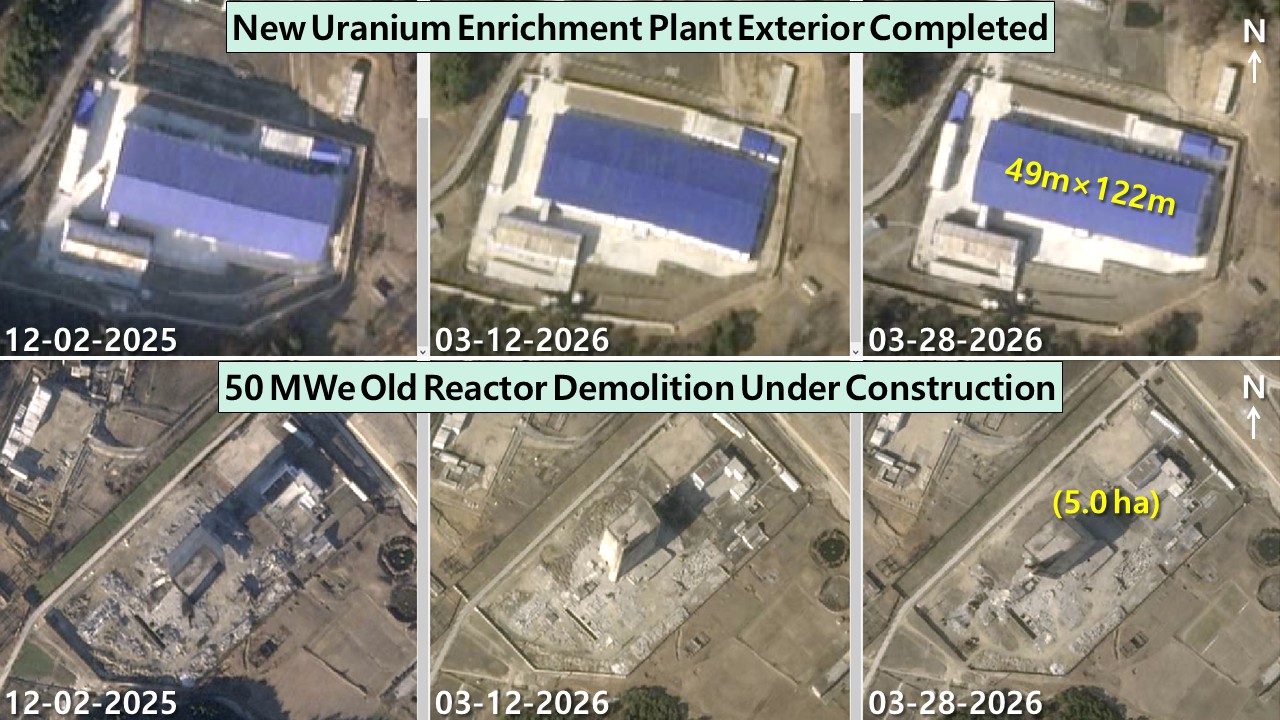
A large building assessed to be a new uranium enrichment facility has reached near-complete exterior construction, while demolition of the unfinished 50 MWe reactor site continues within the Yongbyon complex. / Photo: Planet Labs
Concurrent with reactor operations, Yongbyon is undergoing significant structural changes: the long-dormant 50 MWe reactor is being demolished while a large new building assessed to be a uranium enrichment facility nears exterior completion.
The 50 MWe reactor site, covering approximately 5.0 hectares, is being cleared at a notable pace. Construction on the reactor began in the late 1980s but was halted following the 1994 U.S.-North Korea Agreed Framework and left unfinished for decades. Recent satellite imagery shows the surrounding buildings and structures being dismantled in stages, with cranes and excavators removing debris and clearing the site. The scale and character of the activity indicate a full demolition effort rather than routine maintenance or salvage.
Adjacent to the demolition site, a large building measuring approximately 49 by 122 meters has been rising rapidly and is assessed to be a new uranium enrichment facility. Construction began in late 2024, and by mid-2025, exterior work including the roof and outer walls appeared largely complete. The building’s internal layout, featuring a wide central hall flanked by support spaces, closely resembles the Kangson enrichment facility near Pyongyang, a configuration suited to housing large numbers of centrifuges. The building’s scale, security infrastructure, and structural features collectively support the assessment that the facility is intended for industrial-scale uranium enrichment rather than research.
Activity around the building includes materials staging, piping installation preparation, and construction of support structures, indicating that interior equipment installation and operational preparation are underway. Centrifuge facilities require specialized flooring to minimize vibration, stable power supply, and dedicated cooling and ventilation systems, and satellite imagery confirms the presence of security fencing, piping, and additional structures consistent with such requirements.
Overall assessment: Modernization aimed at expanded production
Taken together, the satellite evidence indicates that Yongbyon has entered a modernization phase in which reactor operations, enrichment capacity expansion, and facility clearance are advancing simultaneously. The changes reflect a strategic shift away from large graphite-moderated reactor infrastructure and toward expanded highly enriched uranium production, while maintaining existing plutonium production. The Yongbyon Nuclear Scientific Research Center functions as North Korea’s principal site for both plutonium production and uranium enrichment, and recent activity across the complex confirms that expansion and renovation are ongoing.
The four principal developments identified through satellite analysis are: continued operation of the plutonium-producing 5 MWe reactor; operation and testing of the experimental light water reactor; construction of a new uranium enrichment facility; and demolition of the aging 50 MWe reactor site. Analysts assess that these changes reflect a long-term strategy to sustain, expand, and modernize North Korea’s fissile material production capabilities.