- Though conflict and instability have shaped much of the Central African Republic’s recent history, Dzanga-Sangha in the country’s southwest is experiencing a modest rise in ecotourism centered on forest elephants, western lowland gorillas and the dense Congo Basin rainforest.
- Officials say about 800 tourists visited Dzanga-Sangha in 2025, generating roughly $1 million in revenue, with local guides and lodge workers reporting gradual growth linked to improved stability.
- Tourism is bringing some benefits, including income sharing, cultural tourism and small economic opportunities, though some involved in the country’s ecotourism ecosystem say job creation remains limited and uneven.
- While optimism is growing, challenges such as poor infrastructure, limited access and questions about equitable benefits mean Dzanga-Sangha’s ecotourism remains a work in progress.
See All Key Ideas
BAYANGA, Central African Republic — For many outside the country, the Central African Republic remains defined by a set of familiar images: conflict, instability, weak infrastructure and a state that struggles to extend its authority much beyond Bangui, the country’s capital.
These realities are not imaginary. They continue to shape daily life across much of the country. Roads are in poor condition, health services are fragile and insecurity persists in certain areas. For years, these conditions have overshadowed nearly every other story.
But they do not tell the whole story.
Hundreds of kilometers southwest of Bangui, near the borders with Cameroon and the Republic of Congo, a more low-key experiment is taking shape in the forests of Dzanga-Sangha. It is an attempt to build a local economy centered on wildlife, conservation and tourism in a country rarely associated with these three elements.
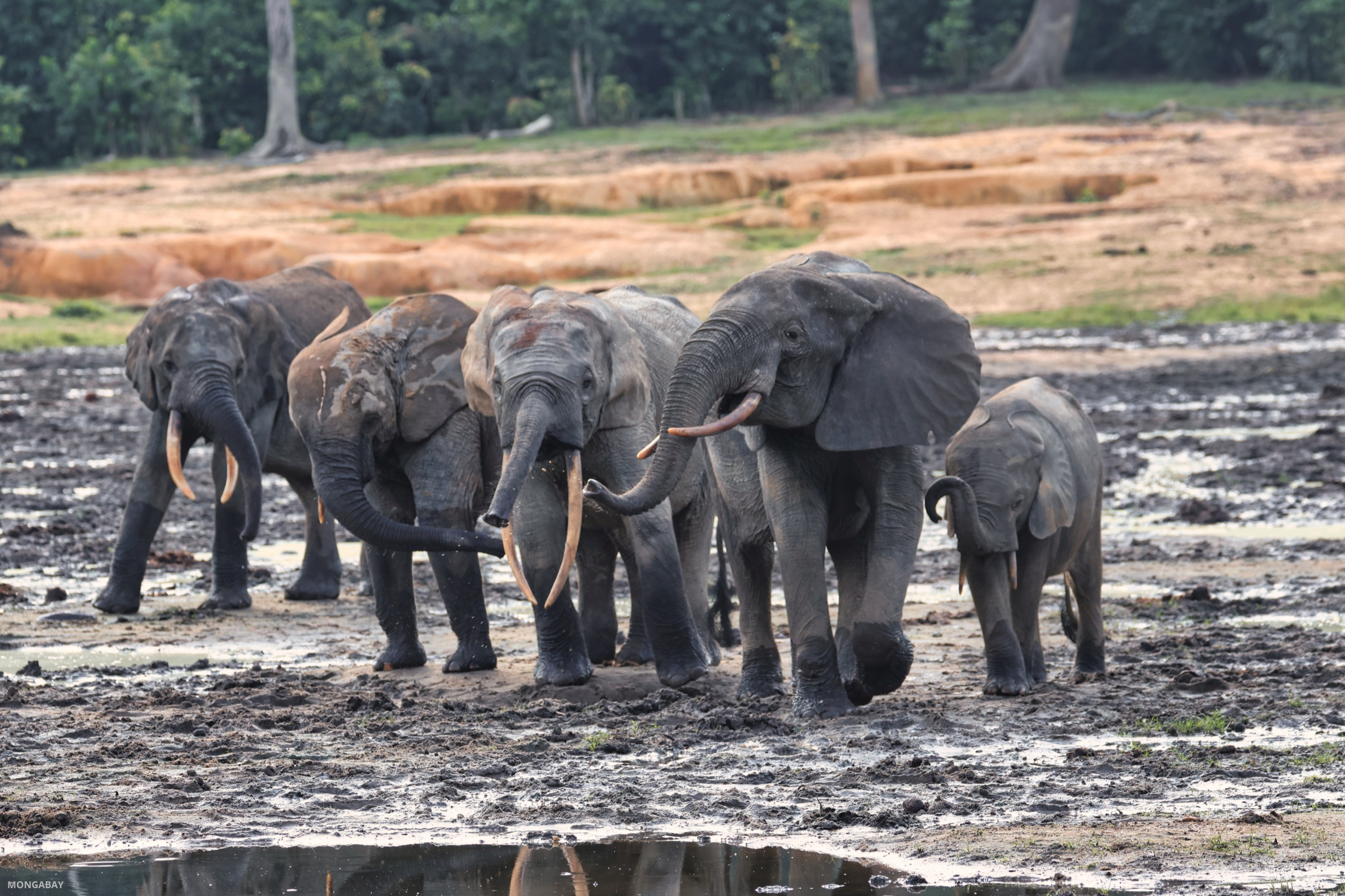
In Bayanga, a small town serving as the gateway to Dzanga-Sangha National Park, visitors come for Dzanga Bai, one of the most famous forest elephant (Loxodonta cyclotis) gathering places in tropical Africa, where dozens — and sometimes well over a hundred — elephants can gather in a single area. They also come for the western lowland gorillas (Gorilla gorilla gorilla) accustomed to human presence, the dense forest of the Congo Basin, and a conservation landscape that remains, in many ways, raw and un-finished.
Dzanga Bai, one of the best-known forest elephant clearings in tropical Africa, where dozens and sometimes well over a hundred elephants can gather in a single open space. Image by Rhett A. Butler/Mongabay.
According to officials and field workers, visitor numbers have increased over the past two to three years, with an increasingly visible local impact, even if the figures remain modest on an international scale.
“We’ve observed that there is growth,” says Gervais Pamongui, deputy director of Dzanga-Sangha Protected Areas (DSPA), which is co-managed by the Central African government within the Ministry of Water and Forests. “First, it’s what we have to offer as a product. Second, in recent years, there has been a certain stability. For tourism to develop, a country needs stability so that visitors feel safe.”
This sense of relative calm in Bayanga comes up frequently in interviews conducted on the ground, often accompanied by caveats. No one suggests that the Central African Republic has overcome its overall fragility. However, in several interviews conducted by Mongabay, residents and officials draw a distinction between national perceptions and local realities in this part of the country.
Léonce Madomi, a tour guide who has been working in the region for about 16 years, says he believes the change has been most visible in recent years. “I think it’s over the last two or three years that tourism has really increased,” he says. “For me, it’s communication … advertising. People come, leave, and say they’ve visited Dzanga-Sangha. They say it’s calm, that it’s positive — that means there’s stability in the area. That’s why others are listening.”
Most tourists who travel to the Central African Republic (CAR) are drawn by the western lowland gorillas (Gorilla gorilla gorilla) in Dzanga-Sangha National Park. Image by Rhett A. Butler/ Mongabay.
He is careful to qualify this, however. “It’s both true and false,” he says regarding the idea that the Central African Republic is synonymous only with war and insecurity. “Yes, there are areas where there are problems. But not here in Bayanga. I’ve been here for 18 years, I’ve been working here for 16 years, and I’ve never experienced chaos — running, hiding, none of that.”
The wildlife remains the main attraction. “They love nature here in Dzanga Bai,” Madomi says. “They’ve never seen elephants gathered like this in families. In other countries, they’re more scattered. You might see 10, 15, maybe 20. But here, if the timing is right, you can see 140, even 150 in a single day.”
According to Pamongui, Dzanga-Sangha welcomed around 800 tourists in 2025, representing some 20 nationalities, including Germany, Russia, Spain and the U.S. He also highlights a notable trend: “We’re also seeing growing interest in domestic tourism. More and more Central Africans are coming to visit.”
On the ground, this growth shows up in incremental changes. Guides prepare forest excursions at dawn. Lodges welcome a steady stream of visitors. Trackers lead tourists through the dense forest, interpreting signs invisible to the uninitiated. Hotel staff report more consistent activity than before.
“There weren’t many tourists before,” says Zongbo Noella, who has worked at Doli Lodge — one of Bayanga’s lodging options — since 2014. “But now they come more often. When they come, it helps us. It also helps our families; that’s how we support them.”
Grace Balembe, right, is a WWF tracker. He told Mongabay that without tourism, he might not have a job. His work includes accompanying tourists into the forest and helping locate and track wildlife. Image by Rhett A. Butler/ Mongabay.
She says she welcomes this change, while pointing out its limitations. Bayanga may be quieter than other parts of the country, but life remains difficult. “Here in Bayanga, we haven’t experienced war,” she says. “But there are other challenges — many needs. We face difficulties, especially food shortages.”
This gap between promise and reality is a recurring theme in many discussions about ecotourism here.
Officials highlight revenue-sharing mechanisms. According to Pamongui, revenue from entrance fees is distributed according to a formal framework: 30% for local communities, 15% for the Ministry of Water and Forests, 20-25% for the Ministry of Tourism, and 35% for the park.
He also mentions cultural activities — traditional dances and community practices — the revenues from which directly benefit locals. “Tourists don’t just visit the park,” he says. “They also discover cultural practices and traditions.”
For some residents, the benefits are very real. Béatrice Babona, a member of the Indigenous Ba’aka community who works with Radio Ndjoku, a community radio station in Bayanga, said tourism has had visible social effects.
“For me, the arrival of tourists here — in the park and in the surrounding communities — is something positive,” she says. “It motivates people. When they go into the forest, it also helps them revive their activities.”
“The benefits of tourism are very real,” she adds. “When tourists come, they bring money, and that helps a lot. It allows families to send their children to school and go to the hospital — it does many things for the Ba’aka.”
Traditional dances are also among the main attractions for tourists in the southwestern region of the Central African Republic. Here, the Ba’aka, an Indigenous community, perform a traditional dance to welcome visitors in the village of Yobé-Sangha. Image by David Akana/ Mongabay.
But local support does not mean the model is beyond criticism. Several interviews suggested that the gains remain uneven, seasonal and too limited to absorb wider unemployment.
Madomi, despite his long career in tourism, is blunt about that. “Not really more jobs,” he says regarding whether the sector had created significantly more work. “If I count, it’s mostly eco-guards and people like us. But it’s not enough for the population. It’s not sufficient.”
For him, the solution lies in a broader economy. “We need to create small businesses,” he says.
That may be one of the clearest lessons from Bayanga so far: Wildlife tourism alone is unlikely to transform a place like this unless it is linked to wider local enterprise, infrastructure and public services.
The region has also benefited from increased political visibility. Pamongui cites President Faustin-Archange Touadéra’s recent visit as a key moment. “It helped promote Dzanga-Sangha,” he says.
But many challenges remain. Access is difficult, roads are unreliable, and the country’s image continues to hinder development.
“What is certain is that there is calm and peace,” Pamongui says. “We encourage people to come and discover Dzanga-Sangha.”
A deeper question remains: Can a fragile country develop equitable ecotourism without replicating the inequalities seen elsewhere in the Congo Basin?
In Bayanga, the answer remains uncertain.
For now, Dzanga-Sangha is neither a resounding success nor a failure. It is a fragile, gradual endeavor, where exceptional wildlife, relative stability, and slow growth in tourism are opening up new possibilities.
“My hope is to strengthen monitoring, create small businesses, and raise more awareness,” Madomi says. “And in 10 years, this could become a little paradise.”
Rhett A. Butler contributed reporting to this piece.
Banner image: Forest elephants gather in the Dzanga Bai forest clearing. According to researchers, they are drawn to mineral-rich soils, and at times, more than 200 individuals assemble here, making it one of the few places on Earth where this elusive and endangered species can be observed in large numbers. Image by Rhett A. Butler/Mongabay.
FEEDBACK: Use this form to send a message to the author of this post. If you want to post a public comment, you can do that at the bottom of the page.