- The high seas treaty was agreed to by the world’s nations in 2023 and took effect in January. The treaty created a means to establish marine protected areas (MPAs) in international waters, or the high seas.
- A summit to draft the treaty rules took place March 23-April 2 at the United Nations headquarters in New York City. Five multilateral organizations that manage high seas fishing, known as regional fisheries management organizations (RFMOs), jointly proposed changes in a bid to ensure their own work is not duplicated or displaced.
- The draft rules that emerged from the summit, to be voted on at a future meeting, accommodated the RFMOs’ wishes, according to critical observers, who argue the RFMOs are influenced by fishing industry priorities and may use authority conferred by the rules to inhibit MPA creation.
- In other news at the summit, parties also worked on developing rules governing the participation of non-state observers such as NGOs and a process for determining the location of the treaty’s secretariat.
See All Key Ideas
For conservationists, one of the major achievements of the high seas treaty was that it created a means to establish marine protected areas (MPAs) in international waters. High seas MPAs are viewed as essential to meeting the looming 2030 deadline to protect 30% of the Earth’s ocean, especially since countries have only just reached one-third of that goal.
Now, the multilateral organizations that manage high seas fishing, known as regional fisheries management organizations (RFMOs), are pushing to make sure their own work is not duplicated or displaced. Some conservationists see the RFMOs’ engagement as a way of inhibiting protection efforts, arguing that RFMOs are heavily influenced by fishing industry priorities.
The high seas treaty, more formally called the agreement on the conservation and sustainable use of marine biological diversity of areas beyond national jurisdiction (BBNJ), was agreed to by the world’s nations in 2023 and took effect in January. A summit to draft BBNJ rules took place March 23-April 2 at the United Nations headquarters in New York City. There, five major RFMOs jointly proposed changes to the draft rules of procedure that would help enshrine their authority to be part of decision-making under the treaty. The draft rules that emerged from the summit, to be voted on at a future meeting, accommodated the RFMOs’ wishes, according to critical observers.
“The BBNJ agreement was intended to be this overarching agreement to protect all high seas biodiversity because [that protection] is fragmented, because it is inefficient,” Gabrielle Carmine, a postdoctoral fellow at Georgetown University who’s researched governance gaps in RFMOs and who attended the meeting, told Mongabay. She emphasized the word “because” as she spoke. “I have felt like saying, ‘Does everyone remember why we’re here? It’s not because the existing frameworks and bodies are so functional and effective.’”
In a statement, Megan Randles, global political lead for oceans at the Netherlands-based NGO Greenpeace, who attended the talks as an observer, said, “The organisations that have presided over decades of destruction on the high seas have made a completely unacceptable power-grab which would dramatically weaken the [treaty’s] ability to protect the ocean. They are attempting to re-write the Treaty in favour of fishing industry vested interests.”
RFMO leaders told Mongabay the criticism was misplaced.
“Any suggestion that the proposed text reflects anything beyond a desire for efficient collaboration and smooth implementation is simply baseless,” Dominic Vallieres, executive secretary of the Commission for Conservation of Southern Bluefin Tuna, an RFMO that co-authored the joint RFMO proposal, told Mongabay in an email.
At the summit, BBNJ parties also worked on developing rules on the participation of non-state observers, such as NGOs, and a process for determining the location of the BBNJ secretariat.
Crew of the Spanish longliner Naboeiro haul up a shark in the Canary Guinea Convergence Zone off West Africa in March 2026. Countries in the region have identified the zone, an ecologically rich area where two ocean currents meet, as the possible site of a high seas marine protected area (MPA). Greenpeace staff members said this shark is likely a blue shark (Prionace glauca). Image courtesy of Maarten van Rouveroy / Greenpeace.
RFMO-BBNJ interplay
The New York summit was the final preparatory commission for the BBNJ before the first conference of the parties (COP), which will take place in January 2027, also at U.N. headquarters. The treaty applies to all of the ocean that lies outside countries’ exclusive economic zones, which generally extend 200 nautical miles (370 kilometers) from coastlines. In addition to MPAs, the treaty deals mainly with the sharing of marine genetic resources, the completion of environmental impact assessments for ocean projects and the transfer of ocean-related technology to low-income countries. It doesn’t directly address fisheries, and its relationship with RFMOs remains to be fully worked out. The draft rules on BBNJ interactions with RFMOs, like many other contentious issues, will be decided at COP1.
The post-summit draft rules state that interactions between the BBNJ and bodies such as RFMOs shall be guided by “the recognition of the mandate complementarity and various synergies” between them and “the need to develop strategies to manage overlapping mandates and avoid duplication of efforts, including, where appropriate, by leveraging the expertise and best practices of relevant instruments, frameworks and bodies, and existing cooperation and coordination arrangements and platforms.” Like the treaty text itself, it says that RFMOs shouldn’t be undermined.
The language differs from what the RFMOs requested in their joint proposal. However, some experts regarded it as overly deferential to RFMOs and predicted it would allow the RFMOs significant power to determine how the BBNJ conducts its science and makes decisions about MPAs.
Ryan Orgera, global director of Accountability.Fish, a U.S.-based advocacy group, said he was “concerned” about BBNJ-RFMO interactions following the summit.
“[RFMOs] are not equipped as bodies, philosophically nor logistically, to add value to MPA creation processes,” Orgera told Mongabay in a text message. “Many of the actors internal to RFMO processes are publicly opposed to the creation of MPAs in their respective treaty-areas. RFMOs fail in ecosystem protection — they don’t think of systems in meaningful ways; they often treat individual fisheries as discrete entities.”
“The ocean, and humans, need BBNJ to be fully functional if it is ever to retool the shortcomings of multilateral fisheries governance,” he continued. “BBNJ nations must speak with one voice in both BBNJ and RFMO venues; they cannot allow their Environment/Foreign Ministries to be pro creation of MPAs in BBNJ and then turn around and allow their Fisheries Ministries, on behalf of their respective industries, [to] fight tooth and nail against high seas MPAs.”
Like Vallieres, key figures at the Western and Central Pacific Fisheries Commission (WCPFC) and the Indian Ocean Tuna Commission (IOTC), two prominent RFMOs that co-authored the joint proposal, pushed back against criticism.
Paul de Bruyn, the IOTC’s executive secretary, said RFMOs have established mandates under BBNJ and other international law, and their leaders’ goal is to “ensure that these mandates are respected.”
“The RFMOs are not seeking to restrict the possibility of implementing area based management, they are simply seeking to ensure that they are duly consulted on these proposals and are part of the decision-making process,” he told Mongabay via email.
Rhea Moss-Christian, the WCPFC’s executive director, made similar remarks in an email to Mongabay. She emphasized that many WCPFC member countries were signatories or parties to the BBNJ and that WCPFC was attending BBNJ to cooperate and share information.
On April 2, Greenpeace published a report that found that, on average, nearly one-third of the people on national delegations to RFMO meetings are industry representatives, based on an analysis of eight major RFMOs over the last five years, including the three mentioned in this article. The industry representation was especially common among “major distant-water fishing powers,” including the European Union, the report said. The European Commission, the EU’s executive branch, declined to comment for this article.
Vallieres, de Bruyn and Moss-Christian all questioned the analysis in the report. They said the number of industry members in a delegation doesn’t clearly indicate industry influence, and that NGOs have a large presence and role in RFMOs as well.
Delegates work into the early morning hours on March 4, 2023, to agree on a provision in the high seas treaty, which was finalized that day and signed by more than 100 countries later that year. The treaty entered into force in January. Image courtesy of Mike Muzurakis/IISD/ENB.
Debates over observers and the secretariat seat
After much debate, the parties in New York developed draft rules on the participation of observers, which can include NGOs and Indigenous groups, at future COPs; this was part of a rules of procedure document. Observers deliver statements, serve as advisors to other participants and submit their views in writing but have no voting or decision-making power. The debate concerned whether parties to BBNJ could ban certain observers and how many parties it would take to institute such a ban.
The draft rules, considered a compromise, call for a two-step process that would allow countries to object to particular observers but give the COP the final decision on any such objections, presumably meaning a majority of countries could overturn objections and allow an observer in. Duncan Currie, a legal advisor at the High Sea Alliance (HSA), an umbrella group of NGOs, said that the observer rules, which include a hard-to-parse footnote, were not written clearly and were devised to win China’s agreement.
“Does it make sense? No,” Currie, who attended the summit, told Mongabay in a text message. “Does it keep China happy? Apparently.”
An HSA statement said that the rules were “not as restrictive as other options on the table [but] the approach still introduces uncertainty and could result in inconsistent or restrictive participation across bodies, especially for less well resourced observers.”
The European Union stood up for observer rights during the debate, according to both Currie and Carmine of Georgetown.
Endangered American (Anguilla rostrata) and critically endangered European (A. anguilla) eels spawn in the Sargasso Sea in the Atlantic Ocean. The Sargasso Sea is one of eight locations that the High Seas Alliance, an umbrella group of NGOs, has identified as ideal for the development of a high-seas marine protected area. Image courtesy of Rafael Enrique Baez Segui via iNaturalist (CC BY-NC 4.0).
Endangered American (Anguilla rostrata) and critically endangered European eels (A. anguilla) spawn in the Sargasso Sea in the Atlantic Ocean. The Sargasso Sea is one of eight locations that the High Seas Alliance, an umbrella group of NGOs, has identified as ideal for the development of a high-seas marine protected area. Image courtesy of Rafael Enrique Baez Segui via iNaturalist. (CC BY-NC 4.0).
Three countries are vying to host the BBNJ secretariat: Belgium, Chile and China. The BBNJ parties wrote draft rules on a voting process to determine which it should be. They say if parties can’t reach a simple consensus, the winner will be chosen by a two-thirds majority in a secret ballot vote.
Some people familiar with backroom discussions at the New York summit said China appeared the favorite to host. In private meetings, its diplomats argued that their country was stepping up to assume more responsibility given the reduced role of the United States in BBNJ and other international institutions, according to the Financial Times. China made a roughly 20-minute presentation on its bid at the summit. It noted that no U.N. institutions have their international headquarters in the Asia-Pacific region, home to 60% of the world’s population. Having the BBNJ seat in China would make global governance more “just, equitable [and] balanced,” it stated. (Chile has also put forth an equity-based argument, citing a lack of U.N. institutions in Latin America.) Xiamen, a city on the country’s southeastern coast, is the proposed site.
Carmine expressed reservations about China hosting the secretariat, pointing to the limitations the country places on the free academic inquiry of its own citizens and to its role as the largest distant water fishing fleet in the world. Chinese vessels operating in the high seas have been tied to illegal fishing practices as well as human rights and labor violations. It is widely considered an authoritarian state with a weak civil liberties record by institutions such as the Sweden-based NGO V-Dem and the U.K.-based Economist Intelligence Unit that maintain democracy indexes.
An article published March 26 in The Conversation by scholars at the University of British Columbia argued that the location of an institution’s secretariat matters greatly to how it functions and pointed to China’s resistance to developing MPAs around Antarctica. Yet the scholars also raised the possibility that hosting the secretariat could strengthen China’s commitment to marine conservation and help national authorities in Beijing bring provincial authorities and fishing operators under more control. Many NGOs haven’t taken public positions on which country should host the secretariat.
China’s Ministry of Foreign Affairs, which took part in the New York summit, didn’t respond to Mongabay’s request for comment for this article.
The Alliance of Small Island States, a bloc of 39 countries that tends to advocate for stringent marine and climate protections in international fora, condemned the lack of progress made at the summit. It called the summit “disappointing” in a closing statement, referring to the parties’ inability to resolve numerous issues and an “incredibly difficult” negotiating process. The statement, delivered by Palau’s delegation, said disputes that had “nothing to do with the Ocean” interfered.
“[The BBNJ] was built because the international community chose to rise above its fractures in the service of something larger,” the statement said. “We owe it to that history — and far more urgently, to the Ocean itself and the people who depend on it — to do better as we head towards the first Conference of the Parties.”
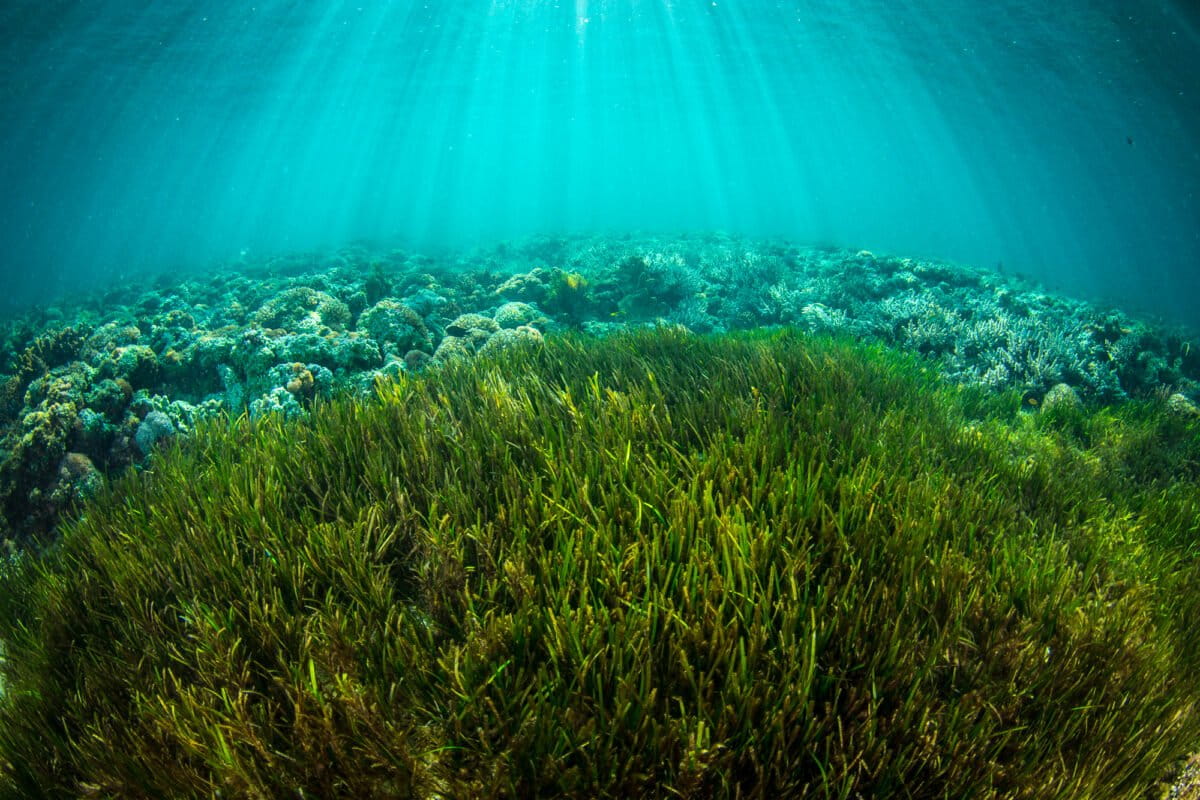
Banner image: Seagrass and coral reef off Lord Howe Island in Australia. The island, situated between the Australian mainland mainland and New Zealand, is near Lord Howe Rise and the Tasman Sea, areas that are viewed by conservationists as a potential site for the development of a high seas marine protected area. Image courtesy of Matt Curnock / Ocean Image Bank.
Citations:
Carmine, G., Cronin, M. R., Barkley, C., Tuohy, C. L., Crespo, G. O., Österblom, H., … Halpin, P. N. (2025). An expanded evaluation of global fisheries management organizations on the high seas. Environmental Research Letters, 20(12), 123001. doi:10.1088/1748-9326/ae1b1e
Zhou, H. (2023). Provincial variations and entrepreneurialism in the development of China’s distant water fisheries (2011–2020). Marine Policy, 147, 105344. doi:10.1016/j.marpol.2022.105344
Feedback: Use this form to send a message to the author of this post. If you want to post a public comment, you can do that at the bottom of the page.