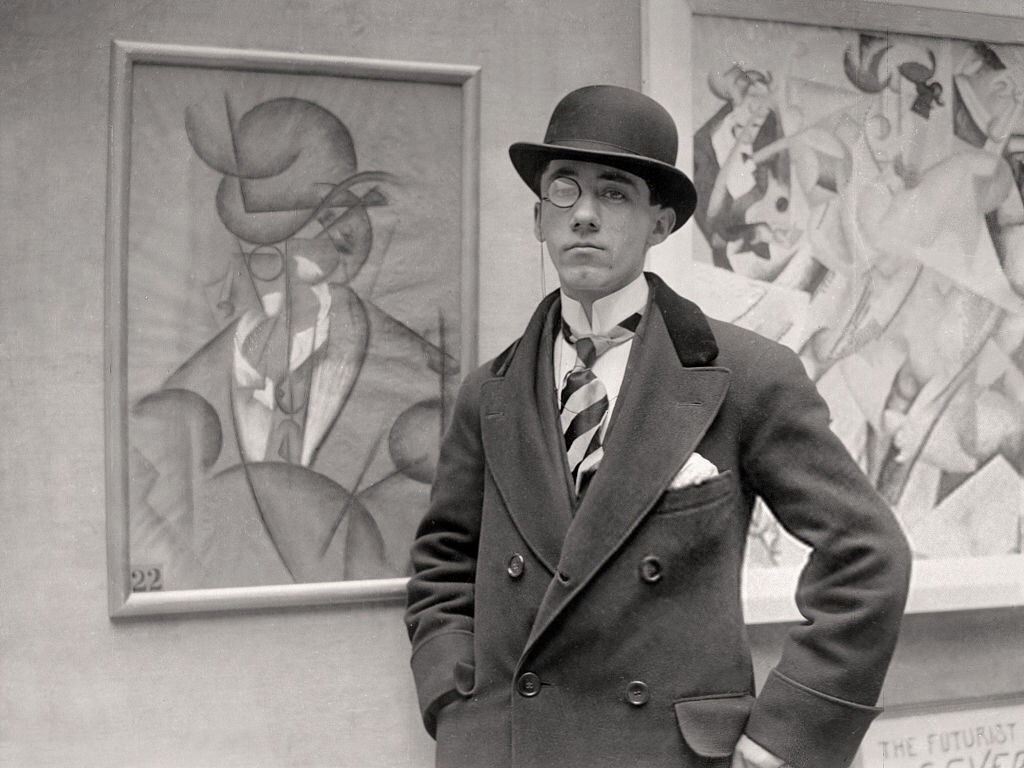
The painter and mosaicist Gino Severini was born on 7 April 1883 in the hilltop Tuscan town of Cortona. A leading figure in early 20th-century Italian art, Severini became one of the most internationally connected members of the Futurist movement, bridging artistic developments in Italy and Paris before moving through Cubism and later Neoclassicism.
Although closely associated with Italian Futurism, Severini’s work was never entirely typical of the movement. He was a signatory, alongside Umberto Boccioni, Carlo Carrà, Luigi Russolo and Giacomo Balla, of the 1910 Manifesto of Futurist Painters promoted by Filippo Tommaso Marinetti. Yet unlike many Futurists, who focused on machines and speed, Severini often depicted dancers, cafés and Parisian street life, exploring movement through rhythm, colour and human form.
Also read: Manifesto of Futurism published
From Cortona to Rome
Severini was born into modest circumstances. His father worked as a junior court official and his mother was a dressmaker. His formal education ended abruptly at 15 when he and classmates were caught attempting to steal exam papers. Expelled from school, he moved to Rome with his mother in 1899.
There he worked as a shipping clerk while studying art informally. He soon met Boccioni and Balla, who introduced him to divisionism and pointillism, techniques based on contrasting dots of colour. These methods would influence both Severini’s early paintings and the visual language of Futurism.
Severini lived in extreme poverty during this period, occupying a small storage room in a kitchen in Rome. Nevertheless, his artistic ambitions grew, and in 1906, encouraged by Balla, he moved to Paris, which he would later call his spiritual home.
Paris, Futurism and Cubism
In Paris, Severini settled in Montmartre and became part of the city’s avant-garde circles. He befriended Amedeo Modigliani and encountered Cubist pioneers including Pablo Picasso and Georges Braque. He also met artists such as Jean Metzinger, Albert Gleizes and Juan Gris.
Severini played a crucial role in connecting Italian Futurists with Parisian modernism. When Futurist artists visited Paris in 1911, they absorbed Cubist influences, particularly the fragmented depiction of the human figure in motion.
His own Futurist paintings often focused on nightlife and urban movement. Works such as Dynamic Hieroglyph of the Bal Tabarin (1912) and Le Boulevard (1913) captured the energy of Paris through flickering colour and rhythmic composition. He also produced notable Futurist war images, including Armoured Train (1915) and Italian Lancers at a Gallop (1915).
Dynamic Hieroglyph of the Bal Tabarin
From Futurism to classical order
After the First World War, Severini gradually distanced himself from Futurism. Influenced by Cubism, he moved towards a more structured style and later embraced a return to classical forms. His 1921 book Du cubism au classicisme outlined his theoretical shift toward order, proportion and tradition.
During this period he also married Jeanne Paul Fort, daughter of French poet Paul Fort. The couple struggled financially, and the death of their young son contributed to Severini’s renewed Catholic faith, which would shape his later work.
Mosaics, religion and controversy
From the 1920s onward, Gino Severini increasingly focused on frescoes and mosaics. He became associated with the Novecento Italiano movement and worked on public commissions during the Fascist period, including projects connected to the “Third Rome” vision promoted under Benito Mussolini.
He produced mosaics and decorative works for buildings such as the Palazzo di Giustizia in Milan, the University of Padua and projects within Rome’s EUR district. These collaborations attracted criticism from parts of the international art community, although his works were not overtly political.
Severini’s later religious mosaics earned him recognition as a pioneer of modern mosaic technique. One of his signature works, the Mosaic of San Marco (1961), adorns the façade of the Church of San Marco in Cortona.
Mosaic of San Marco
Final years
After the Second World War, Severini continued to receive commissions, including decorative work for airline offices such as Alitalia. He divided his time between Rome and Paris, remaining active into his later years.
Gino Severini died in Paris in 1966 at the age of 82. He was buried in his hometown of Cortona. Today he is remembered as one of the most progressive Italian artists of the 20th century, a painter who moved fluidly between movements and helped shape the dialogue between Italian Futurism and the wider European avant-garde.