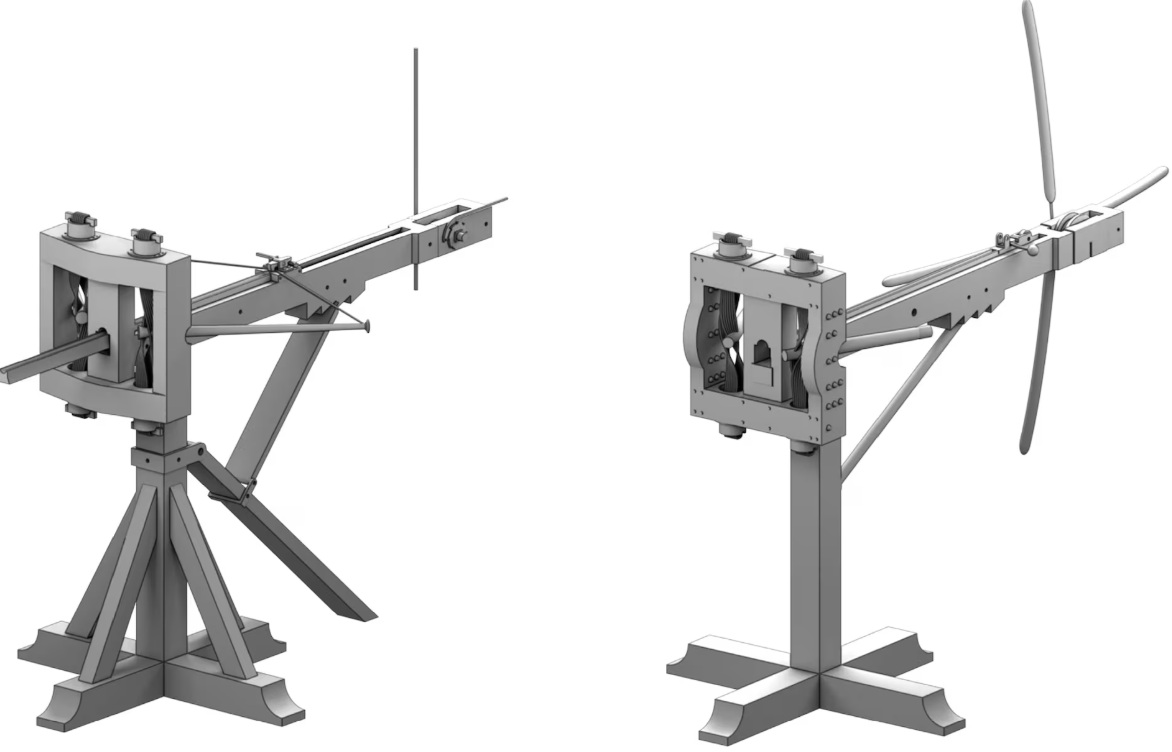
The ruins of Pompeii have once again rewritten the historical record, casting new light on the military technology of the ancient world. A team of Italian researchers has identified impact marks on the city’s northern defensive walls that they believe were made by a polybolos. The Greek-engineered repeating artillery weapon (‘machine gun’) was capable of firing multiple metal-tipped projectiles in rapid succession during the Roman siege of 89 BC.
The team, led by Adriana Rossi and Silvia Bertacchi from the University of Campania Luigi Vanvitelli, alongside Veronica Casadei from the University of Bologna, published their findings in Heritage magazine after five years of engineering analysis. The study was funded by Italy’s Ministry of University and Research as part of the SCORPiò-NIDI project.
A weapon known only through texts
No physical example of the polybolos has ever been found. It exists, so far, only in words. Its invention is attributed to Dionysius of Alexandria, and its mechanisms are described in detail by the Greek engineer Philo of Byzantium in the 3rd century BC.
Unlike standard catapults, the polybolos featured a wooden hopper magazine capable of holding several dozen bolts and a mechanical chain drive allowing it to fire multiple metal-tipped darts in rapid succession without manual reloading. For two millennia, the weapon occupied a curious space in the historical imagination: sophisticated enough to seem almost implausible, yet documented in too much engineering detail to dismiss.
The evidence in stone
The newly identified impact clusters are concentrated along Pompeii’s northern walls, particularly near the Vesuvio and Herculaneum gates. These were among the most vulnerable points of attack during the siege. These distinctive marks bear no resemblance to the circular impact signatures expected from ballista stones or sling projectiles. Instead, their geometry, spacing, and radial orientation point to multiple projectiles fired in rapid succession along nearly identical trajectories.
Impact marks on the north wall of Pompeii, whcih appear to be made by polybolos projectiles.
Image credit: Silvia Bertacchi
To build their case, Rossi’s team deployed an impressive suite of modern imaging tools: close-range photogrammetry, structured-light 3D scanning, and laser scanning, all working together to produce high-resolution 3D models of each impact site. The resulting virtual reconstruction allowed the researchers to compare the damage directly against Philo of Byzantium’s ancient description, and the correspondence proved compelling. Philo had even noted what he considered a tactical flaw of the weapon: that its darts did not disperse but concentrated along a narrow arc. That very feature corresponds precisely to the configuration the researchers observed on the walls of Pompeii.
Virtual model showing how the arc of the projectiles correspond with the holes in the stone wall.
Image credit: Silvia Bertacchi
The researchers noted that the wall damage had “miraculously survived” Roman rebuilding, Second World War bombing and natural disasters. The eruption of Vesuvius in AD 79, which entombed the city under metres of ash and pumice less than two centuries after the siege, played no small part in preserving these scars for the modern world to find.
Why Sulla had access to the ancient ‘machine gun’
The researchers also offer a persuasive explanation for how a Roman general came to deploy a weapon of Greek Rhodian design. In 96 BC, Sulla had served as governor of Cilicia, a province adjacent to Rhodes. This was the acknowledged centre of excellence in military engineering and artillery construction, where Philo himself had likely had contact with the master craftsmen of the Rhodian arsenal. It is therefore plausible that Sulla had access to an advanced version of the polybolos, potentially updated from the original model Philo had described more than a century earlier.
Researchers propose that the weapon was deployed primarily for anti-personnel purposes, targeting defenders positioned along the ramparts and between the merlons, rather than to demolish the fortifications themselves.
Could there be more ‘machine gun’ evidence buried in Pompeii?
The discovery carries implications well beyond Pompeii. With around a third of Pompeii still buried beneath volcanic material, researchers believe further discoveries about the polybolos may yet emerge. More broadly, now that archaeologists know precisely what kind of marks this weapon leaves on stone, similar traces may be identifiable at other fortifications from the same era; sites that were previously examined without the interpretive framework to recognise them.
For a weapon that existed, until now, only in the writings of ancient engineers, the walls of Pompeii have given it its first physical voice.
Sources: Heritage (Rossi, Bertacchi & Casadei, 2026), Ancient Origins, IFLScience, AOL/Popular Mechanics