- In drought-hit regions of Bangladesh, excavation and restoration of wetlands are crucial for local ecosystem and agriculture.
- An engineer at a government agency, A.K.M. Fazlul Haque challenges anomalies in wetland regulations around the country’s northern region.
- His efforts serve the community and biodiversity, and Fazlul’s story shows that conservation is a continuous struggle.
See All Key Ideas
The moment A.K.M. Fazlul Haque learnt that the government had declared two wetlands —Bharardaho Beel and Patuakamri Beel — located in Bangladesh’s northern district of Rangpur as the Special Biodiversity Conservation Area, he smiled with relief, he said.
“Our years-long conservation efforts have paid off,” was his immediate response.
In Bangladesh, a beel is defined as a large topographically low area that accumulates surface runoff water.
As a senior deputy-assistant engineer at the Barind Multipurpose Development Authority (BMDA), the state-run agency responsible for restoring surface water sources, Fazlul, in 2021 and 2023, led the excavation of the two beels that had almost disappeared from the landscape, having been transformed as silted crop field.
After excavating the 4.7 hectares (11.6 acres) of Bharardaho Beel, Fazlul and his peers volunteered the plantation of rare indigenous tree species along the ridges. When the BMDA team approached to excavate the nearby Patuakamtri Beel, illegal occupants attacked Fazlul physically and damaged his high-end photography camera, he said. Despite such obstacles, BMDA finally succeeded in the excavation of the 4.5 hectares (11.3 acres) of Patuakamri Beel.
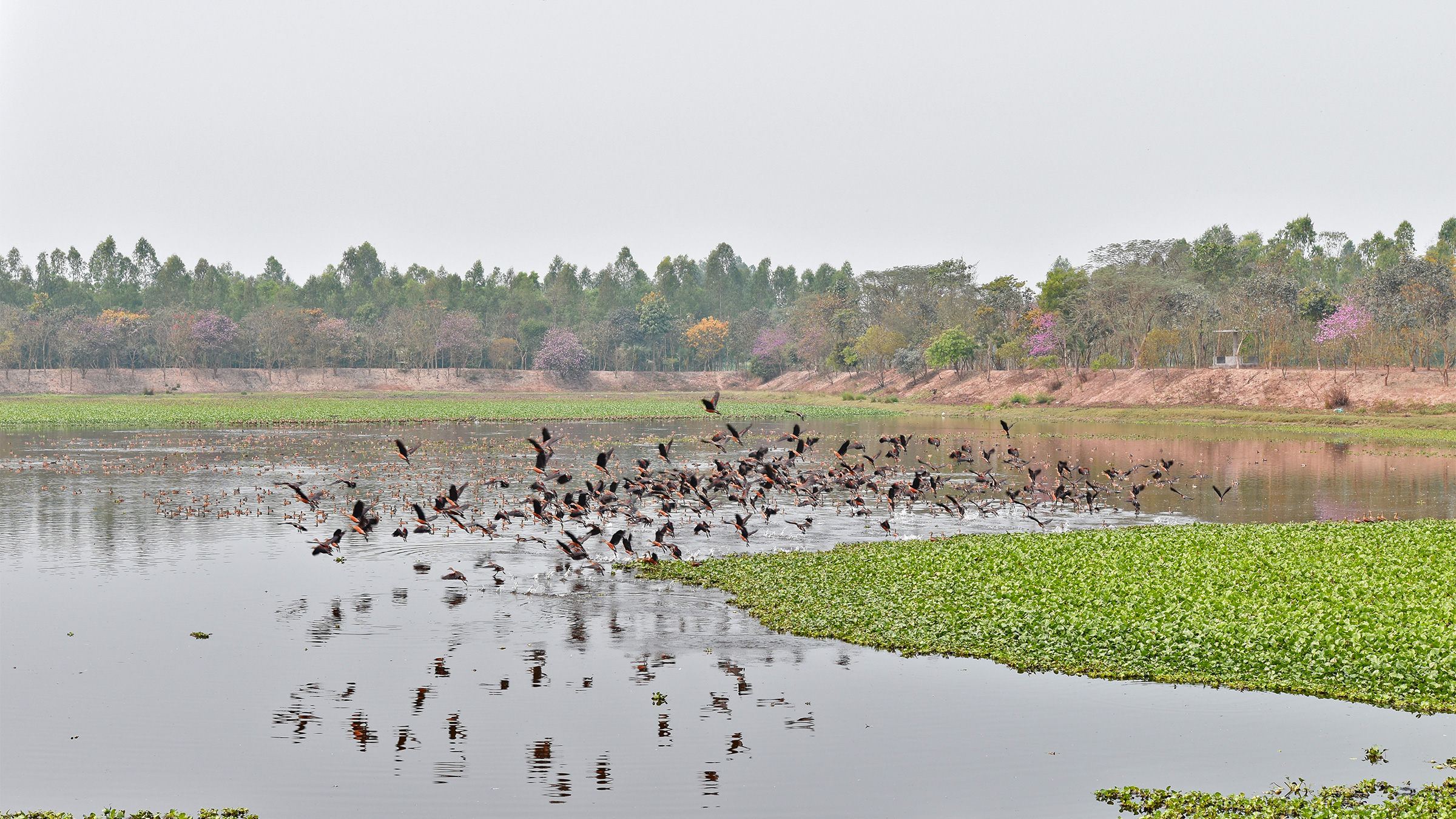
Today, both water bodies shelter hundreds of water birds, some of them migratory, and other wildlife around the year. Such conservation efforts are crucial to be replicated in such drought-prone northern regions of Bangladesh where wetlands are depleting fast, experts say.
A study published in November 2022 reveals that Bangladesh’s northwest region lost more than 57% of its total wetland area between 1989 and 2020.
Md Shafiqul Bari, a professor at the department of agroforestry and environment in Hajee Mohammad Danesh Science and Technology University in Dinajpur, Bangladesh, told Mongabay, “Conservation of wetlands in a drought-prone region is equally vital for protecting local ecology and national food security.”
A.K.M. Fazlul Haque (center) frequently visits Badarganj to monitor the restored beels. Farmer Atiar Rahman (right) walks with him here. Image by Sadiqur Rahman for Mongabay.
Illegal occupants of Bharardaho Beel drove away BMDA excavators on two consecutive days. Image courtesy of A.K.M. Fazlul Haque.
Re-emergence of the two beels
Based on oral history, Fazlul narrated the tales of Bharardaho and Patuakamri.
“The deep and swirling part of a mighty river is called a daho. One such daho existed in Badarganj subdistrict in the confluence of two rivers, the Chikli and the Goddangi,” he said.
The daho survived as a beel after Chikli River changed its course hundreds of years ago. Over time, it split into two parts: Bharardaho and Patuakamri.
Born and brought up in Badarganj, Fazlul knows the locality like the palm of his hand.
“The two beels were known as major fish hubs and water reservoirs of the area even 40-50 years back,” he recalled.
A Hindu community called Jugi developed their settlement around the water bodies. They used to collect mussels from the beels for food. From the shells, they produced lime which they sold to earn their livelihood, Fazlul said.
Fazlul joined BMDA in 1994 as a sub-assistant engineer and, before being posted in Badarganj, he worked in other northern districts — Rajshahi, Naogaon, Thakurgaon, Panchagarh and Rangpur.
Bharardaho and Patuakqmri beels shelter hundreds of water birds and other wildlife around the year. Image by Sadiqur Rahman for Mongabay.
Despite working elsewhere, he said, he remained concerned about the depleting wetlands in his birthplace, Badarganj.
He said that although the Bharardaho and the Patuakamri were listed as khas land (government-owned land), around 30 local individuals and their descendants gradually occupied and used them for agriculture illegally for 50 years, depriving the fishers of their rights to access the wetlands.
To facilitate the illegal land encroachment, a government agency even altered a river course. The local unit of the Bangladesh Agricultural Development Corporation (BADC) partially diverted the Goddangi River.
According to the local administration’s land documents, the Goddangi River flows along the northern side of Bharardaho Beel.
Between 2014 and 2019, instead of dredging the river in its original channel, the BADC re-excavated it through the middle of Bharardaho. Moreover, while the dredged soil was dumped into the beel, it filled up further and disappeared completely.
In a final effort to preserve the beel, Fazlul proposed its excavation, adding the component into a BMDA project for the 2019-25 period for the expansion of irrigation using surface water and rainwater conservation. His proposal was approved and he was posted at Badarganj to implement the excavation.
“Initiating excavation of the Bharardaho was a big challenge. Illegal occupants drove away our excavators on two consecutive days,” Fazlul recalled the tough days.
To expedite the excavation, Tuhin Wadud, one of the directors of the wetland conservation platform Riverine People, intervened and informed Asib Ahsan, then-deputy commissioner and custodian of the government-owned lands in Rangpur district, of the matter.
Eventually, with the support of local leaders and the district and upazila (sub-district) administrations, the excavation finally began on Dec. 31, 2020, and completed on Feb. 26, 2021.
Later, the Goddangi River on the northern side of the beel was also re-excavated as per the government land document.
Moreover, the excavation of Patuakamri Beel began on Feb. 2, 2023, and was completed on April 14 of the same year, says Fazlul, expressing his joy of freeing two wetlands from illegal occupants finally.
To facilitate the encroachment of the Bharardaho Beel, a government agency altered the course of Goddangi River. Image courtesy of A.K.M. Fazlul Haque.
After the project was completed, the local administration attempted to lease out the two beels for commercial fish farming to generate revenue.
But Fazlul wrote to the subdistrict administration on April 30, 2023, requesting the two beels be declared non-leasable “public easement.”
His rationale was, “Birds feed on the fish of the beels. Leasing them out would drive away the birds.”
Fazlul’s request was accepted.
Wadud, who is also a professor at Begum Rokeya University in Rangpur, Bangladesh, told Mongabay, “Government land encroachment not only reflects administrative failure but also indicates that a collusion of some dishonest officials within the administration facilitates this.”
He urged local community to resist attempts to encroach public wetlands and protect the environment they depend on.
Fazlul, Wadud and the Bharardaho-Patuakamri-Surokkha committee — a group of local volunteers — also led a planned forestation initiative along the ridges of the restored water bodies, planting more than 200 species. Within a year, the water bodies are a haven for waterbirds, including the migratory northern pintail (Anas acuta).
Local farmer Atiar Rahman, 52, tells Mongabay how beels are important for agriculture.
“As the birds have made the beels and the surrounding forests their habitat, harmful insects in the nearby crop fields have almost gone,” Atiur says.
Fazlul and his peers volunteered the plantation of rare indigenous tree species along the ridges. Image by Sadiqur Rahman for Mongabay.
Conservation is a continuous struggle
Now promoted to assistant engineer of the same organization but posted at another district, Fazlul frequents Badarganj to monitor the restored beels.
He said he often feels that conservation of natural resources is a continuous movement.
“The previous illegal occupants were none but the neighbors. Some of whom still try to damage the natural resources of the beels,” he lamented.
In February, Atiur, who volunteers to guard the beels, encountered some intruders who, in the dark, hung a long fishing net circling a portion of the beels and set fire to a tree so that the roosting birds would fly in fear and get trapped in the net.
As Atiur raided the spot, the intruders fled, he said.
However, he doesn’t succeed every time, Atiur said: Illegal logging and fishing are posing threats to the beels. “That’s why we have written to the local administration to allocate budget for enclosing the beels with grade beam fence so that cattle and humans cannot trespass.”
He’s also been fighting for the restoration of the 30 hectares (74 acres) of Untar Beel, another wetland much larger than the Bharardaho and the Patuakamri.
Untar Beel is also being encroached. Image by Sadiqur Rahman for Mongabay.
Thirty-five-year-old farmer, Taherul Islam who lives close to Untar Beel, said, “An influential political elite group has been exploring the beel resources [land] for generations.”
Taherul is a member of a cooperative of fishers. According to him, gradual encroachment of beel land and their transformation to crop fields has reduced fish breeding grounds. Regarding this, Fazlul said he keeps lobbying the government to bring the Untar Beel under a restoration project.
Banner image: Bharardaho Beel shelters hundreds of water birds and other wildlife around the year. Image by Md Mehedi Hasan.
A Ramsar site in Bangladesh fast loses its fish diversity amid government inaction
Citation:
Haider, A. B. M., Hassan, M., & Rasib, A. (2023). Geospatial approach to wetland vulnerability assessment for northwest Bangladesh. The International Archives of the Photogrammetry, Remote Sensing and Spatial Information Sciences, 48(4/W6-2022), 139–143. doi:10.5194/isprs-archives-XLVIII-4-W6-2022-139-2023