COURTESY DLNR
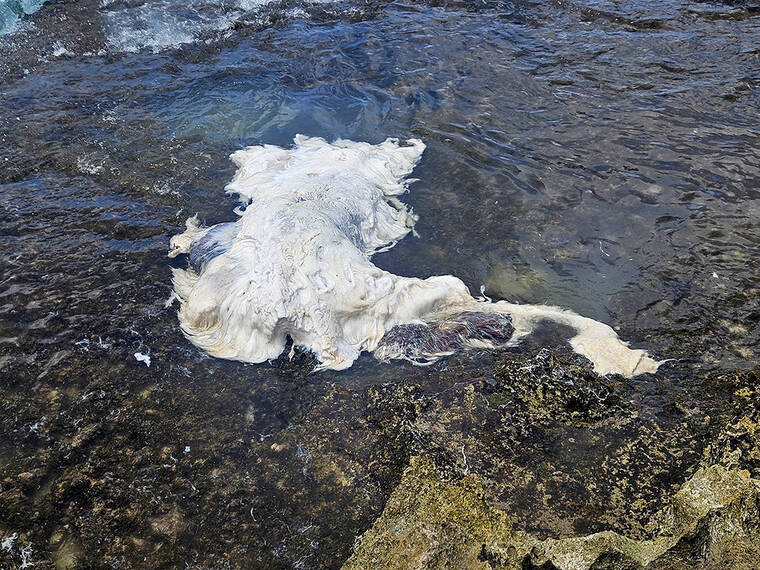
The Hawaii Department of Land and Natural Resources announced last Friday that blubber, bones and other remnants were washing ashore between Nanakuli Beach Park and Barbers Point, which attracts predators such as tiger sharks.
State officials are continuing to ask the public to stay clear of sperm whale carcass parts that may still be floating along Oahu’s southwest coast.
The Hawaii Department of Land and Natural Resources announced last Friday that blubber, bones and other remnants were washing ashore between Nanakuli Beach Park and Barbers Point, which attracts predators such as tiger sharks.
According to DLNR, there have been a few incidences of people trying to get too close, but cultural practitioners continue to remain on watch. A perimeter has also been put in place.
The largest sections of the tail — previously just outside of the Ko Olina Lagoon areas — have been removed by cultural practitioners and the University of Hawaii, while other pieces floated toward Barbers Point, DLNR said.
Smaller pieces of blubber that may still be in waters and on the rocks and sand in the area, and visitors should avoid contact with them. The head section, meanwhile, is still floating in the same area.
DLNR asks the public not to swim in or near areas where remnants are found, nor touch or interact with remains of any size along the shoreline. Cultural practitioners ask the public to refrain from drones, photography, video and social media posting out of respect for the kupuna palaoa, or endangered sperm whale.
Don’t miss out on what’s happening!
Stay in touch with breaking news, as it happens, conveniently in your email inbox. It’s FREE!
DLNR is monitoring the whale’s remains in partnership with the cultural practitioners, UH Marine Mammal Stranding Lab and National Oceanic and Atmospheric Administration.
All marine mammals, living or dead, are protected under the Marine Mammal Protection Act. Sperm whales are protected under the federal Endangered Species Act. Additionally, the taking of marine mammal parts is prohibited.
“The Division of Aquatic Resources advises that people leave any pieces of whale carcass where they find them,” said DLNR in the release. “These remnants will naturally biodegrade back into the environment and continue to provide food for the birds, crabs, smaller fish and other wildlife who make their homes in Hawaii’s ocean and coastal ecosystems.”
Violations can be reported to 808-643-DLNR.