- New satellite data show that deforestation in Indonesia surged in 2025, up 66% from the previous year, marking a sharp reversal after several years of decline.
- The implications extend beyond forest loss, as rising deforestation could derail Indonesia’s climate goals, including its target of turning the forestry and land use sector into a net carbon sink by 2030.
- NGO Auriga Nusantara points to policy decisions under both the current and former administrations; at the same time, government-backed projects have been allowed to expand into forest areas, often without adequate spatial planning.
See All Key Ideas
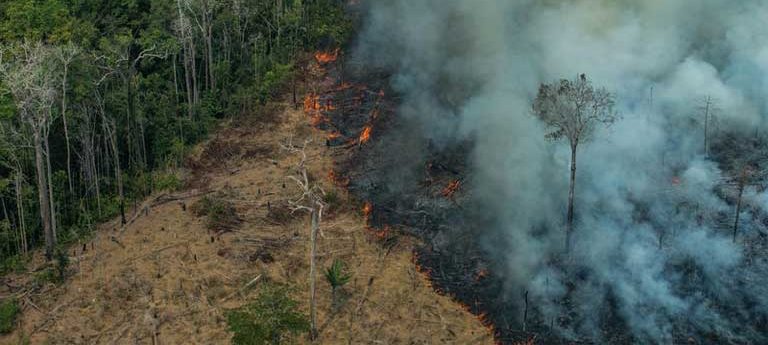
JAKARTA — Indonesia’s deforestation surged in 2025, rising 66% from the previous year, marking a sharp reversal after several years of decline, according to new data from the NGO Auriga Nusantara.
Based on satellite analysis, Auriga estimates that 433,751 hectares (1.1 million acres) of forest, an area more than twice the size of London, were lost in 2025, the highest level in eight years.
Forest loss had previously fallen to a historic low in 2021, following five consecutive years of decline since 2017, driven in part by a series of forest protection policies under former President Joko Widodo. But since 2022, the trend has reversed, with deforestation rising again before spiking in 2025 across all of Indonesia’s major islands.
“The surge in deforestation in 2025 is truly distressing, taking Indonesia back to a time when it was at its highest,” said Auriga executive director Timer Manurung.
The trend stands in contrast to developments in the Amazon, where deforestation has declined for three consecutive years following renewed enforcement and federal efforts under Brazil President Luiz Inácio Lula da Silva. In 2025, deforestation in the biome fell 11.1% to 579,600 hectares (1.4 million acres), the lowest level in more than a decade.
“Brazil’s deforestation, concentrated in the Amazon, is declining. Meanwhile, Indonesia’s is increasing. So it’s possible Indonesia could become the world’s top deforester among tropical countries in 2025,” Timer said.
Auriga’s findings are broadly consistent with early signals from official data. While the government has yet to release full-year figures for 2025, available data show Indonesia lost more forest in the first nine months of the year than the annual totals for any of the first three years of this decade.
Gross deforestation in 2025 was on track to at least match 2024 levels, the highest since 2019, Forestry Minister Raja Juli Antoni told lawmakers in December 2025.
Forestry Deputy Minister Rohmat Marzuki said Auriga had presented the findings to the ministry and the government welcomed them.
“We are very open to it. We appreciate input, suggestions and even criticism from various parties,” he told Mongabay.
The implications extend beyond forest loss. Riko Wahyudi, a senior researcher at the Research Center for Climate Change at the University of Indonesia, warned that rising deforestation could derail Indonesia’s climate goals, including its target of turning the forestry and land use (FOLU) sector into a net carbon sink by 2030.
Based on official data submitted to the United Nations, emissions from the FOLU sector have exceeded the levels required to meet Indonesia’s climate targets in every year since 2019 through the latest available data in 2022. This suggests emissions reductions remain insufficient as forest loss continues.
“With increasing deforestation in 2025, it will be even more challenging,” Riko said. “Even in 2020-22, during the COVID-19 pandemic, when mobility dropped and logging slowed, we still didn’t meet our targets.”
Emissions from Indonesia’s FOLU sector from 2010 to 2022.
He added that emissions from the FOLU sector are likely to rise further when Indonesia submits updated data to the U.N. later this year.
Indonesia ranks among the world’s top greenhouse gas emitters, typically between fifth and sixth globally, with emissions driven largely by land use change, deforestation, peat degradation and coal use.
Monoculture tree plantation replacing logged areas of forest in PT Toba Pulp Lestari (TPL)’s concession. Image courtesy of Eartsight/Auriga Nusantara.
Drivers of deforestation
Auriga points to policy decisions under both the administration of former President Widodo and the current government of President Prabowo Subianto as key drivers behind the reversal.
During Widodo’s second term, environmental protections weakened, particularly with the passage of the omnibus Job Creation Law, which removed requirements such as maintaining a minimum of 30% forest cover in each region.
At the same time, government-backed projects, especially those classified as National Strategic Projects (PSN), have been allowed to expand into forest areas, often without adequate spatial planning.
The Prabowo administration has largely continued this approach, including pushing ahead with the large-scale food estate program aimed at boosting food and energy security.
The government has allocated 20.6 million hectares (50.9 million acres) of land for the program. Auriga found that 78,213 hectares (193,000 acres), or 18% of national deforestation, occurred within these designated areas.
Timer described this as “planned deforestation,” arguing that current policy priorities are driving forest loss.
Land clearing already started to make way for sugarcane plantation in Merauke, South Papua, Indonesia. Image courtesy of Yayasan Pusaka.
Food estate expansion in Papua
Papua, the center of the food estate program, recorded a 348% increase in deforestation in 2025, with 77,678 hectares lost (192,000 acres).
This makes Papua the third-largest deforestation hotspot, behind Kalimantan and Sumatra, which have long been affected by industrial expansion.
In South Papua alone, rice plantation development linked to the program cleared 5,934 hectares (14,700 acres) of forest as of October 2025, while a separate sugarcane project cleared 15,643 hectares (38,700 acres) as of January 2026.
With Papua still home to around 28 million hectares (69.2 million acres) of intact forest, the largest remaining in Indonesia, conservation groups say the region is critical.
“Now that deforestation is shifting eastward, Papua must be seen as a region that needs to be protected,” said Agung Ady Setiyawan of Forest Watch Indonesia.
Responding to concerns, Rohmat said safeguards are in place, including spatial planning reviews involving multiple agencies to exclude conservation areas, high-value ecosystems and customary lands.
“The aim is to ensure natural forests are not affected,” he said. “Primary forests remain protected.”
However, Mongabay previously reported that the government reclassified 486,939 hectares (1.2 million acres) of forest in South Papua as nonforest land to enable the project, making those areas legally available for clearing.
Indigenous communities say the reclassification was carried out without consultation and overlaps with areas they have long proposed as customary forests, raising concerns over land rights and displacement. The move has prompted formal objections.
Forestry Ministry spokesperson Ristianto Pribadi said such projects would not be halted but improved through better monitoring and evaluation to ensure forest and biodiversity protections are upheld.
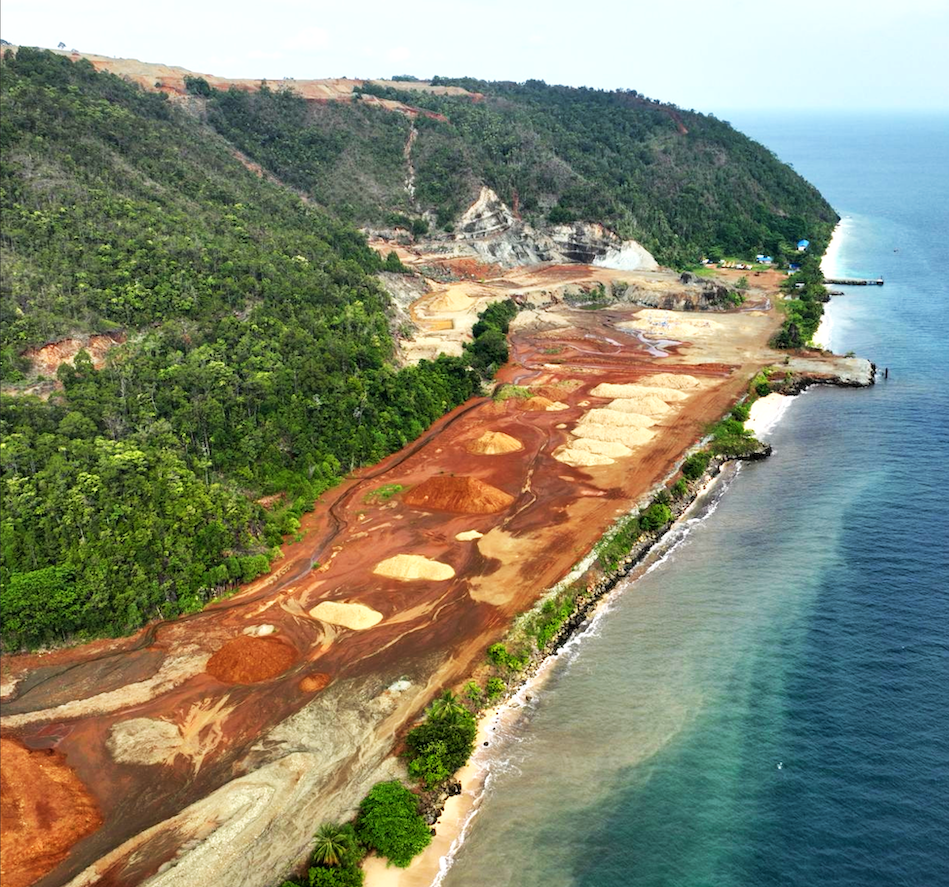
Deforestation for nickel mining in Gag Island, Raja Ampat, Indonesia. Image courtesy of Auriga Nusantara.
Electrification
Another driver of deforestation is Indonesia’s push to become a global hub for electric vehicle (EV) production, a policy closely tied to its vast nickel reserves.
Nickel mining and processing have expanded rapidly over the past decade, driven by rising global demand for EV batteries. Under former President Joko Widodo, the government pursued an aggressive downstreaming policy, triggering a surge in smelter construction, from just a handful before 2014 to dozens today. The buildout has extended beyond processing plants, opening up new forest areas for mines, roads and other supporting infrastructure.
The expansion is most visible in Sulawesi and North Maluku, where Indonesia’s largest nickel deposits are located.
Auriga says the way permits are issued is part of the problem: Approvals for smelters and processing industries are not always tied to clearly defined sources of raw materials, effectively pushing companies to secure supply from new areas, often at the expense of forests.
For Timer, the nickel boom exposes a deeper tension in Indonesia’s energy transition. Electrification is widely promoted as a climate solution, he said, but on the ground it is also driving land clearing.
He noted that areas with nickel potential are often treated as open for exploitation, with no meaningful “no-go zones” to protect remaining forests. “If mining must happen, it should only take place in areas that are acceptable and tolerable,” he said.
Timer also pointed to longer-term risks that remain unresolved, including post-mining rehabilitation and the cumulative impact of industrial expansion.
In his view, the rush to supply global EV demand risks repeating a familiar pattern, which is rapid extraction without sufficient safeguards.
Tropical logs from deforestation in PT Indosubur Sukses Makmur being loaded onto a truck, January 2025 © Auriga / Earthsight
Industrial deforestation
Beyond government programs, corporate activity continues to drive forest loss, with 44%, or 189,970 hectares (469,500 acres), occurring inside licensed concessions.
Forestry concessions account for the largest share, followed by mining and oil palm plantations. This underscores the extent to which deforestation remains tied to legally permitted industrial concessions.
Palm oil expansion appears to be shifting eastward, particularly into Papua, as land becomes scarcer in Sumatra and Kalimantan.
An analysis by technology consultancy TheTreeMap found that palm-oil-driven deforestation in Papua doubled in 2025, reaching 7,333 hectares (18,100 acres) cleared compared with 3,510 hectares (8,700 acres) in 2024, marking the highest annual level since 2018.
The government’s biodiesel policy may be contributing to this trend. President Prabowo has signaled plans to expand biodiesel use, including a 50% palm oil blend (B50).
“We are going in a big way to biofuel,” Prabowo said, as quoted by Reuters.
Prabowo had also previously called for palm oil expansion by arguing that oil palm plantations are like forests, stating “oil palms are trees. … They’ve got leaves.’”
“And I think in the future, we also need to plant more palm oil. We don’t need to be afraid of endangering — what’s it called — deforestation, right?” Prabowo said.
Timer said such policies and statements could accelerate forest clearing if safeguards are not strengthened.
“Without safeguards for natural forests, oil palm expansion will inevitably move into forested areas,” he said.
Banner image of an adult and baby orangutan at Betung Kerihun National Park in Indonesian Borneo, by Sabar Minsyah via Wikimedia Commons (CC BY-SA 4.0).
Biodiversity under pressure
Auriga’s data show deforestation is also affecting ecologically important areas beyond officially designated conservation zones, such as wildlife habitat and Key Biodiversity Areas.
Together, these areas cover 63.5 million hectares (156.9 million acres). In 2025, deforestation within these areas reached 186,465 hectares (460,700 acres), or 43% of the national total.
Losses were particularly severe in habitats for endangered species, including Sumatran tigers, elephants and rhinos, as well as orangutans in Kalimantan.
Within 29 million hectares (71.7 million acres) of habitat for tigers, elephants, rhinos and orangutans, deforestation reached 156,463 hectares (386,700 acres).
“These endangered species are becoming even more threatened as their forests disappear,” Timer said.
In response to concerns over the loss of habitat for rare species such as rhinos, tigers and orangutans, the Ministry of Forestry said biodiversity protection remains a priority.
The ministry noted that challenges on the ground persist, both from land use change pressures and illegal activities.
To address this, the government is strengthening conservation efforts through the designation and management of protected areas, habitat protection patrols, forest rehabilitation and collaboration with a range of stakeholders, including local communities, academics and international organizations.
Auriga noted that this approach leaves gaps, as conservation policy remains focused on formally designated areas rather than the broader ecological landscape where wildlife habitat and Key Biodiversity Areas exist beyond officially designated conservation zones.
Stacks of logs near newly cleared areas in PT Toba Pulp Lestari (TPL) concession in North Sumatra, Indonesia, in December 2025. Image courtesy of Earthsight/Auriga Nusantara.
Why the numbers differ
While the government has welcomed Auriga’s findings, officials point to differences in methodology.
“There will inevitably be a margin of error,” Rohmat said, referring to the use of AI and satellite analysis.
Auriga, however, said differences in figures reflect different approaches rather than inaccuracies.
“All data are valid, as long as they adhere to their respective methodologies,” Timer said. “Methodology is what sets these data sets apart.”
Some data sets track tree cover loss broadly while others, like the ministry, count only permanent deforestation. Auriga includes both permanent and temporary loss, capturing early-stage clearing that may later be confirmed or reversed.
Global Forest Watch tracks tree cover loss over time using a fixed baseline while excluding young secondary forests in its tropical forest analysis. Auriga, by contrast, uses a composite forest map updated over time, allowing it to capture regrowth and subsequent clearing.
“One of the differences is that they do not capture young secondary forests, whereas we do,” Timer said. “In tropical regions, these forests can be highly biodiverse.”
The scale of detection also plays a role. Auriga tracks forest loss down to a quarter hectare (0.6 acres), capturing small, scattered clearings that may not appear in data sets with larger thresholds.
Officials say small patches can still be detected but are not always classified as permanent deforestation in national statistics.
Auriga combines machine learning with manual verification and field checks and filters out natural disturbances such as landslides.
“We were surprised by the numbers ourselves,” said Auriga data director Dedy Sukmara. “That’s why we applied strict quality control. And yes — the numbers are what they are.”
Tropical forest cleared by PT Indosubur Sukses Makmur in Borneo, January 2025 © Auriga / Earthsight
What comes next
Timer said stronger policy is needed, including a presidential regulation to protect all remaining natural forests.
“The idea is that any deforestation in natural forests, whether in conservation areas, non-forest land or private land, should be considered illegal,” he said.
He added that incentives such as carbon trading could help ensure forest protection does not come at the expense of livelihoods.
“That way, the public can more easily help protect forests because any deforestation would clearly be illegal,” he said.
Banner image: Nickel mining on Manuran Island. Image courtesy of Auriga Nusantara.
FEEDBACK: Use this form to send a message to the author of this post. If you want to post a public comment, you can do that at the bottom of the page.