All of the world’s leading steelmakers, including Luxembourg’s ArcelorMittal and Ternium, are nowhere near ready to transition to near-zero carbon emissions production, according to a study by a civil society group monitoring the sector.
The Steelwatch Corporate Scorecard, published on Tuesday, assessed 18 major steelmakers around the globe on their progress towards phasing out coal-based production and scaling up green energy.
Despite many companies “committing to long-term climate goals, coal dependence remains the norm”, Steelwatch said, adding that “none are currently ready to transition to near-zero-emissions production”.
‘Big gaps to bridge’
“Embarrassingly, not a single steelmaker has scored above 50 points out of 100, and even those at the head of the pack have big gaps to bridge before they can claim to be acting responsibly on the climate crisis,” said Caroline Ashley, SteelWatch Executive Director.
The report assessed steelmakers across five categories, including phasing out coal, climate performance and targets and transparency. It then scored them out of 100 and ranked them against each other.
It ranked Luxembourg-based steelmakers, ArcelorMittal and Ternium third and fourth respectively. It scored ArcelorMittal 33.5 and Ternium 31.8 out of 100.
Steelwatch placed SSAB and thyssenkrupp at the top of the ranking and said they were the only two companies to “break away from the pack” and start to “put the foundations in place” for a full transition to near-zero emissions.
ArcelorMittal rejects climate criticism after OECD complaint
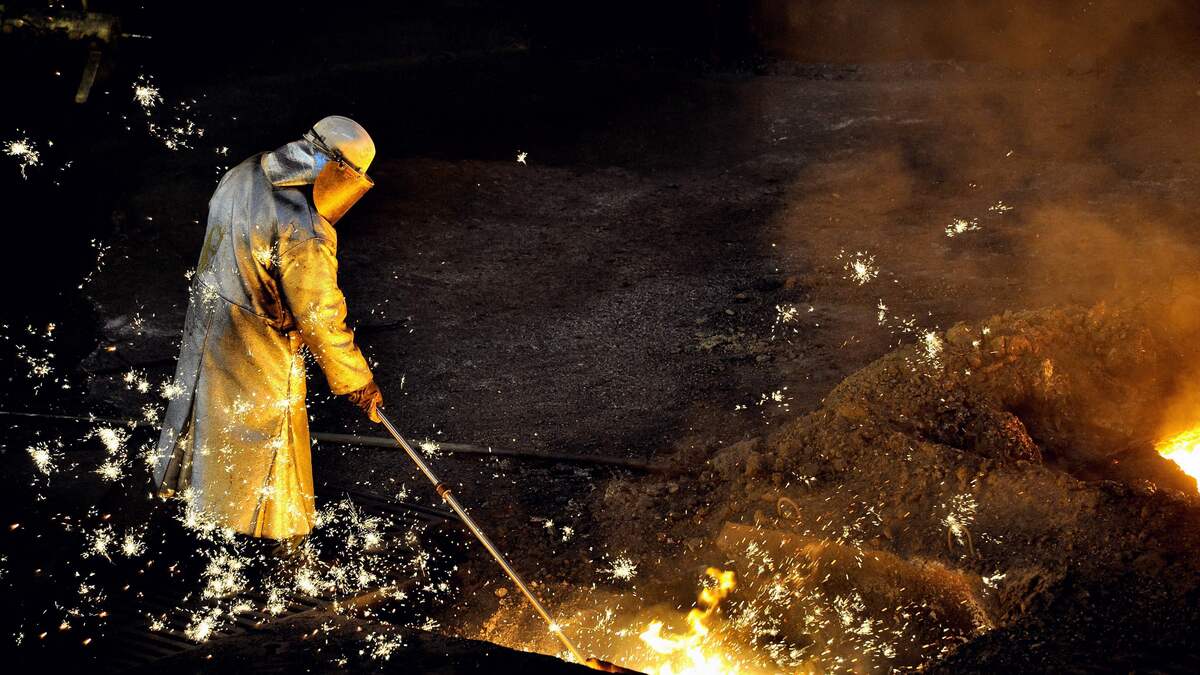
Although ArcelorMittal has “seen modest declines in GHG [greenhouse gas] intensity over four years due to a modest uptake of EAFs [electric arc furnaces] and disposal of dirtier coal-based assets”, the report noted, it added that the steelmaker “still relies on blast furnaces for 87% of its ironmaking capacity.”
Keeping track of targets
Only two steelmakers, SSAB and thyssenkrupp, have adopted Science Based Targets initiatives (SBTis) verification for their commitments to reach net-zero by 2050, the report said. SBTi is a network established in 2015 to assist companies in setting emission targets in line with science-based evidence, and allows firms to have their progress towards those targets checked and validated.
Although ArcelorMittal has also adopted the mid-century target, the report said that “without SBTi verification, it is difficult to assess the pace at which change is planned. A 2050 target alone does not guarantee serious action today.”
“Ternium, by contrast, has a carbon neutrality ambition with no target year, placing it among a small group of outliers,” the report said.
The score attributed to ArcelorMittal “reflects incremental progress across a very large and diversified global asset base”, Steelwatch said, “rather than a decisive shift away from coal-based steelmaking”.
“It has stalled all of its recently announced projects for low-emissions ironmaking, missing the marks for transition readiness,” the report found.
Three key actions
The civil society group has urged ArcelorMittal to adopt SBTi-verified climate targets and retirement plans for all existing blast furnaces, as well as invest in large scale hydrogen DRI [direct reduced iron] projects.
ArcelorMittal backs out of subsidised green-steel transformation
Ternium, which is headquartered in the Grand Duchy but with production in Central and South America, has demonstrated “moderate progress”, Steelwatch said.
“While the company has shown operational improvements in emissions intensity and near-zero emissions-capable iron production, it lacks long-term strategic commitments, such as a net-zero target with a date or blast furnace retirement plans,” the report found.
The report praised both Luxembourg steelmakers for their disclosure of data, with ArcelorMittal at “an above-average level of transparency” and reporting transparency described as “a notable strength for Ternium, with the company achieving the highest transparency score in this category among all companies assessed”.
Activists file complaint in Luxembourg over missing human rights defenders
Challenges not limited to steel industry
Responding to the report, an ArcelorMittal spokesperson said that the findings reflected challenges not limited to the steel industry.
“Even beyond steel, it is increasingly understood, including by the International Energy Agency (IEA) in its World Energy Outlook 2025, that limiting the global average temperature increase to 1.5°C, with a limited overshoot, will be hard to guarantee, reflecting a challenge shared across all areas of the economy,” the ArcelorMittal spokesperson said.
Luxembourg companies linked to thousands of pollution deaths
“ArcelorMittal’s carbon footprint has changed markedly since 2018, with emissions reducing by 47.7% on a historical basis (including divestments),” the spokesperson said. “When policy aligns, we are able to take final investment decisions – earlier this year we announced that a new EAF would be built in Dunkirk, to replace one of the two blast furnaces. EAF-based production now represents around 26% of the group’s steel output (up from 19% in 2018).”
ArcelorMittal is “actively investing in supporting and enabling the energy transition”, the spokesperson added, through measures including “investing directly in renewables energy projects and growing our portfolio of high-quality solutions for buildings and mobility, including high margin electrical steels for EVs.”
Ternium did not respond to a request for comment by the time of publication.