On 29 March 1516, the Doge of Venice signed a decree that changed a word forever. The small island in the Cannaregio quarter to which Venice’s Jewish population was confined would give its name — ghetto — to every enforced urban segregation in history.
In 1516, in the chancery of the Palazzo Ducale, a decree was drawn up in the name of Doge Leonardo Loredan and sent out into a city still arguing about what to do with its Jewish population. The document was not born of a single ideology or a sudden hatred. It emerged from a long, heated debate in the Republic’s governing council, from centuries of unresolved tension between commerce and faith, from the pressure of the Catholic Church and the anxieties of Venetian merchants, and from a pragmatic calculation that would define European urban life for centuries. It created the world’s first ghetto, and in doing so, gave the word itself to global languages.
The Jews of Venice had been living under accumulating restrictions since the thirteenth century, confined to the main islands only on temporary tolerated-residence permits, banned from most professions, required since 1394 to wear yellow circles of identification (later changed to yellow hats, then red ones for Jews from the Levant). But they had never been compelled to live in a single designated area. The 1516 decree changed that. It directed the entire Jewish community to move to a small island in the northwestern corner of the Cannaregio sestiere. The island connected the rest of Venice by only two bridges, both of which would be fitted with heavy gates that were locked each night from sunset to sunrise, patrolled by watchmen whose wages the Jewish community itself was required to pay.
A Venetian compromise – designated living space vs expulsion
Aerial view of the Ghetto in Venice
It would be too simple, however, to read the 1516 decree as pure persecution. Venice in the early sixteenth century was, by the standards of its age, a remarkably tolerant city. The debate that preceded the decree reflected genuine complexity. The Republic’s governing council recognised, explicitly, that Jewish merchants and moneylenders had become vital to Venice’s economy. They provided credit for military campaigns, traded in cloth and grain that kept the Republic provisioned, and ran the pawnshops that served a population too poor to borrow from the great banking houses. The Third Lateran Council of 1179 had forbidden Christians from charging interest on loans, creating a vacuum that Venice’s Jewish community largely filled. To expel them, as many European cities had already done, would be commercially damaging. To leave them entirely unconstrained would be theologically and politically untenable.
The 1516 decree was therefore a compromise, characteristic of the Republic’s pragmatic governing tradition. Jews could live in Venice, indeed but only in this designated space. They could work anywhere in the city during daylight hours. They could trade, lend, practice medicine, deal in cloth and second-hand goods. The Jews could worship in their own synagogues, run their own institutions, maintain their own community. When the gates closed at night and the watchmen took up their posts, it was enforced confinement. However, within that confinement, there was a life of unusual richness.
Venetian Ghetto expanded
As waves of persecution swept through the rest of Europe, the Venice Ghetto filled. Jews expelled from Spain and Portugal after 1492 arrived with their Sephardic traditions, their Spanish and Ladino languages, their distinctive dress. Those from the eastern Mediterranean brought with them the tastes and habits of the Ottoman world that made the modest, dark clothing of the German Ashkenazi Jews look austere by comparison. Jews from the Veneto, displaced by the Habsburg army’s devastation during the War of the League of Cambrai, swelled the population further. By the seventeenth century, more than 5,000 people were living on an island originally designed for a fraction of that number.
The consequences of overcrowding were severe. The Venetian authorities, recognising the problem, passed special laws permitting buildings in the Ghetto to be raised to a third taller than those in the rest of the city. Unscrupulous landlords, mostly Christian Venetians, charged exorbitant rents and instructed builders to cram as many floors as possible into the permitted height. The result is the Ghetto’s most distinctive visual feature, visible to this day: a row of extraordinarily tall buildings, some reaching eight or nine floors, their windows tiny, their ceilings low, their staircases steep and narrow. They look like nothing else in Venice.
Jewish culture thrived nonetheless
And yet the area became the centre of a genuinely remarkable culture. Five synagogues were built each reflecting the distinctive aesthetic traditions of its congregation. There was a theatre, an academy of music, literary salons where scholars debated Talmud and philosophy, an inn, and a hospital.
The Venetian Ghetto produced poets, physicians, financiers and musicians. Leone da Modena — rabbi, poet, and controversialist — served the community in the early seventeenth century and wrote works read across Europe. Sara Copio Sullam, a poet and intellectual, conducted one of the most celebrated literary correspondences of the Italian baroque era from an address in the Cannaregio.
Freedom courtesy of Napoleon Bonaparte
Freedom, when it finally came, arrived with characteristic Venetian irony: at the hands of a foreign conqueror. Napoleon Bonaparte, who had just dismantled a thousand years of the Serenissima in the spring of 1797, ordered the gates of the Ghetto torn down and declared Venice’s Jews equal citizens. The wealthier inhabitants left immediately, purchasing properties elsewhere in the city. Some, with considerable symbolism, acquired palaces on the Grand Canal. But many of the poorer residents stayed, and when the Austrian administration that replaced the French shortly reimposed restrictions, those who had not already left were forced back. Full emancipation came only with Venice’s incorporation into the unified Kingdom of Italy in 1866, 350 years after the original decree.
The darkest chapter came last. In September 1943, Italy signed an armistice with the Allies and Germany occupied northern Italy. The following year, 246 Jewish residents of Venice were rounded up and deported to Auschwitz and other camps. Of those 246 people, only eight survived. A series of bronze reliefs on the wall of the Campo di Gheto Nuovo, installed in 1980 by the sculptor Arbit Blatas, commemorates the deportation.
Memorial to Holocaust victims in Venice’s Ghetto
Etymology of the word ghetto
The most widely accepted etymology traces the word to geto — the Venetian dialect word for a foundry or iron foundry. The island in Cannaregio had, until the early 16th century, housed a factory producing heavy iron cannons for the Venetian fleet. When the Jewish community moved in, the name came with the place.
The spelling and pronunciation histories have been debated for centuries. The geto of the Venetian dialect has a soft ‘g’, as in the Italian word gente. The early inhabitants of the area were primarily German-speaking Ashkenazi Jews, who pronounced it with a hard ‘g’, as in get — hence the addition of an ‘h’ to harden the sound in writing. The double ‘t’ that appears in standard Italian and in most European languages is more recent still, though street signs in Venice to this day maintain only a single ‘t’: Gheto.
Whatever its precise path through spelling and pronunciation, the word travelled. By the 17th century it was being used metaphorically across Europe to denote any overcrowded urban district inhabited by a single ethnic or religious group. By the 20th century, and especially after the horrors of the Nazi-established ghettos in Warsaw, Łódź, Kraków and hundreds of other cities, it had acquired its modern weight: enforced racial segregation, deprivation, and the prelude to annihilation. All of that is in the word. All of it began here, in a disused cannon foundry on a Venetian island, on 29 March 1516.
Visiting Venice’s Ghetto today
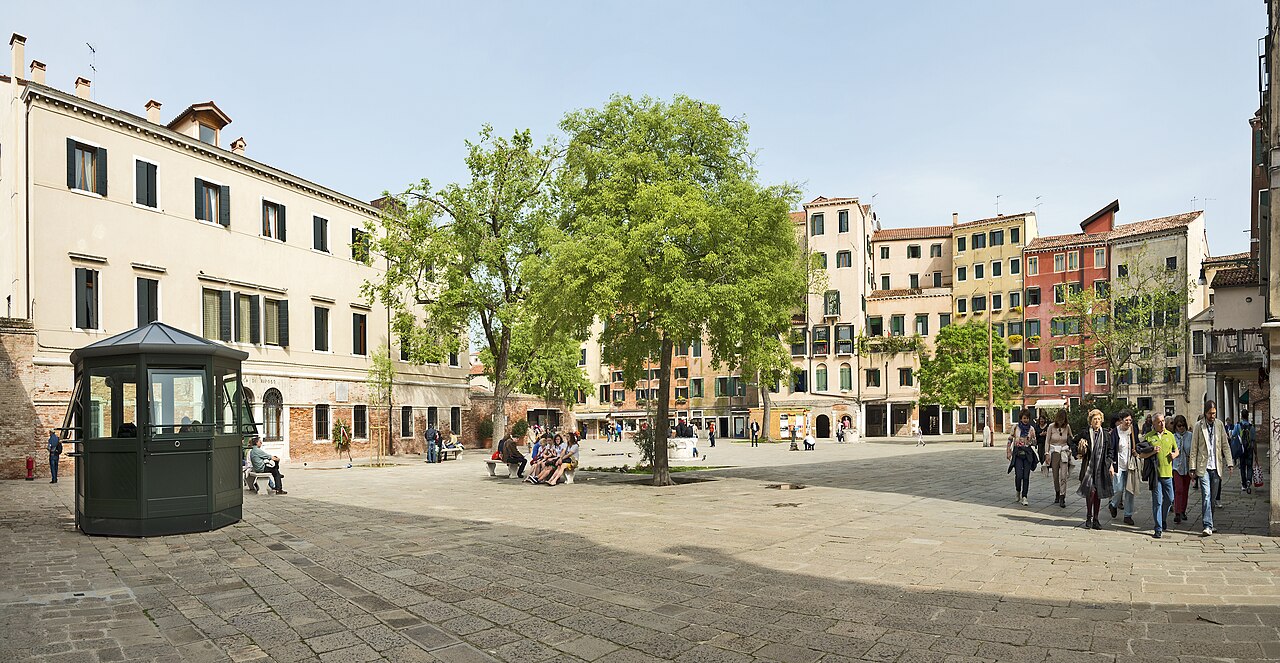
Today, the Ghetto is the most expensive residential neighbourhood in Venice. The approximately 500 Jewish residents of the city are, for the most part, spread across its various sestieri. The area that was once enforced confinement has become, as so often in the long, strange life of cities, a place of choice for young professionals and artists who find its quieter canals and its tall, unusual buildings more compelling than the tourist routes of San Marco. The two active synagogues — the Spagnola and the Levantina — still hold Shabbat services, rotating with the seasons. The Museo Ebraico is open six days a week. The bronze reliefs on the wall of the campo, which no guidebook can quite prepare you for, look out over a square that fills each morning with children and dogs and tourists eating pastries, five centuries removed from the decree that created it.
Scuola Levantina (Levantine Synagogue)
The word ghetto has travelled very far from this place. It has been used to describe the deliberately starved and walled zones where the Nazis concentrated and then murdered millions, and to describe the organic concentrations of immigrant communities in twentieth-century American cities, and to describe any urban area marked by poverty or ethnic identity. In each of these uses, something of the original word persists: the sense of a boundary, of a community defined by what surrounds it as much as by what it contains.
Five hundred and ten years on, ghetto remains one of the most consequential words in the European imagination and it was coined, accidentally, on this small Venetian island, where a cannon foundry used to stand.