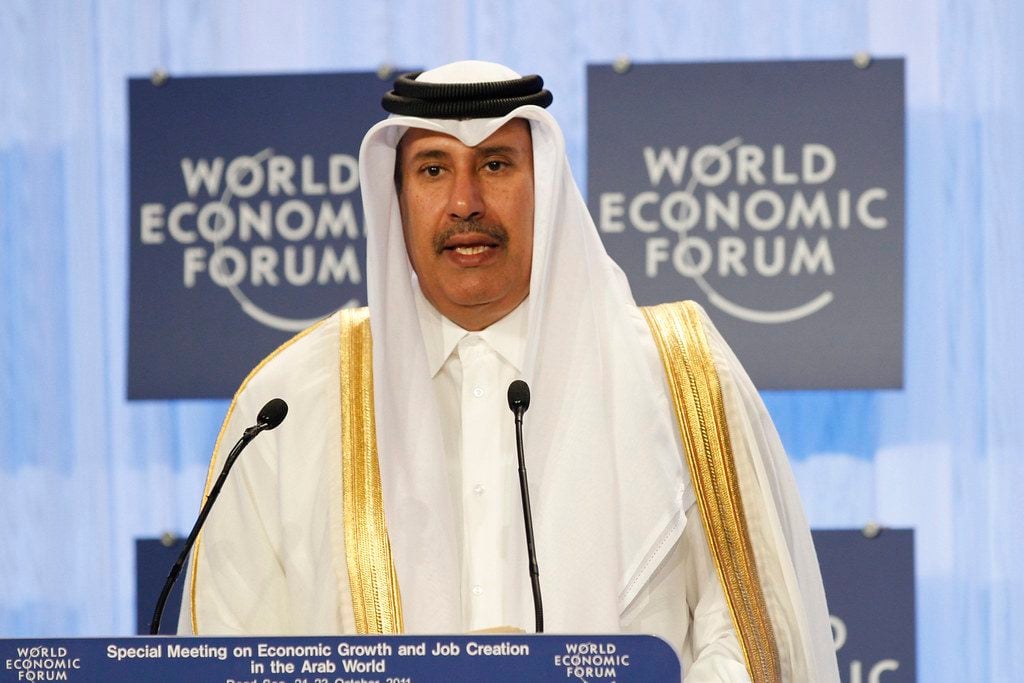
Sheikh Hamad, in his latest post on X, warned that “any attempt to impose unilateral control over it, or to turn it into a tool of extortion, represents a direct threat” to the Gulf and the global economy.
Former Qatari Prime Minister Sheikh Hamad bin Jassim bin Jaber Al Thani has said the Gulf Cooperation Council must be included in any negotiations involving the Strait of Hormuz.
In a post on X on Wednesday, he said regional stability is “not a file to be discussed” on behalf of the GCC and the Strait of Hormuz “is not a bargaining chip, nor a tool of pressure”.
“The security of this region is not a secondary matter, nor a file to be discussed on our behalf, it is the essence of our stability and existence. Here, the matter of the Strait of Hormuz must be placed in its proper context,” Sheikh Hamad said.
في هذه اللحظة الدقيقة من تاريخ المنطقة، ومع ما يُتداول عن مباحثات جارية بين الولايات المتحدة وإيران لوقف العمليات العسكرية، أود أن أؤكد أنه لا يمكن أن تكون دول مجلس التعاون الخليجي غائبة عن أي طاولة تُرسم عليها ملامح المستقبل الإقليمي.
إن أمن هذه المنطقة ليس شأنًا ثانويًا، ولا…
— حمد بن جاسم بن جبر (@hamadjjalthani) March 24, 2026
“The Strait of Hormuz is not a bargaining chip, nor a tool of pressure. It is an international passage that must remain open without condition or restriction, under any circumstances. In fact, it is crucial that it be kept open before any agreement is reached,” he added.
The war between Iran, the United States, and Israel has had a significant impact on the global economy since it began on 28 February, particularly after Iran’s closure of the Strait of Hormuz.
Iran maintains that the strait was not completely closed but barred to American and allied ships, while others are allowed to pass.
The Strait of Hormuz, located between Oman and Iran, is one of the world’s most critical routes for crude oil shipments, and its closure has become a key issue in the negotiations.
The critical waterway is used for roughly 20 percent of the world’s oil and liquefied natural gas (LNG) trade, according to Bloomberg.
U.S. President Donald Trump threatened on Saturday to “obliterate” Iran’s power plants if it did not open the Strait of Hormuz within 48 hours.
“If Iran doesn’t fully open, without threat, the Strait of Hormuz, within 48 hours from this exact point in time, the United States of America will hit and obliterate their various power plants, starting with the biggest one first,” Trump wrote at the time on Truth Social.
Sheikh Hamad, in his latest post on X, noted that “any attempt to impose unilateral control over it, or to turn it into a tool of extortion, represents a direct threat” to the Gulf and the global economy. He also pointed out that the current crisis was imposed on the region.
“This crisis was imposed on us without consultation and we have borne its economic and strategic consequences—disruptions to exports, restrictions on trade movement, threats to energy security, and disturbances to regional stability,” the former Qatari prime minister said.
“It is essential that our countries do not accept being the ones paying the price for conflicts in which we had no role in igniting. It is also our full right—and indeed our duty—to present the extent of the losses we have suffered,” he added.
Iran has responded to Israel and U.S. attacks on its territory by targeting the Gulf region, including key energy infrastructure such as Qatar’s Ras Laffan Industrial City.
Sheikh Hamad, while highlighting the importance of laying out losses sustained during the war, stressed that “the coming phase cannot tolerate ambiguity, nor accept marginalisation”.
“The voice of the GCC countries must be present alongside their allies, heard, and influential in shaping everything related to the future of this region. This is not an option… it is a necessity,” he said.