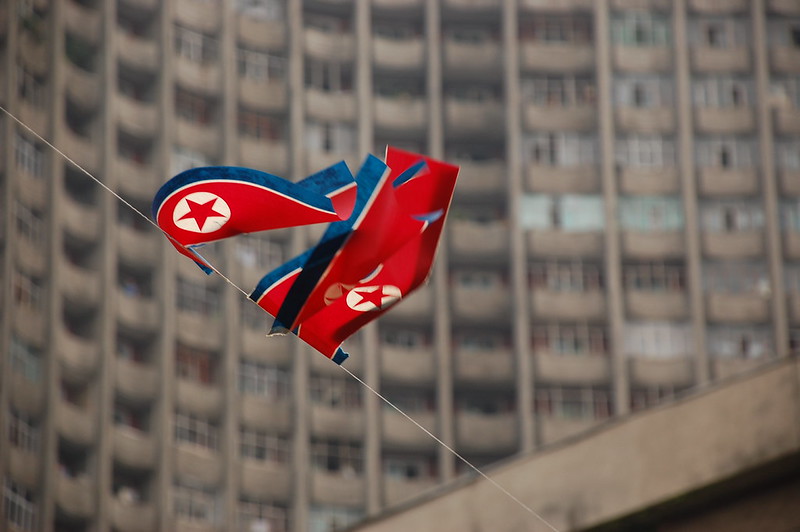
(Image: “North Korea — Pyongyang” by (stephan), CC BY-SA 2.0 via Flickr)
Today, millions of people living in North Korea are being quietly cut off from life-saving humanitarian cooperation. While we do not know when or whether North Korea may allow humanitarian cooperation to resume, support is available and there are US humanitarian organizations willing to work with North Korea. However, currently, US nongovernmental organizations (NGOs) are being blocked from working in North Korea in a number of ways, including stalling of general license reports and special validation passport applications.
These restrictions have persisted across three administrations, contradict strong public support for people-to-people access, and work against the current administration’s own diplomatic objectives. Aligning humanitarian licensing with the precedents in Syria, Iran, and Afghanistan and removing barriers to people-to-people engagement can help save lives and support broader diplomatic goals.
Barriers to Humanitarian Engagement
The last several years have been tumultuous for international organizations working in North Korea. Not only have the North Korean borders largely remained closed since the early days of the COVID-19 pandemic, but the United States has increasingly sought to stymie humanitarian engagement. These hurdles ultimately have the greatest impact on ordinary North Koreans.
NGOs with decades of experience operating in Noth Korea have been asked by the US Department of State (DoS) to withdraw—or in some cases denied—applications for the licenses necessary to conduct operations in the country. For example, the American Friends Service Committee (AFSC), a Quaker organization with four decades of experience cooperating with North Korean partners, was informed by DoS—through a pre-activity reporting process —that its work was denied use of the humanitarian exemptions in the 2024 amendment to the North Korea Sanctions Regulations. The rationale for this decision was not stated in the denial, but the effect was a de facto block on AFSC’s humanitarian work.
DoS asking organizations to withdraw applications is just the latest concerning barrier to meaningful engagement between the United States and North Korea. During the first Trump presidency, NGO humanitarian engagement became a target of the administration’s “maximum pressure” policy on North Korea. Even while Donald Trump and Kim Jong Un engaged in summitry, NGOs faced severe hurdles—such as a ban on American travelers to North Korea and unpredictable timelines for licenses to implement projects—and investigations into their humanitarian work.
The Biden administration walked into a prolonged period of stalled US-North Korea relations and returned to the “hurry up and wait” approach, signaling a willingness to talk without taking concrete action to bring North Korea to the table, and alliance deterrence build up akin to previous administrations. In 2024, US Treasury amended the North Korea Sanctions Regulations (general license), adding some sanctions exemptions that ostensibly allow NGOs to use the new exemptions for a narrow list of authorized activities, such as delivering medical supplies, supporting agricultural projects, and undertaking clean water projects. However, the amendment also included a new pre-activity reporting mechanism that granted DoS authority to deny this privilege as it sees fit. For many NGOs utilizing the process, this created an arbitrary and opaque barrier to humanitarian work, essentially resulting in one step forward and two steps back for NGO engagement.
Where Things Stand Under Trump 2.0
During the first year of Trump’s second term, his administration was unsuccessful in reviving US-North Korea talks. Unlike past administrations that have typically announced the results of a North Korea policy review early in their term, this administration has said little publicly about its North Korea policy except for Trump’s occasional overtures expressing a willingness to meet Kim Jong Un again and a Joint Fact Sheet issued following the US-South Korea summit in October which includes a few bullet points related to the North Korea.
Despite the seeming lack of a formal policy, the administration continues to take actions that undermine the work of NGOs. A recent report by the National Committee on North Korea, a leading NGO promoting principled engagement between the United States and North Korea, cited consensus among practitioners that years of restricted access have eroded critical relationships with North Korean counterparts. Practitioners emphasized the need for a streamlined policy from the United States government to enhance humanitarian preparedness.
Sidelining NGOs while trying to meet directly with Kim Jong Un is reminiscent of the 2017-2019 era when the administration took the view that humanitarian work is not in the United States’ “national interest.” But international humanitarian principles make clear that humanitarian cooperation is not a political tool and should not be used as such. Most people in the United States also support humanitarian assistance. According to a 2026 public opinion poll conducted by The Harris Poll, 64 percent of respondents agreed that the US government should allow privately funded charities to deliver humanitarian assistance to the people of North Korea.
At the United Nations, the United States spent much of 2025 using its position on the Security Council to put a hold on requests for humanitarian exemptions sent to the 1718 Committee that oversees UN sanctions on North Korea, leaving humanitarian projects stalled for months. While recent reports indicate that the committee has now unanimously approved exemptions for 17 humanitarian projects—many of which had been pending since the first half of 2025—this belated approval follows a prolonged period of inaction. By contrast, ten requests for humanitarian exemptions were approved in 2024, while only one was approved in 2025. The recent approvals underscore that humanitarian assistance was effectively held up for nearly a year.
Experts have previously noted the significant delays in humanitarian exemptions spearheaded by the United States following new sectoral sanctions in 2017. Such prolonged delays disrupt the operations of US and international NGOs and place UN agencies such as WHO, UNICEF, and FAO at risk as existing exemptions expire. Childhood vaccinations and maternal immunizations protecting pregnant women and newborns from preventable illnesses are among the operations jeopardized by extended holds on humanitarian exemptions. This approach runs counter to public opinion, where 66 percent of survey participants believe the United States should lift sanctions when they interfere with humanitarian aid and global public health.
Why It Matters and What Should Change
North Korean borders have largely remained closed since 2020, which is certainly a hurdle for NGOs and the continuity of humanitarian work inside the country. But a de facto block on licenses, exemptions, and special validation passports by the United States only further limits the few openings that do exist. This has detrimental impacts for millions of ordinary people in North Korea. An estimated 11.8 million people, over 45 percent of the population, were undernourished and require nutritional support between 2020-2022, according to a report from the World Food Program—a number that has likely risen following the COVID pandemic. For the United States to prohibit US NGOs from being able to provide assistance makes the North Korean people essentially collateral damage of a failed policy of maximum pressure on their leaders.
A straightforward starting point would be replacing the pre-activity reporting requirement with post-activity reporting, consistent with how the US already manages humanitarian general licenses for Syria, Iran, and Afghanistan. This would reduce delays and administrative burdens without weakening oversight. Yet the argument for re-enabling NGO access is not only procedural—it is strategic.
Humanitarian engagement with North Korea not only saves lives but it also provides a vital channel that connects North Korea with the global community. Trump and Kim agreed in the Singapore Joint Statement in 2018 to “establish new relations” in line with the peoples’ desire for peace and prosperity and Trump continues to indicate a desire for new negotiations. However, the administration’s actions restricting people-to-people engagement undermine this agenda and squander a potential engagement channel. The connections, relationships, and learnings shared between ordinary citizens in the United States and North Korea are a core pillar of peace and cooperation between the two countries. Rethinking this strategy and removing US barriers for humanitarian cooperation and people-to-people contact to resume, is a concrete action that could help signal intentions on the diplomatic front more clearly than any potential social media posting.