Flying over the remains of the boat frozen in overflow last fall. At first pass over the Ambler River, it looked impossible to recover the boat from overflow or to even land. (Seth Kantner)
KOTZEBUE — It’s 20 below and a northwest wind is making its own ice fog, obscuring the sun, and drifting snow. I need to go shovel, and drag in more firewood, but for now it’s warm in my shack. For the past month, the storms have blown from the east, and then veered west, and I’ve spent most days shoveling and re-shoveling. It’s good exercise, good for thinking, although a bit relentless, like Sisyphus endlessly rolling that mythical boulder up a mountain. And before I come in, I have to watch where I leave my snow scoop, or even that will blow away and disappear.
In here I’ve got coffee beans from my dad, tools, heaped firewood and books. I read for short stints while I warm my hands. I haven’t been writing. Shoveling is easier. I did promise to write an update on that old longboat I rescued last fall. But, that is proving tough.
[Previously: The strange old wooden boat]
The leather-bound volume contains the “Report of the Cruise of the Revenue Marine Steamer Corwin in the Arctic Ocean in the Year 1885” by Capt. M. A. Healy, and on top is a small wooden rib from the old boat. (Seth Kantner)
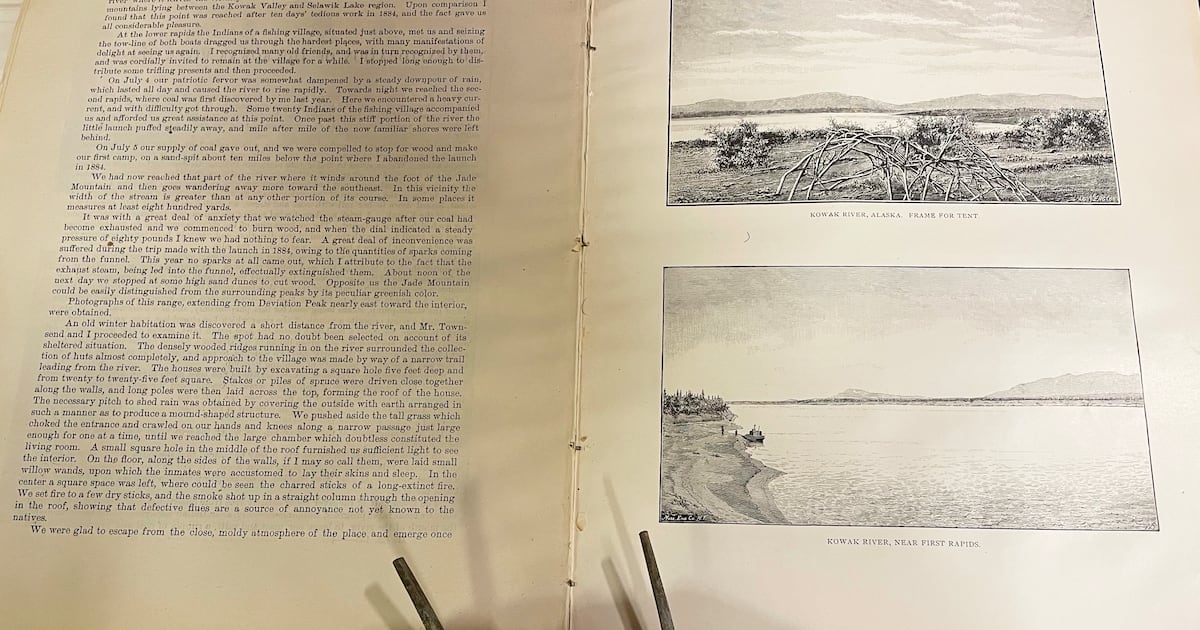
What I’m reading is a leather-bound book, without a single word or photo on the spine or covers. I find that appealing in this word-spattered world. Earlier this winter, after I wrote about that gold rush-era boat, a man named Jerry Stroebele mailed me this book. Another mutual friend, Dennis Witmer, had given it to him. It’s Captain Healy’s report of the 1885 voyage of the Revenue steamer Corwin, to the Arctic Ocean. The binding is broken and pages spill out. There’s an ancient map that folds out to 20 inches by 38 inches. It quickly became three maps when I attempted to unfold it. The line drawings are shockingly accurate around Kotzebue and the Baldwin Peninsula, and less accurate as squiggles lead off up the Kobuk River. The Noatak and Selawik rivers and the Brooks Range are blank, nothing, like a map Magellan might have had. There are pictures of Natives and communities — except they’re not photos. I don’t know what they are, maybe etched metal. They’re good, though. One of the Waring Mountains is so perfect it brought me straight home to the Kobuk.
One of the images in the “Report of the Cruise of the Revenue Marine Steamer Corwin in the Arctic Ocean in the Year 1885” by Capt. M. A. Healy shows the Waring Mountains from the Kobuk River near Onion Portage, and is so perfect that Seth Kantner could see home. At bottom is a small wooden rib from the old boat. (Seth Kantner)
My iPhone camera has been on the blink, and I miss it. I spend too much time on that attention-destroying device, and ironically that old boat caused more hours — hundreds of texts, emails and phone calls. And in late January just when I thought it was over and delivered, a call from the University of Alaska informed me that the airlines had lost the wooden remains.
I had to make more calls and texts: to the museum, the airline that ferried the boat remains from Ambler, the expediter in Kotzebue. It was hard to get information. No one knew where it had disappeared to.
Seth Kantner switches blades and batteries on his saw as he works with others to remove the old wooden boat from the ice along the Ambler River in the fall. (Seth Kantner)
Back in November, after chopping the remains out of the ice, I fretted and cajoled, trying to get anyone in Ambler to sled the boat sections a mile or two to the airstrip. I was volunteering, and only could offer UAF’s $500 honorarium, for a machine and a couple hours work. Apparently, it wasn’t enough. I planned to visit my parents for most of December, and was desperate it make it to Kotzebue while I was here. As it turned out, the boat shipped a day after I left. The local airline was impressed, enough to do a Facebook post about it, but not enough to label it with the shipping information I sent, or shrink-wrap the pieces to a pallet. They forklifted the heap across the tarmac here in Kotzebue to the expediter that turns freight for Everts, Northern Air Cargo and Lynden. A blurry photo shows a distant pallet, looking like, well, junk. Then came snow. And wind. At some point, around Christmas, it was gone.
• • •
Back in 1885, when the Corwin passed Hotham Inlet, locally called Kobuk Lake, Captain Healy dropped off Third Lieutenant John C. Cantwell with a crew, a steam launch, and coal, to explore the “Kowak River.” Cantwell found no one at the trade rendezvous — the shore at Kotzebue — but managed to buy a skin boat and hire guides. He headed across Kobuk Lake in rough water.
Captain Healy noted that the Corwin arrived Aug. 3, 1885. Cantwell said he set off July 2. Who knows? We all make mistakes, right? Although, it seems like a fairly glaring discrepancy.
Something about that got my gnat brain thinking; I had a flash of memory, and climbed up on my bed to reach my caribou book, up on a shelf. It was nice and warm up there, not like my frozen floor. Sure enough, I had used a photo of the Corwin in my book, “A Thousand Trails Home.” I’d forgotten the mystery I had to unravel; old photos of the Corwin showed a schooner, with masts and a bowsprit, an entirely different ship than later photos. That confounded me, until I found records of it being modified into a merchant vessel in its later years.
Cantwell took spray crossing Kobuk Lake, as many of us have on that dangerous lake. He mentioned being thankful for a steam pump. Strangely, that unearthed another memory in my head. When I was 4, my brother and I were playing along the river bank with Peter and Danny, the Epstein twins. They were my age, and kid companions in 1969 were rare, hard to come by. Back in the willows, protruding out of the dirt, I found a rusty iron bar. Back then there wasn’t trash along the river, just all nature. My dad dug it out. It was heavy, and on the part under the soil, raised iron letters read: SHIP PUMP. I’d forgotten all about that. Now I can’t help speculating.
Cantwell claimed he made 7 knots in the delta, and slowed where the current picks up, probably near Salmon River. Apparently, the previous summer Commander George Stoney explored all the way above present-day Kobuk, to the Pah River. Cantwell passed there, left his steam launch, and continued on in the skin boat, with local guides he termed “Indians.”
The map of the “Koowak River” at the beginning of the “Report of the Cruise of the Revenue Marine Steamer Corwin in the Arctic Ocean in the Year 1885” by Capt. M. A. Healy. (Seth Kantner)
Those homeboys sure knew the country. Cantwell’s map has little notations, “Portage 5 days to Koawak; 1 day to the Oklashok; 1 day over Notmaktowaoh to Noatak. I assume that’s Nakmaktuak Pass. But wait! —that longboat I chopped out in November was 100 river-miles below Nakmaktuak, and from there it’s more miles down the Kavachurak, flowing north to the Noatak. IN ONE DAY? Someone was exaggerating. Or tough. Or both. Still, it’s hard not to be impressed how intrepid these people were, the Natives and the white explorers.
Cantwell made no mention of poking around the Ambler or Redstone rivers. He was set on locating the headwaters of the “Kowak.” And he succeeded, making it in less than three weeks all the way to Lake “Car-loog-ah-look-tah.” I think his navigational skills surpassed his Inupiaq skills.
• • •
In late January I talked to an operator at the local expediter. He swore he put the remains of the boat on Lynden, late one night in early December. “We thought it was garbage, then I saw that bow section.” He didn’t recall any paperwork attached. No name. No address. Just gone, off the edge of the map.
I called NAC and Everts; both said they couldn’t do anything without an airway bill. In early February I got ahold of a woman named Makenzie, at Lynden. She’d read my article in ADN and was intrigued by the mystery of the old boat. Lynden has loadmasters, she explained, who oversee every thing that goes on their aircraft. I suggested the wood might have gotten heaped with another shipment. I told her the weight: 548 pounds. She said basically that doesn’t happen, but agreed to walk their grounds in Anchorage, just in case.
It was storming in Kotzebue, one blizzard after another. Flights canceled. The town shut down. I was getting no calls back and daily feeling like a pest. The expediter dreaded when I dropped in or phoned. In mid-February I started again; I got a helpful guy, Brian, at Everts. He’d read my story, too, had grown up in Fairbanks and loved the UAF museum. I texted photos of the boat. Daily he sent updates of searching video surveillance records. All of December; then all of January. Everts hadn’t transported it. Days later, I found another sympathetic ear, Charles at NAC. He searched their video records. NAC hadn’t flown it either.
I went back to shoveling, and reading about Healy, up north rescuing wrecked whalers; and Cantwell in the steam launch, finding coal where we now call Coal Mine, above Kiana, and then switched to burning wood. He made amazing time to the Jade Mountains — where I was born and raised — just days after leaving Kotzebue. Somewhere above the Pah he nearly wrecked the launch, lurching downstream through boulder-filled rapids. He continued on in the skin boat. He didn’t have any drawings of it, but it definitely wasn’t the oak-framed boat I rescued.
Seth Kantner examines a small wooden rib, one of the final remaining pieces of the boat’s frame, with square nails visible. (Aakatchaq Schaeffer)
On Feb. 17 a man named Matt from Lynden called. By then I was depressed about the whole effort. Matt didn’t believe Lynden had hauled the shipment but was willing to search surveillance recordings. I again sent photos. A few days later he called. He had clues. Listening was like hearing details leading to a murder: The wood remains had come in, unlabeled, on Dec. 10 with a shipment of drilling equipment. The equipment was picked up, the wooden boat sections left behind. The pallet sat for nine days, then was forklifted to the parameter. On Jan. 5 it was unearthed from a snowbank; five days later on Jan. 10 it was forked into a dumpster. On Jan. 19 Alaska Waste picked up the dumpster and transported it to Anchorage Regional Landfill.
On the phone, I stared out my window at the snowdrifts. I asked Matt if he minded calling Alaska Waste. He agreed. Neither of us had much hope. That evening at my girlfriend’s parents’ house I glanced at their TV just as a story about the landfill came on. The sound was off and I saw mountains — not mountains like I’m used to, but mountains of trash. I knew the boat was gone.
It was a lowering kind of feeling. It felt analogous to a lot we humans are doing lately. In my mind an angry five-word line from the movie “Zero Dark Thirty” had been replaying, for weeks, and I had to struggle to try to be like my dad, to observe, focus on the good. To always learn from this life. I had met good people, kind and generous, doing their jobs and more.
Lately, it has been hard to know what to think. Or how to think. We humans do try, but it seems we flail, and fail, a lot. It is disappointing, but maybe that’s just how things are. I know there’s more of that boat still up there, until the spring ice flushes out. They are not the best pieces, and terribly frozen in now, covered in deep drifts and nearly impossible to find. And for now, I’m busy with other work, but still thinking, and of course shoveling.