A few days after the quick passing of the amnesty law, 30 people were released from El Rodeo I prison in Caracas on February 23rd. This came after a hunger strike by 200 inmates to demand benefits from this legislation and to denounce the deplorable conditions they’ve been held in.
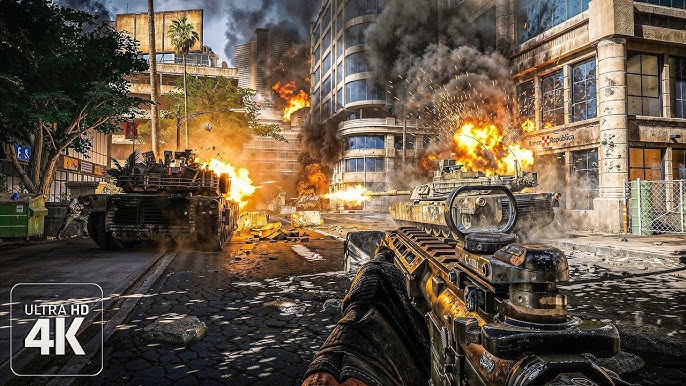
Among them were 11 cadets from the Venezuelan Military Academy who spent more than a year incarcerated for being part of an alleged conspiracy. On what evidence? Screen captures of them playing the popular first-person shooter videogame Call of Duty.
This particular case caught the attention of the international press, including this article from Spanish newspaper El Mundo, in which relatives accused the Military Intelligence Directorate (DGCIM) of holding them at first for four days at a clandestine site. The cadets were reportedly subjected to torture in order to reveal the supposed plot. Gladly, those cadets are now free and reunited with their loved ones.
However, the connection between Venezuela and Call of Duty, one of the most recognized video game series today, goes way back.
Call of Duty is a long-running series of games by major video game publisher Activision, which started first as World War II-set games before embracing a more contemporary setting thanks to the massive success of its 2007 release Call of Duty 4: Modern Warfare. Thanks to its yearly-release schedule, the franchise has remained enormously popular.
Paramount Pictures announced back in September a Call of Duty movie, which had serious interest from Steven Spielberg (Instead, Battleship‘s Peter Berg will helm the film with a screenplay by Yellowstone‘s Taylor Sheridan, but no date yet for production to start).
CoD’s influence has not just reached Hollywood but also Washington DC: Donald Trump’s White House has been using scenes of the game as part of their meme-driven PR operation to promote the recent military campaign in Iran on social media.
Before that, in the immediate aftermath of Operation Absolute Resolve (the US military operation that seized Maduro and Cilia Flores on January 3rd), Spanish writer Jorge Morla, who covers video games for Madrid newspaper El País, wrote how video games in general and more especially first-person shooters like Call of Duty or rival series like Battlefield or Tom Clancy’s Rainbow Six have served as part of the United State’ soft power display in recent years.
“…we can say that these products (referring to games and movies) are supposed to be a middle point between pure, hardcore military propaganda and the fictionalized military thriller, but beyond the punctilious analysis, it’s clear that all of them share the same base: to convert geo-political conflicts in immediate and frantic action spectacles in which (forced) intervention by the US is necessary and morally justified by circumstances. Meaning, these creations are ambassadors of made-in-USA military power”.
The fact that this fictional South American union with anti-US leanings somehow mirrors the wave of leftist governments in the region in that time period is hard to ignore, even if it was mere coincidence.
Interestingly enough, the imagery of Operation Absolute Resolve was used in not-so-subtle ways by the Trump administration as part of its media narrative, taking in consideration an analysis of posts made in X (formerly Twitter) between October 20th, 2025 and January 8th, 2026 by Brazil’s Agência Pública.
Call of Duty being an instrument to promote American military might has not been ignored by the Venezuelan State’s communicational hegemony. Back in 2022, pro-chavismo outlet Misión Verdad quoted a report by far-left news site MintPress News (thanks to a successful FOIA request), showing the relationship between Activision Blizzard and the Pentagon, as the team behind the games was given access to vehicles and equipment to familiarize and display them properly.
This kind of close cooperation between the American military and the entertainment industry is a common practice for the making of movies and series. And for years now, the US Department of Defense has been involved in the gaming world for more than obvious recruitment purposes.
Which leads to the time when Venezuela was front and center in the Call of Duty universe, sort of: its 2013 release Call of Duty: Ghosts, a stand-alone story set in an alternative timeline where after a disastrous conflict in the Middle East leaves the world in a deep energy crisis, several South American nations become the Federation of the Americas, with its capital in Caracas.
The game also includes more speculative sci-fi elements like kinetic orbital bombardment weapons and even a special “extinction” mode, in which you fight the alien race Cryptids.
Obviously, parallelisms were noticed at the time of the Maduro raid, but months before a video essay by YouTube channel Folding Ideas on the game considered that wars in Afghanistan and Iraq, along with exhaustion with the Global War on Terror, forced makers to look for a new foe.
The Federation is presented as hostile, despite its generic presentation (its flag is just the European Union one but in a red and black background instead of blue). The fact that this fictional South American union with anti-US leanings somehow mirrors the wave of leftist governments in the region in that time period is hard to ignore, even if it was mere coincidence.
Led by anti-US general Diego Almagro, the Federation expanded into Central America, the Caribbean and Mexico. In response, the US sent the special force group known as Ghosts in order to assassinate Almagro (a mission they complete successfully), setting the events of the game in motion as one of the Ghosts named Rorke is left behind and presumed KIA after the mission. He was actually captured and tortured in order to become a Fed operative and main villain of the game as he seeks revenge on Ghosts’ team leader Elias Walker, along with his sons Logan and Hesh.
In 2009, the chavista-controlled National Assembly approved the Law for the Banning of Warlike Video Games and Toys.
Rorke is not only the principal antagonist of the game: Unlike Almagro or any Fed-native counterpart, he’s directly responsible for all the major events in the game’s campaign mode.
For the record, the scenario of a US invasion of Venezuela was already used years before CoD. Ghosts in another game: 2008’s Mercenaries 2: World on Flames (a third-person shooter very different in tone in comparison). The country’s depiction caused some serious controversy.
One year later, the then-fully controlled chavista National Assembly approved the Law for the Banning of Warlike Video Games and Toys, which establishes a punishment of three to five years in prison, and a hefty financial fine to anyone involved with “the import, making, selling, renting or distributing of warlike games or toys”.
Despite the law remains in effect up to this day, official mouthpieces like Telesur kept pointing to both video games as part of a larger effort by Hollywood to present Venezuela as either a failed state, a dictatorship and/or a narco-state in order to purposefully justify a US military intervention just months before the events of January 3.
Video games have greatly evolved over the decades both technologically and narratively and many of them have not shied away from touching real-life issues, including current geopolitics. Despite the backlash from either cultural war enthusiasts or authoritarians looking out to suppress any form of dissent, in the end players should decide for themselves.
Which brings this article from Aporrea published months before the release of CoD: Ghosts, in which writer Gregory David Escobar complained about how the Law Against Violent Videogames was, in his view, the wrong approach to confront what Mercenaries 2 and then-unreleased CoD game said about the country. I’d like to end by quoting this line from him, which I completely agree with.
“Just like in cinema, music, theater, TV and literature, we don’t like the pieces that ideologically attack us? Well, let’s see them, debate them, criticize them and classify them by its content. It’s the first step to begin, beside that, to tell our own stories using all platforms possible”.