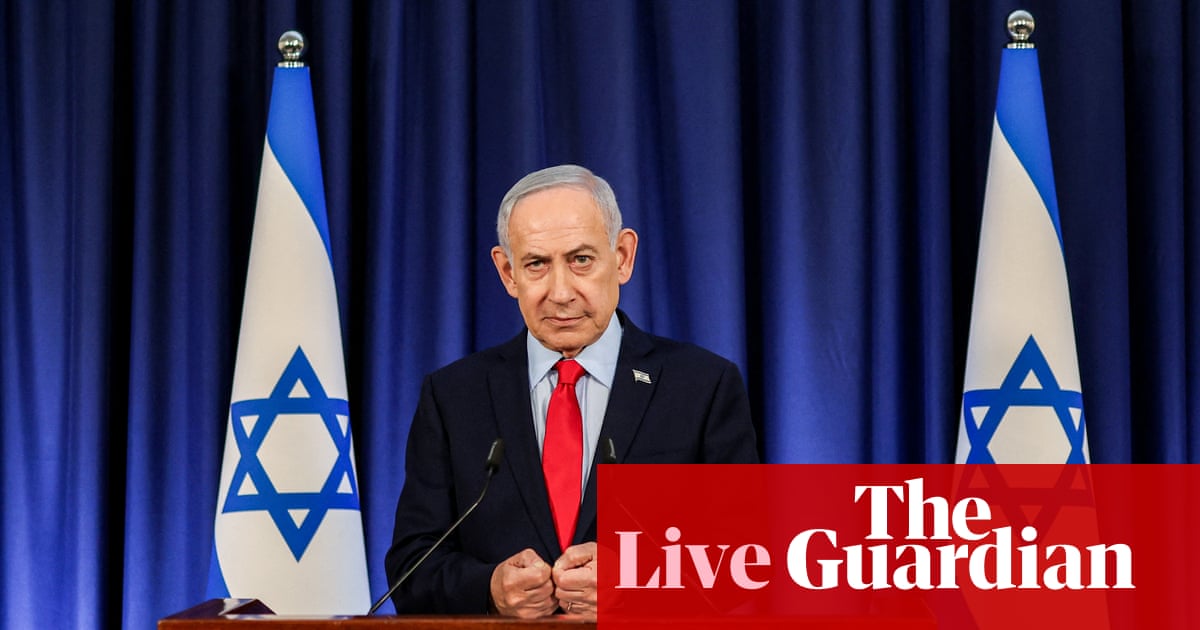
Israel pounds Tehran with airstrikes on Friday
Israel pounded Tehran with airstrikes on Friday as Iranians marked Nowruz, or the Persian New Year, and Israeli prime minister Benjamin Netanyahu denied he ‘dragged’ Trump into the war with Iran.
A woman shops for flowers at a market in preparation for Nowruz celebrations on 19 March 2026 in Tehran, Iran. Photograph: Majid Saeedi/Getty Images
Activists reported hearing strikes around Iran’s capital. The attacks occurred a day after Israel pledged to refrain from more strikes on a key Iranian gas field and Iran intensified attacks on oil and natural gas facilities around the Gulf.
The strikes come as questions mount about how aligned the US and Israel are in their war aims, with Netanyahu saying that Israel had acted alone in the bombing of Iran’s South Pars gas field. He also confirmed that Trump had asked Israel to hold off on such attacks.
Iran is being “decimated” and no longer had the capacity to enrich uranium or make ballistic missiles, but a revolution in the country would require a “ground component,” he said, without elaborating.
The Israeli premier also rejected the notion that he had dragged Trump into the conflict, implying that he was the junior partner in the joint assault on Iran.
“Does anyone really think that someone can tell President Trump what to do?” Netanyahu told reporters, at a press conference.
“He didn’t need any convincing,” he added.
“I don’t think any two leaders have been as coordinated as President Trump and I. He’s the leader. I’m, you know, his ally.”
Share
Updated at 00.27 EDT
Key events
Show key events only
Please turn on JavaScript to use this feature
Some more images of people preparing for Nowruz, or Persian New Year, in Tehran.
People shop for flowers at a market ahead of Nowruz celebrations on 19 March 2026 in Tehran, Iran. Photograph: Majid Saeedi/Getty ImagesPeople shop at a market in preparation for Nowruz celebrations on 19 March 2026 in Tehran, Iran. Photograph: Majid Saeedi/Getty ImagesPeople shop for goldfish at a market ahead of Nowruz celebrations on 19 March 2026 in Tehran, Iran. Photograph: Majid Saeedi/Getty ImagesA vendor sells flowers at a market as people shop in preparation for Nowruz celebrations on 19 March 2026 in Tehran, Iran. Photograph: Majid Saeedi/Getty ImagesShare
Israel pounds Tehran with airstrikes on Friday
Israel pounded Tehran with airstrikes on Friday as Iranians marked Nowruz, or the Persian New Year, and Israeli prime minister Benjamin Netanyahu denied he ‘dragged’ Trump into the war with Iran.
A woman shops for flowers at a market in preparation for Nowruz celebrations on 19 March 2026 in Tehran, Iran. Photograph: Majid Saeedi/Getty Images
Activists reported hearing strikes around Iran’s capital. The attacks occurred a day after Israel pledged to refrain from more strikes on a key Iranian gas field and Iran intensified attacks on oil and natural gas facilities around the Gulf.
The strikes come as questions mount about how aligned the US and Israel are in their war aims, with Netanyahu saying that Israel had acted alone in the bombing of Iran’s South Pars gas field. He also confirmed that Trump had asked Israel to hold off on such attacks.
Iran is being “decimated” and no longer had the capacity to enrich uranium or make ballistic missiles, but a revolution in the country would require a “ground component,” he said, without elaborating.
The Israeli premier also rejected the notion that he had dragged Trump into the conflict, implying that he was the junior partner in the joint assault on Iran.
“Does anyone really think that someone can tell President Trump what to do?” Netanyahu told reporters, at a press conference.
“He didn’t need any convincing,” he added.
“I don’t think any two leaders have been as coordinated as President Trump and I. He’s the leader. I’m, you know, his ally.”
Share
Updated at 00.27 EDT
As other Asian economies race to conserve energy amid a shortage sparked by the war, China has huge reserves of oil and gas, as well as alternative energy sources like wind and solar.
The Guardian’s Callum Jones look’s at how Xi Jinping has been preparing for a crisis like this for years.
A drone view shows oil storage tanks at a depot at Tsing Yi port in Hong Kong, China March 19, 2026. Photograph: Joyce Zhou/ReutersShare
Updated at 00.24 EDT
South Korea, the world’s third biggest importer of liquified natural gas (LNG) has played down the impact of Iranian strikes on Qatari energy facilities.
QatarEnergy, the state-run energy giant, estimated earlier that Iran’s strikes on Ras Laffan Industrial City have reduced the country’s LNG export capacity by 17%, and warned it could take up to five years to repair “extensive” damage.
“Given that the share of imports from Qatar is relatively low (at around 14% in 2026) and alternative supply sources are available, there are no issues regarding gas supply and demand,” South Korea’s industry ministry said in a statement. “However, as uncertainty has been growing, we plan to closely monitor supply, demand, and price trends and respond accordingly.”
Only China and Japan import more LNG from overseas than South Korea.
Share
One of Iran’s top football players has been expelled from the national team for a perceived act of disloyalty to the government, according to Iranian media.
Sardar Azmoun is said to have upset authorities this week by posting a picture on social media of a meeting with Mohammed bin Rashid Al Maktoum, ruler of Dubai.
A report on the Fars News Agency, which has links to Iran’s hardline Islamic Revolutionary Guard Corps, cited “an informed source within the national team” as saying that Azmoun, 31, had been expelled from the squad.
The country’s women’s football team returned to Iran earlier this week. While seven members of the delegation had sought asylum in Australia last week, five later changed their minds, including captain Zahra Ghanbari.
Iran’s Sardar Azmoun in action with United Arab Emirates’ Kouame Kouadio, Azadi Sports Complex, Tehran, Iran – March 20, 2025. Photograph: Majid Asgaripour/WANA (West Asia News Agency)/ReutersShare
Updated at 23.18 EDT
Israel launches fresh wave of strikes on Tehran
Israel says it has launched more strikes on the Iranian capital.
In a brief statement on X, the Israel Defense Forces said: “The IDF has now begun a wave of strikes targeting infrastructure of the Iranian terror regime in the heart of Tehran.”
Activists reported hearing strikes across the city, the AP reports.
Share
UAE, Kuwait authorities say responding to missile attacks
Emirati and Kuwaiti air defences were responding to missile attacks early on Friday, Kuwait’s army and the UAE’s interior ministry said in separate statements.
Elsewhere in the Gulf, Bahrain’s interior ministry said air raid sirens were activated, and Saudi Arabia’s defence ministry said it had intercepted a drone in the country’s east.
Share
Updated at 22.36 EDT
Welcome summary
Hello and welcome to our continuing live coverage of the US-Israel war on Iran and the effect the conflict is having on the region, the world and the global economy.
Benjamin Netanyahu has hinted at a possible “ground component” to the US-Israel warn on Iran – while Donald Trump suggested the US had no plans to put boots on the ground.
“You don’t want to replace one ayatollah with another,” the Israeli prime minister said on Thursday, adding that the Iranian regime was unlikely to be overthrown using air strikes alone.
It is “often said” that you can’t “do revolutions from the air”, Netanyahu told a press conference. “There has to be a ground component as well. There are many possibilities for this ground component and I take the liberty of not sharing [those] with you.”
Trump, meanwhile, claimed he had no plans for the US to engage in such an operation. “I’m not putting troops anywhere,” he told a reporter, when asked about using ground troops. But he added: “If I were, I certainly wouldn’t tell you.”
The president also confirmed that the Pentagon has asked Congress to approve a further $200bn to fund the war.
Some 65% of Americans believe Trump will order troops into a large-scale ground war in Iran, according to a new Reuters/Ipsos poll, but just 7% support that idea.
In other developments:
-
Benjamin Netanyahu denied that Donald Trump was “dragged” into the war by Israel, as he tried to pour cold water on suggestions that Israel influenced the US’s decision to attack Iran and amid growing signs that the US and Israel are not aligned on their war aims. “Does anyone really think that someone can tell President Trump what to do,” the Israeli prime minister said, adding: “I misled no one.”
-
Netanyahu also stated that Israel “acted alone” in striking Iran’s South Pars gasfield, though he didn’t address whether or not he had told Trump about the attack beforehand. “President Trump asked us to hold off on future attacks, and we’re holding out,” he added. Trump has distanced himself from Israel’s attack on the world’s largest gasfield (which he claimed on Wednesday that Washington “knew nothing” about), and confirmed today that he told Netanyahu to stop attacking Iran’s energy facilities.
-
Netanyahu also claimed that Iran has “no ability to enrich uranium at the moment and no capability of manufacturing ballistic missiles”. He said that the war would take “as long as is necessary”, adding: “We will crush them entirely, all those capabilities.”
-
Iranian attacks on Ras Laffan Industrial City in Qatar have reduced the country’s liquefied natural gas (LNG) export capacity by 17%, according to QatarEnergy, the state-run energy giant. The “extensive damage” could reduce its annual revenues by $20bn and take “up to five years” to repair, Saad al-Kaabi, the Qatari energy minister and CEO of QatarEnergy, said in a statement.
-
US Central Command said that it has destroyed the Iranian regime’s surface-to-surface missile plant in Karaj. The plant was used to “assemble ballistic missiles that threatened Americans, neighboring countries, and commercial shipping,” Centcom said.
-
France will double its humanitarian aid to Lebanon to the value of €17m ($19.7m), foreign minister Jean-Noel Barrot said, as Lebanon grapples with Israel’s latest military assault. Israeli strikes on Beirut and its ground invasion of southern Lebanon have killed over 1,000 people, including 118 children, and wounded more than 2,500 since Tel Aviv’s renewed offensive on 2 March. More than one million – roughly one in five – of the population have been displaced.
-
An Iranian missile attack hit Israel’s oil refineries in the northern port city of Haifa but did not cause “significant damage“, Israel’s energy ministry said. Energy minister Eli Cohen said power was briefly disrupted, with electricity restored to most of those who were affected, Reuters reported.
Share