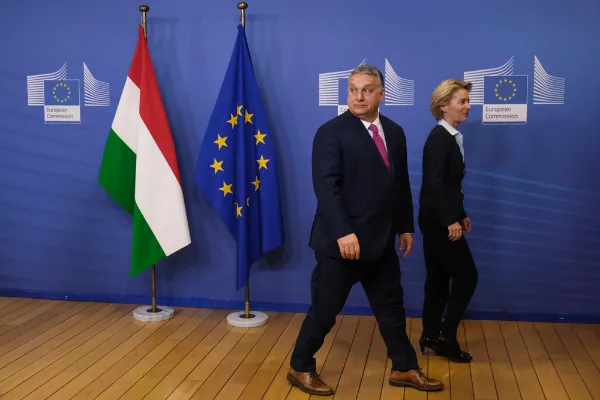
Slovak PM Fico and Hungarian PM Orbán. Allies. Source: Anadolu
Middle East developments
The summit’s other main agenda item is expected to be the developments in the Middle East, as leaders are expected to discuss what efforts can be made to minimize the impact of joint US and Israeli attacks on Iran. EU leaders are expected to strongly advocate for de-escalation while discussing the impact of Iran and regional developments on the EU’s energy prices and security. Leaders are expected to convey support for Lebanon amid Israel’s attacks on the country while addressing developments in the Gaza Strip and the West Bank.
The summit may also explore a solution to the Strait of Hormuz problem similar to the Black Sea Grain Initiative. The summit is expected to focus on the importance of multilateralism alongside UN chief Guterres, while pressure on international law is also expected to be on the agenda. The eurozone economy will also be discussed to assess progress toward economic and monetary union, the euro’s global role, the savings and investment union, and the digital euro.
The summit will also address the bloc’s competitiveness, resilience, and strategic sovereignty in the current environment, as well as the deepening and strengthening of the single market and integration, simplifying rules and reducing administrative burdens, ensuring affordable energy and transitioning to green energy, promoting industrial renewal and innovation, reducing dependencies, and mobilizing investments. Future budget, security, defense, and migration issues are also expected to be discussed.
If you missed our previous articles concerning the ongoing war in Ukraine:
Featured image: depositphotos.com