In recent months, Guwahati has witnessed a visible wave of infrastructure development. The inauguration of the Kumar Bhaskar Varma Setu connecting the city with North Guwahati, the Maharaj Prithu Flyover, and recent additions such as the Jyoti Bishnu Auditorium, Ekta Mall, and Science City reflect a clear push towards modernising the city’s urban landscape. Many of these initiatives have taken shape under the leadership of Chief Minister Himanta Biswa Sarma and reflect the foundations of a growing city.
Yet, for the ordinary resident, the daily experience of moving across Guwahati tells a very different story.
A short five-kilometre journey from Ulubari to GS Road can take up to forty-five minutes during peak hours, compared to an ideal ten to fifteen minutes under free-flow conditions, as reflected in recent traffic observations. The issue goes beyond the number of vehicles. It lies in weakening traffic discipline and the absence of a coordinated urban mobility system, where even minor disruptions can cascade into significant delays across the network.
Over the past decade, the number of registered vehicles in Guwahati has grown sharply, with estimates suggesting that total registrations have more than doubled—driven largely by private cars, two-wheelers, and small commercial vehicles. At the same time, road capacity, parking infrastructure, and enforcement mechanisms have not expanded at a comparable pace. This widening gap between vehicle growth and civic capacity is now visible in everyday congestion, longer travel times, and increasing pressure on road safety systems.
The Friction of Unregulated Growth
One visible contributor is the sharp increase in battery-operated rickshaws and unauthorised motor-fitted cycle rickshaws in recent years. While electric mobility supports last-mile connectivity and livelihoods, unregulated movement on major roads often adds to congestion and reduces average travel speeds across key corridors.
On key corridors such as GS Road, Silpukhuri, Chandmari, Fancy Bazar, Paltan Bazar, Hatigaon, Dhirenpara, and Pandu, slow-moving vehicles frequently operate without defined lanes or timing discipline, leading to avoidable bottlenecks and compounding peak-hour delays.
A more structured approach is necessary. Slow-moving vehicles, including battery-operated rickshaws and goods tempos, should be regulated through defined routes or restricted from high-density corridors during peak hours. At the same time, unauthorised, self-made motor-fitted rickshaws that do not meet safety standards should be restricted from operating on major city roads. Enforcement must be consistent and effective, supported by visible penalties. The objective is not to limit livelihoods, but to align them with the larger need for a safer and more efficient city.
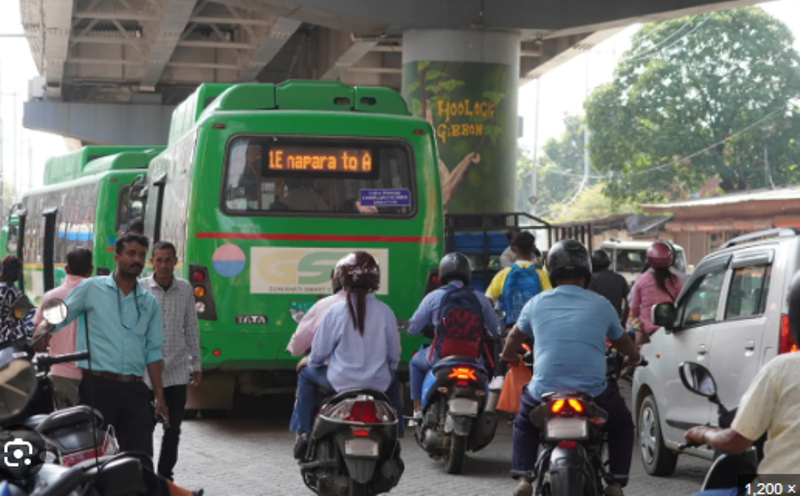
The second issue is the lack of proper city bus bays and disciplined operations. Buses, particularly the Green Bus service, often stop directly on the main road, blocking entire lanes and worsening congestion—at times affecting traffic flow across multiple junctions. Instances of unauthorised stoppages, sudden halts, and occasional rash driving further add to the problem. It is also observed that buses use narrow service roads or even spaces below flyovers while waiting to fill passengers, creating avoidable bottlenecks on already constrained stretches. Cities like Indore have shown that disciplined bus halting, supported by proper infrastructure, can significantly improve travel-time reliability and reduce roadside congestion. While public transport remains essential and operates with government support, a more consistent and disciplined approach to operations and enforcement can greatly improve both traffic flow and commuter experience.
Pedestrian safety has also eroded across major stretches of the city. Along GS Road and adjoining areas such as Chandmari, Silpukhuri, Paltan Bazar, Fancy Bazar, and Hatigaon, sidewalks are frequently encroached upon or used by vehicles, forcing pedestrians onto busy roads and increasing both risk and congestion. This not only affects safety but also reduces overall road efficiency.
The Parking and Resilience Gap
The growth of commercial establishments without adequate parking has turned many streets into informal parking zones, reducing the effective road width and lowering the carrying capacity of already constrained roads.
Traffic in Guwahati is also closely linked to drainage. Even moderate rainfall disrupts movement across key stretches, with waterlogging frequently slowing or halting traffic across significant portions of the network. This highlights the need for better integration between traffic planning and climate resilience.
The Path Forward
A key missing element in Guwahati is an integrated traffic management system. Cities like Hyderabad have demonstrated how command-and-control centres, supported by real-time monitoring and coordinated enforcement, can improve traffic flow, reduce congestion at key junctions, and enable faster responses to disruptions.
Guwahati would benefit from a similar unified mobility task force, bringing together the municipal corporation, traffic police, and urban planners. Supported by digital monitoring tools and integrated systems, such a framework can improve traffic discipline, optimise signal management, and reduce peak-hour delays.
There is also a larger question of enforcement. If violations such as riding without helmets can be consistently penalised, it raises a valid question: why is similar consistency not applied to issues that directly affect traffic flow?
Overloaded tempos, unauthorised motorised rickshaws, and battery-operated vehicles operating freely on major corridors continue to disrupt movement on a daily basis. The challenge lies in consistent enforcement and visible deterrence.
Efficient public transport must become the backbone of city mobility, supported by proper bus infrastructure and realistic parking policies. Designated vending zones can help balance livelihoods with mobility while returning footpaths to pedestrians.
Beyond policy and enforcement, there is also a shared civic responsibility. As residents, we must engage more actively, ask questions, and prioritise basic civic needs such as mobility, safety, and planning.
The selection of our public representatives must increasingly reflect their performance on basic civic issues. Citizens have both the right and the opportunity—through democratic processes ranging from local municipal elections to state assembly elections—to evaluate how effectively these concerns are being addressed. Greater public awareness and participation can help ensure that civic priorities receive the attention they deserve.
Guwahati now has the infrastructure to support its growth. The next challenge is ensuring that governance, planning, and discipline grow at the same pace.
Match governance to infrastructure—or risk chaos amid growth.
Pankaj Kr Deka is a retired professional based in Guwahati. He writes on civic issues, urban development, and public policy.
Related
!function(f,b,e,v,n,t,s)
{if(f.fbq)return;n=f.fbq=function(){n.callMethod?
n.callMethod.apply(n,arguments):n.queue.push(arguments)};
if(!f._fbq)f._fbq=n;n.push=n;n.loaded=!0;n.version=’2.0′;
n.queue=[];t=b.createElement(e);t.async=!0;
t.src=v;s=b.getElementsByTagName(e)[0];
s.parentNode.insertBefore(t,s)}(window, document,’script’,
‘https://connect.facebook.net/en_US/fbevents.js’);
fbq(‘init’, ‘609578899588292’);
fbq(‘track’, ‘PageView’);