by Mary Landers, The Current
March 16, 2026
Ogeechee Riverkeeper Damon Mullis is looking for something he hopes he never finds: evidence the Hyundai plant in Ellabell is polluting the river his organization is dedicated to protecting.
“I would like for it to show no impact,” he said. “I’m looking for no effect.”
Hyundai started making EVs about 18 months ago, but only last month began sending its wastewater through the newly constructed Bryan County wastewater treatment facility, which began full operations the first week of February. Prior to that, the company piped wastewater to a Savannah treatment plant. It also had to truck it to out-of-state facilities when the EV manufacturer failed to meet Savannah’s pretreatment standards.
Located right across Interstate 16 from Hyundai, the new Bryan County treatment plant pipes its discharge less than two miles away into the Ogeechee.
The Ogeechee Riverkeeper has regularly tested the river for a variety of measurements for the last three years to establish its pre-Hyundai baseline conditions. Now it’s on the lookout for any variation from the norm.
Location outflow pipe from the Hyundai Metaplant. In Ellabell on March 2, 2026.
Outfall # 001
On a sunny Monday morning in early March, Mullis towed his johnboat to the riverfront home of Jody Slater, a former Riverkeeper board member who allows the Mullis access as well as a safe spot to anchor monitoring equipment. From Slater’s, Mullis motored upstream about a mile and a half to the outfall site passing turtles basking on logs and barely budding black willows lining the sandy bank. A bright white sign near the boat ramp for the Tar City Hunting Club indicates he’s arrived at outfall #001.
The Ogeechee is free of direct industrial pollution. The last direct discharge into the blackwater stream was from textile manufacturer Milliken, which completed its shut down in 2023. That’s the plant in Screven County, previously operated by King America Finishing, that was responsible for a massive 2011 fish kill on the river.
The new outfall pipe discharges underwater and is invisible to Mullis and any other boater.
Damon Mullis, Ogeechee Riverkeeper/Executive Director in Ellabell on March 2, 2026.
But from Milliken, Mullis learned how to take discharge samples in this situation. If he needs to, he’ll take a telescoping pole and attach a probe and tubing for a pump. The probe looks for the water’s conductivity, which typically spikes when pollution is present.
“It really just measures how easily electricity moves through water,” Mullis said. “So it’s like all the dissolved ions, salts, which any pollution has. It’s all your heavy metals. Any of that stuff will increase conductivity. Sewage has high connectivity, mining activity, too. So it’s just an indication that there’s an unnatural source of water coming in.”
The Ogeechee Riverkeeper used that method to prove Milliken was discharging forever chemicals, or PFAS.
“Because obviously, you know, they’re not going to let us go into the plant and take the sample, right?” Mullis said.
As a state-permitted municipal treatment facility, the North Bryan County Water Reclamation facility is required to regularly report the quality of its wastewater discharge. The Ogeechee Riverkeeper hired a wastewater engineer to look at Bryan County’s wastewater treatment plans before the $129 million plant was built.
“He came back and said, ‘Look, this is a best case scenario, what they’re trying to do, it’s good technology,'” Mullis recalled.
The facility uses a membrane bioreactor, which employs microorganisms to degrade pollutants. It also passes the wastewater through pore-covered membranes that allow water to pass through while retaining suspended solids, bacteria, and viruses.
“I think if we were to see an issue in the river, I hope that Bryan County would be proactive in trying to help us troubleshoot what it could be,” Mullis said.
Monthly testing
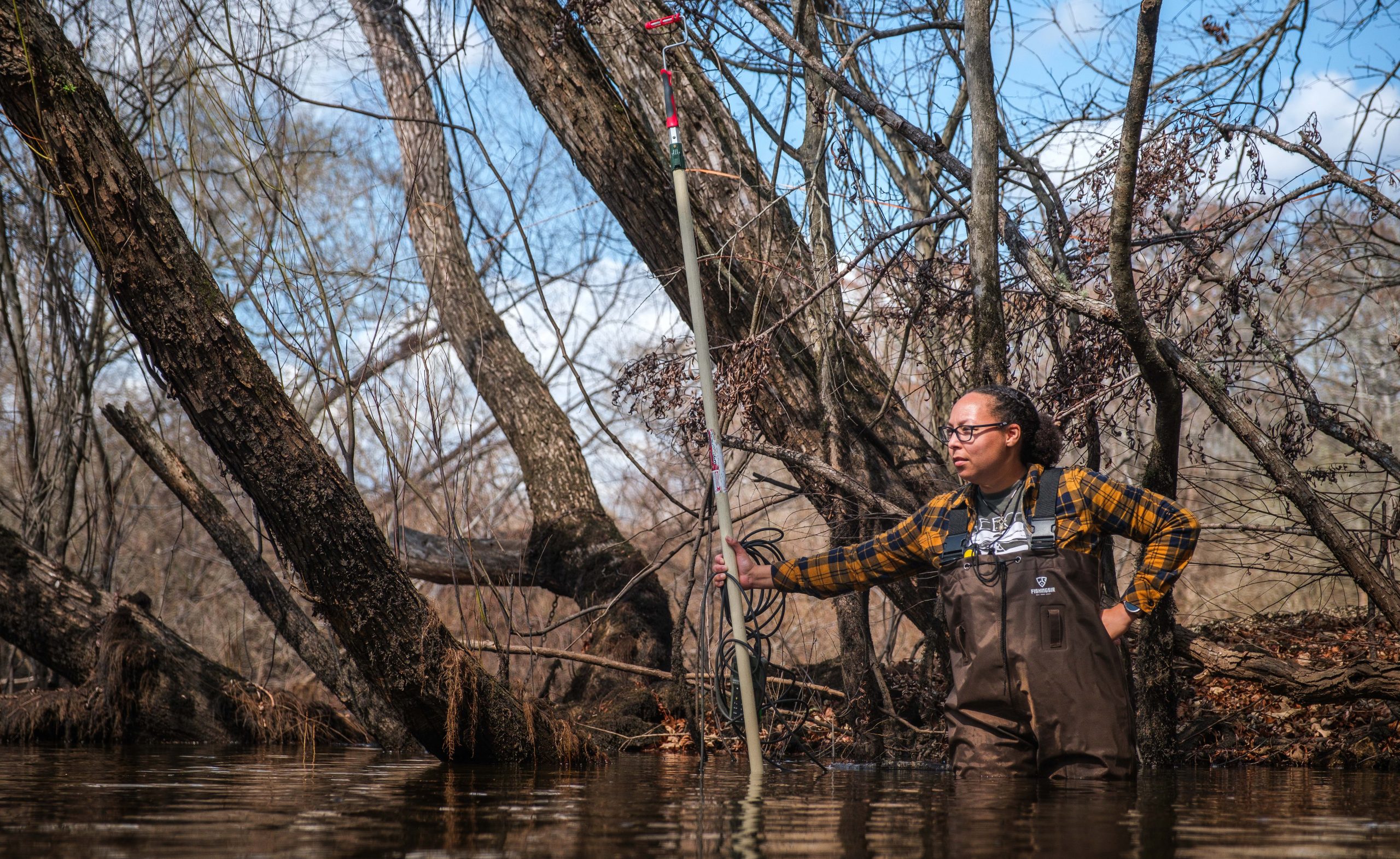
Back at Slater’s property, the riverkeeper’s environmental scientist Michelle Lowery donned brown chest waders and ventured into the water. Grasping a long pole to steady herself she made her way out to a cypress tree that anchors her probes.
First she took measurements with a freshly tested instrument she brought with her. She’ll use that data to calibrate the data her in-stream instruments have been collecting.
The in-stream loggers, battery-powered and encased in stainless steel tubes, record the water’s temperature, pH, oxygen level and conductivity every hour. Lowery downloads the data about once a month. She also takes a water sample that is shipped off to a private lab for PFAS testing.
“Literally, you just dip the cup and then that’s it. We send it off to a lab,” said Lowery, who describes her work as 70% “data management, data analysis, and the use of geographic information systems.”
The riverkeeper initially had two data recording stations set up, but data loggers were lost or stolen – it’s unclear which – from the other one. Every time Lowery downloads data from the remaining loggers, she also takes instream measurements from Dashers Landing, near where the river crosses U.S. 80.
Michelle Lowery, environmental scientist with Ogeechee Riverkeeper, conducts tests on river water samples. In Ellabell on March 2, 2026.
The data collection won’t alert the riverkeepers to problems as they arise.
“It’s not real time, so we’re collecting data after the fact. There’s no way for us to monitor the data live. So you know, if something were to happen, we’d have the data. But … it is not an early warning.
Those systems exist but are expensive to run and finicky to operate, with cell service to transmit the data continually.
“You have to babysit them,” Mullis said. “They’re a lot to keep up with. And unless you really, really need it, usually you get better data doing it this way.”
All that data will be critical to keeping tabs on the health of the Ogeechee moving forward. Three years’ worth of data taken every 30 minutes through every season and every river stage means they know what to expect in a variety of conditions from the higher oxygen levels of winter to the higher conductivity that comes with low flows.
“We have a big enough data set that if we see changes, yeah, it’ll be noticeable,” Mullis said.
This <a target=”_blank” href=”https://thecurrentga.org/2026/03/16/riverkeeper-monitors-ogeechee-as-hyundai-waste-gets-new-treatment/”>article</a> first appeared on <a target=”_blank” href=”https://thecurrentga.org”>The Current</a> and is republished here under a <a target=”_blank” href=”https://creativecommons.org/licenses/by-nd/4.0/”>Creative Commons Attribution-NoDerivatives 4.0 International License</a>.<img src=”https://i0.wp.com/thecurrentga.org/wp-content/uploads/2020/07/cropped-TheCurrent_site-icon.png?resize=150%2C150&ssl=1″ style=”width:1em;height:1em;margin-left:10px;”>
<img id=”republication-tracker-tool-source” src=”https://thecurrentga.org/?republication-pixel=true&post=99339&ga4=G-L05EDNCRHK” style=”width:1px;height:1px;”><script> PARSELY = { autotrack: false, onload: function() { PARSELY.beacon.trackPageView({ url: “https://thecurrentga.org/2026/03/16/riverkeeper-monitors-ogeechee-as-hyundai-waste-gets-new-treatment/”, urlref: window.location.href }); } } </script> <script id=”parsely-cfg” src=”//cdn.parsely.com/keys/thecurrentga.org/p.js”></script>