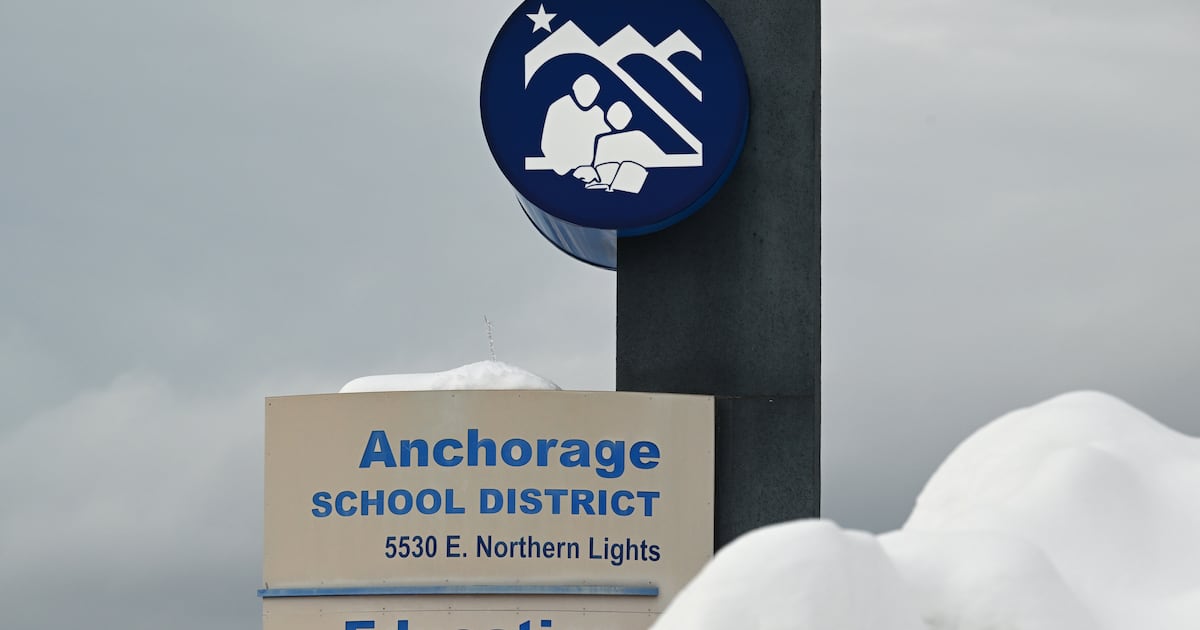
Anchorage School District Education Center on Feb. 3, 2026. (Bill Roth / ADN)
Shortly after the Anchorage School District posted a video with details about projects included on this year’s school bond, South Anchorage Assembly Member Keith McCormick posted on social media questioning whether it was illegal.
“I think it very well could be,” McCormick said in an interview. “I’m not contesting the benefits of the bond. I’m not saying to vote for or against it. I’m just concerned in how they use tax dollars.”
However, officials with the district and the city Ombudsman’s Office said they believe the video follows the law.
“Our communications are intended to explain how funds will be spent and what needs exist in our community. While we do not have legal review of every communication, our longstanding practices have been vetted by counsel and are consistent with Alaska law,” district Chief of Staff MJ Thim said in a statement.
The video McCormick questioned is voiced by Thim and runs about three minutes long. It begins with drone footage of school buildings, then shows secure vestibule entryways — projects included on the bond this year — and district officials speaking about the bond projects. Language accompanying the video states the bond “is projected to have the smallest tax impact in more than 10 years” and that “more than 20 schools — plus the student nutrition facility — would benefit.”
In a video posted to social media March 2, McCormick said, “The Anchorage School District is running an ad asking for more money. Now, I’m not talking about the bond itself. Vote yes, vote no, that’s your call. What I’m talking about is taxpayer-funded government using tax dollars to produce ads asking for more tax money in order to influence an election.”
“Governmental departments should not be using tax dollars to attempt to influence individual election items,” McCormick said.
Anchorage’s municipal Code of Ethics defines municipal resources, in part, as “employees and employee time,” and applies to “the performance of municipal duties, including educational and outreach programs.”
It also prohibits the use of municipal resources for political or partisan activity, but stipulates that a “designee of the district superintendent or mayor can appear before local government bodies and members of the media to support or oppose any ballot measure,” including their ability to “incur associated but limited expenses, such as employee time.”
McCormick is a prolific video poster in his own right, publishing nearly 100 videos to his official Assembly Facebook and TikTok accounts since his election about a year ago.
McCormick said he was concerned that district staff are “campaigning,” and said his legal questions originated from the political activity subsection of code.
“In charter, it does allow, absolutely does allow the school district or the superintendent to present in front of members of the media and promote for bonds. I see that in the charter, I understand it,” McCormick said in an interview. “I just want to make sure that we’re all on the same playing field of ‘does making and producing video content for your own social media fall within presenting yourself in front of a member of the media,’ because if it does, I am very open to using that myself.”
Asked whether he reached out to the district, school board members or took any actions beyond producing and posting his video to social media, McCormick said that he had, but declined to elaborate.
McCormick also said he felt the potential that state legislators could choose not to fund school bond debt reimbursement projects this year — which would increase bond’s cost to Anchorage taxpayers by $30 million — is not accurately represented in the video.
In an interview, district Chief Operating Officer Jim Anderson said he has a higher degree of confidence in state funding for school capital projects this year.
“Everything in the budget, all school funding is subject to appropriation,” Anderson said. “In an election year where the Legislature and the governor appear to be in sync with improving capital improvements, the odds of it (school bond debt reimbursement) being reduced is not real high.”
Thim said the video on the bond took two staff members with prior experience working at Anchorage television stations about two days to complete. In addition to the video, district staff put up flyers in schools, sent postcards to voters and put large signs in front of schools with information about the bond. District staff also produced similar videos each of the last two years. Thim said the district did not spend money to run the video as an advertisement on television channels or other streaming platforms, but published it to the district’s website, YouTube and social media accounts.
“The video was produced to inform the public about the 2026 bond,” Thim said in an email. “This is the first year we’ve received criticism about the bond video.”
When asked about the video, Anchorage Municipal Ombudsman Darrel Hess pointed to the section in the code of ethics that allows government employees to educate people about bonds. While McCormick questioned whether the video falls under the definition of political activity, Hess did not.
“It appears to be simply informing the public what the money from the bonds would be used for and how the reimbursement from the state works. I think the key here, when it comes to the ethics code, is that the video does not encourage people to vote for or against the bonds,” Hess wrote in an email. “I’m not the expert, but I don’t see where the ASD video violates the Muni ethics code.”
Ballots will be mailed to Anchorage voters starting Tuesday. They must be returned or postmarked by municipal election day on April 7.
Municipal departments will host a ballot proposition information fair on Thursday at the Loussac Library from 5:30-7 p.m.