- Governments provide roughly $35 billion a year in fisheries subsidies, much of it supporting fleets that can operate beyond what fish stocks alone would sustain.
- Research suggests many high-seas fisheries would be unprofitable without public support, raising questions about whether some “productive” fishing activity exists largely because of subsidies.
- Recent efforts such as the WTO fisheries subsidies agreement aim to curb support tied to illegal fishing and depleted stocks while improving transparency around how governments finance their fleets.
- Treating oceans as assets on the public balance sheet—from reforming subsidies to investing in monitoring and coastal ecosystems—could help governments reduce long-term fiscal risks while supporting healthier fisheries.
See All Key Ideas
In public finance, some costs are politely kept off the books. The ocean has long been one of them. Governments often speak of “blue growth” and “sustainable use,” yet many policies still treat marine ecosystems as a kind of free input: available, resilient, and cheap to replace. The result is ecological decline. It is also a fiscal problem. States end up assuming risks they would not tolerate on land.
Fishing provides a clear example. For decades, a large share of industrial effort has been propped up by public money. One influential analysis of high-seas fishing found that governments subsidized high-seas fleets by about $4.2 billion in 2014—more than the estimated net economic benefit of that fishing—and that without subsidies, as much as 54% of the high-seas fishing grounds currently exploited would have been unprofitable at the prices and costs prevailing at the time.
The high-seas fishing fleet. High-seas vessels by flag state and gear type, as detected by GFW in 2016. Figure from Sala et al (2018)
That framing is useful: some “profitable” activity may depend as much on government support and permissive accounting as on market demand.
The subsidy patterns are not subtle. A summary of research on “harmful” subsidies lists the top ten providers in 2018, led by China at $5.9 billion and followed by Japan, Korea, Russia, and the United States. It also notes that these subsidizers spent more than $5.3 billion on fishing activity in the waters of 116 other nations, effectively shifting fishing pressure into other countries’ waters.
Global patterns of fishing in the high seas: (A) Fishing effort, (B) economic costs, (C) revenue (landed value of the catch), (D) profits before subsidies, (E) profits after subsidies, and (F) profits after subsidies and low labor costs. Values for costs and profits are scaled averages between lower and upper bound estimates. From Sala et al (2018)
National patterns of fishing in the high seas: Average high-seas fishing profits with and without subsidies for the five main fishing flag states. Figure from Sala et al (2018)
For a coastal state with limited monitoring capacity, this can resemble a transfer of depletion risk rather than a fair economic competition.
What the subsidies actually fund
The issue is not only who pays, but what the money buys. A global dataset distinguishes between subsidies that increase fishing capacity—such as fuel subsidies, tax exemptions, boat construction support, and port development—and spending considered beneficial, such as management and research.
The distinction points to a practical shift in how public money is used. Some public spending improves safety and sustainability. Other subsidies mainly increase fishing effort.
A Chinese flagged squid boat in the Northern Indian Ocean. Photo credit: © Abbie Trayler-Smith / Greenpeace
The World Trade Organization’s fisheries subsidies agreement, which entered into force in September 2025, tries to make these distinctions enforceable. It prohibits subsidies tied to illegal, unreported, and unregulated fishing and to fishing on overfished stocks (with an exception where subsidies are connected to rebuilding measures). It also tightens transparency requirements, asking members to report vessel identification, stock status, catch data, and other details “to the extent possible.”
For economists, this is not glamorous work. It is the kind of administrative detail that can gradually shift incentives.
Bringing oceans onto the balance sheet
The case for “bringing oceans onto public balance sheets” is therefore not mainly about natural-capital theory. It is about how accounting changes incentives in places where governments already keep score: budgets, tax expenditures, and disaster-risk liabilities.
Consider fisheries reform as a fiscal instrument. If a state treats a fishery as a renewable asset, it has reason to protect the asset’s productive capacity and to stop subsidizing its liquidation. In practice, that can mean shifting support away from fuel and capacity and toward monitoring, science, and enforcement. It can also mean creating politically workable ways for vessels to leave the fishery.
Greenpeace’s sailing vessel, the Witness, on an expedition in the English Channel to document industrial fishing activities in several marine protected areas (MPAs), including the Banc des Flandres, the Ridens du Détroit du Pas-de-Calais and the Parc marin des estuaires picards et de la mer d’Opale. Photo credit: © Lorraine Turci / Greenpeace
China’s recent experience is instructive. A careful study of subsidy reforms there found that reductions in harmful fuel subsidies accelerated vessel retirements and reduced capacity, especially among older and smaller vessels. It also found that removing harmful subsidies was only part of the story: increased vessel retirement subsidies were an important driver of the reduction in fleet capacity.
In plain terms, reform worked best when it included help for people and firms to leave the fishery, not just pressure to keep operating without support.
This is where monitoring and compliance gains become relevant to budgets. Transparency requirements under the WTO agreement push members to assemble data that can be used for management and enforcement, including vessel identification and catch by species.
These are not just reporting chores for trade officials in Geneva. They are information that can make oversight cheaper and more effective at home, especially when combined with AIS, satellite analytics, and risk-based monitoring systems that allow limited patrol assets to be deployed more strategically. Even modest investments can make enforcement more predictable and, crucially, easier to defend inside finance ministries.
Nature as coastal infrastructure
Ports are another underused balance-sheet lever. When ports expand, governments tend to treat dredging, breakwaters, and channel deepening as conventional infrastructure, while ecosystem loss is often treated as an unavoidable side effect.
Mangroves, reefs, and seagrass, however, function like protective infrastructure. They can reduce wave energy, limit erosion, and lower expected storm losses. When that protection is degraded, the public sector may face higher future costs for disaster response, insurance backstops, and rebuilding.
A mangrove forest in the Raja Ampat archipelago in Indonesia. Image by Rhett Ayers Butler/Mongabay.
A fiscally minded government does not need to romanticize nature to act on this. It can ask a narrower question: which investments reduce expected liabilities? In some places, that could justify conserving mangroves alongside a port expansion, or funding reef restoration as a risk-reduction measure. The politics can be simpler when the argument is framed in terms of avoided public costs.
The challenge is that ocean assets are diffuse and their benefits arrive over time, while subsidies and construction contracts are immediate. That is why accounting reforms matter. The WTO agreement’s emphasis on transparency suggests a template: require disclosure, standardize reporting, and present the information in a way that allows outsiders to compare performance.
Once information is public, it becomes harder to defend policies that look cheap only because the costs fall elsewhere.
None of this guarantees success. Multilateral rules can move slowly, and domestic politics often move even more slowly. Still, the balance-sheet framing has a pragmatic appeal. It does not ask governments to become ocean lovers. It asks something simpler: manage fiscal exposure more honestly, and stop assuming the sea will absorb the costs indefinitely.
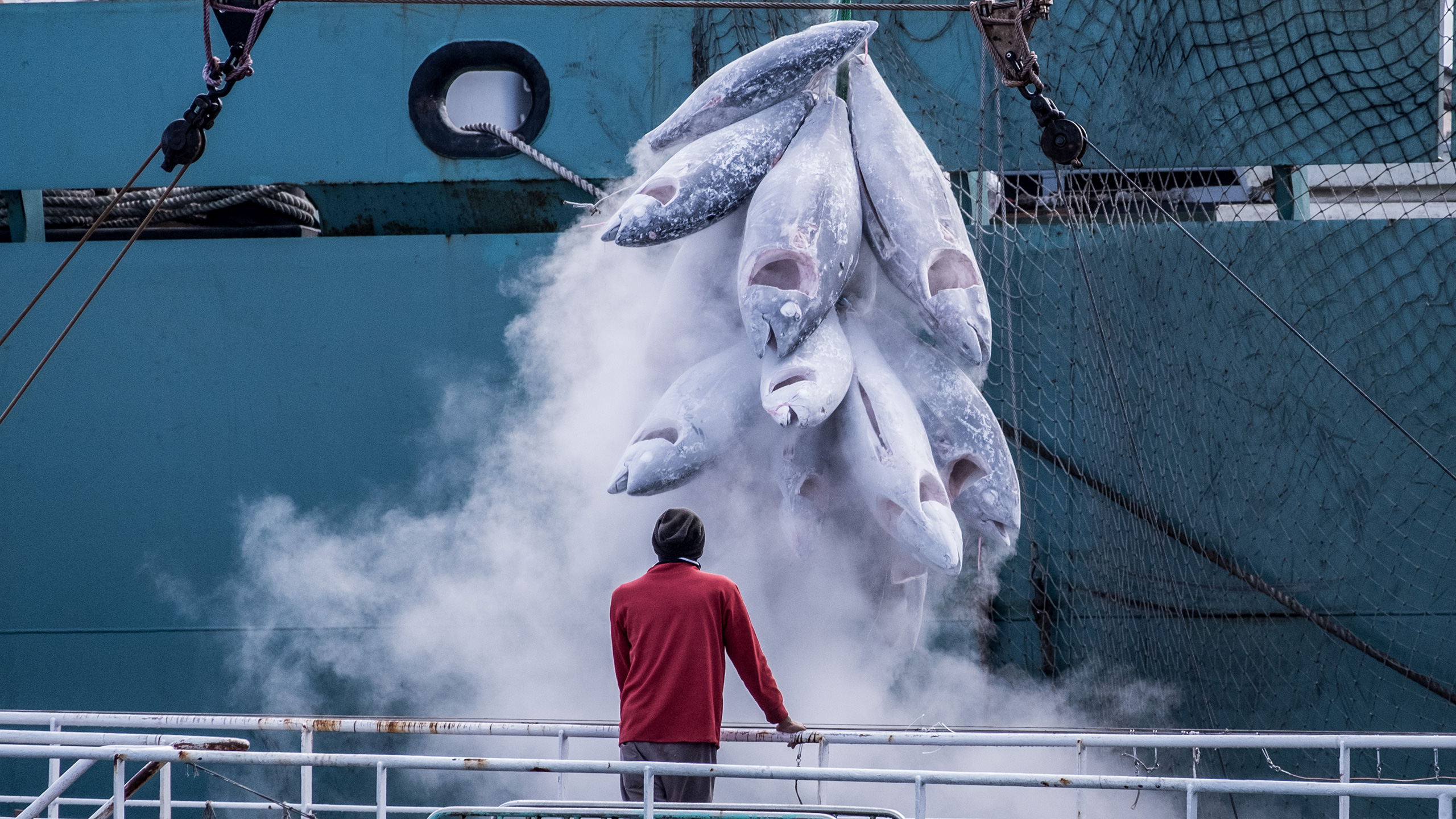
Banner image: Frozen tuna are transferred from the Hung Hwa 202, a Taiwanese longliner, to the Hsiang Hao, a Panama-flagged reefer operating out of Tokyo, Japan, in the middle of the Atlantic Ocean. The Greenpeace ship Arctic Sunrise and crew are investigating distant water fishing fleet practices in the Mid-Atlantic during September and October 2019. Photo credit: © Tommy Trenchard
Citations:
Sala, E., Mayorga, J., Costello, C., Kroodsma, D., Palomares, M. L. D., Pauly, D., Sumaila, U. R., & Zeller, D. (2018). The economics of fishing the high seas. Science Advances, 4(6), eaat2504. https://doi.org/10.1126/sciadv.aat2504
Sumaila, U. R., Ebrahim, N., Schuhbauer, A., Skerritt, D., Li, Y., Kim, H. S., Mallory, T., Lam, V., & Pauly, D. (2019). Updated estimates and analysis of global fisheries subsidies. Marine Policy, 109, 103695. https://doi.org/10.1016/j.marpol.2019.103695
Oceana. (2021). The top 10 harmful fishing subsidizers: China, the European Union, and the United States dominate global harmful fisheries subsidies. Washington, DC: Oceana.
World Trade Organization. (2022). Agreement on Fisheries Subsidies. Geneva, Switzerland: World Trade Organization.
World Trade Organization. (2023). Fisheries subsidies agreement: Factsheet. Geneva, Switzerland: World Trade Organization.
Wang, X., Sumaila, U. R., & Pauly, D. (2023). Fisheries subsidies reform in China: Implications for fleet capacity and sustainability. Marine Policy. https://doi.org/10.1073/pnas.2300688120