Rabat – On one of the final nights of Ramadan each year, mosques across the Muslim world remain lit until dawn. Streets fill with the sound of Quran recitations carried from loudspeakers, families move between homes and mosques, and millions of believers devote the night to prayer, reflection, and charity.
The night is Laylat al-Qadr. Often translated as the Night of Power or the Night of Destiny, it is considered the holiest moment in the Islamic calendar.
In Islamic belief, Laylat al-Qadr marks the night when the first verses of the Quran were revealed to the Prophet Muhammad in 610 CE inside the Cave of Hira near Mecca. According to Islamic tradition, the event began the revelation that would unfold over more than two decades and shape the foundations of Islam.
The night carries extraordinary spiritual significance. The Quran describes it as “better than a thousand months,” meaning acts of worship performed during those hours are believed to carry rewards greater than decades of devotion.
For Muslims, it represents a rare moment when divine mercy, forgiveness, and destiny are believed to converge between sunset and sunrise, a night when the veil between the earthly and the divine is thought to thin.
Because its exact date was never confirmed, believers search for it during the final ten days of Ramadan, particularly the odd-numbered nights such as the 21st, 23rd, 25th, 27th, and 29th. The uncertainty keeps mosques filled throughout the last stretch of the holy month.
In many Sunni communities, the 27th night is the most widely observed, though other Islamic traditions emphasize different dates.
The rhythm of Laylat al-Qadr is similar across continents: night-long prayers, recitation of the Quran, and personal supplication known as dua. But the way the night unfolds varies widely from one culture to another, shaped by history, local customs, and the character of each community.
A night that unites the Muslim world
In the holy cities of Mecca and Medina, the scale of Laylat al-Qadr is immense. On the 27th night of Ramadan, the Grand Mosque in Mecca hosts several million worshippers gathered for late-night prayers known as Tahajjud.
Up to 4.2 million worshippers gathered in 2025 at the Masjid al-Haram in Mecca on the 27th night of Ramadan, breaking a new record.
The sound of the imam’s recitation echoes through vast courtyards and surrounding streets as pilgrims and residents stand shoulder to shoulder.
Elsewhere, the night takes on distinct cultural forms. In Turkey, Laylat al-Qadr or Kadir Gecesi is widely observed on the 27th night of Ramadan, drawing thousands to historic mosques. In Istanbul, worshippers gather at landmarks such as Hagia Sophia, the Sultan Ahmed Mosque, and the Suleymaniye Mosque for special night prayers, Quran recitation, and supplications that last until dawn.
A signature tradition known as the mahya lights up the night sky, with illuminated messages and Quranic verses strung between mosque minarets. Families share salted pastries called Kandil simit, while some worshippers remain in mosques for spiritual retreat, or itikaf, during the final days of Ramadan.
In Egypt, Laylat al-Qadr is often observed on the 27th night of Ramadan with large public prayers and official ceremonies. The government organizes a nationally televised event led by the Ministry of Awqaf, where senior religious figures, including the Grand Imam of Al-Azhar, attend Quran recitations and honor top Quran memorizers.
Across the country, thousands gather in historic mosques such as Amr ibn al-Aas, Al-Azhar, and Sultan Hassan, where worshippers spend the night in Tahajjud prayers, Quran recitation, and supplication until dawn.
Further east, in Indonesia, Laylat al-Qadr is marked by intense devotion during the final days of Ramadan. Mosques fill through the night with worshippers performing extended prayers, reciting the Quran, and observing itikaf, a spiritual retreat spent in the mosque.
Large congregations gather in major mosques such as Jakarta’s Istiqlal Mosque, while many Indonesians also give charity and join communal buka bersama meals to break the fast together.
Despite the diversity, the core experience remains the same: long hours in mosques, quiet reflection, and the hope that prayers offered that night will shape the coming year.
Islamic tradition holds that on Laylat al-Qadr, angels descend to earth with divine decrees concerning human destiny. The night is also associated with an unusual calm. Some believers say the air feels softer or the sky clearer, and a widely cited tradition describes the following sunrise as pale and gentle, without harsh rays.
Morocco’s night of devotion and celebration
In Morocco, Laylat al-Qadr carries both religious weight and deep cultural symbolism, particularly on the 27th night of Ramadan, which most Moroccans observe as the most likely date.
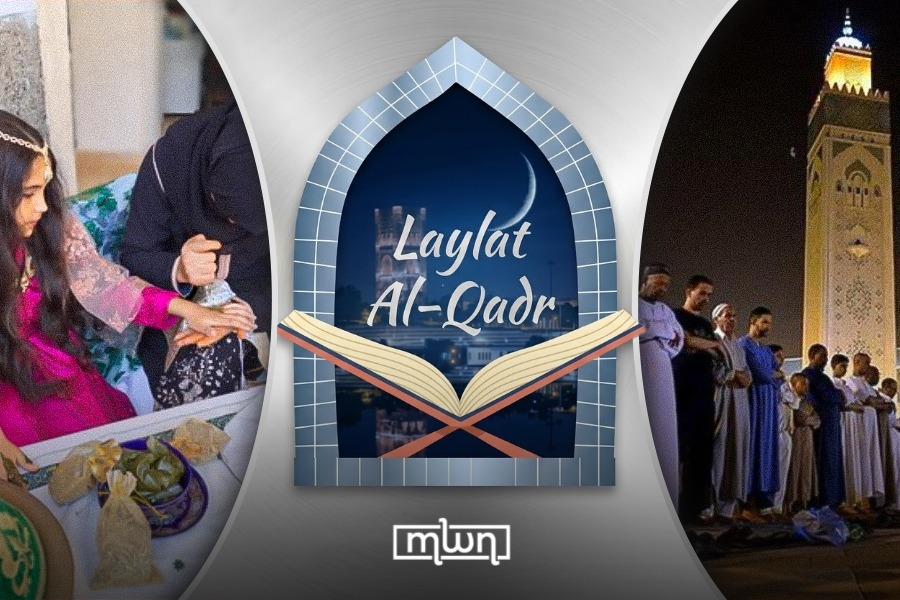
Mosques across the country remain full until sunrise, but the largest gatherings often take place at the Hassan II Mosque in Casablanca, one of the largest mosques in Africa. Thousands of worshippers fill its vast courtyards overlooking the Atlantic Ocean as Quranic recitations echo through the night.
King Mohammed VI traditionally presides over a religious vigil there, reinforcing the monarchy’s historic role as “Commander of the Faithful.”
The night also has a strong visual identity. Many people wear traditional clothing, turning the streets and mosques into a display of Moroccan heritage. Men often appear in white djellabas with red fez hats and leather slippers or balgha, while women wear ornate caftans, takchitas embroidered with silk braiding, or colorful djellabas.
Children play a central role in the celebrations. In many Moroccan families, Laylat al-Qadr is when young boys and girls attempt their first full day of fasting, a milestone celebrated with elaborate rituals.
Children may dress in miniature versions of wedding attire, sometimes complete with henna designs or professional photographs to mark the occasion. They are often rewarded with small gifts or money after breaking the fast.
The sensory atmosphere of the night is unmistakable. In many homes, incense known as “serghina” is burned, filling rooms with the scent of oud, amber, musk, saffron, and floral waters.
The smoke is believed in Moroccan folklore to purify the home and protect it from harmful spirits, reflecting a widespread belief that jinn are shackled for most of the month of Ramadan but released on that night.
Food also plays an important role. Families gather around large shared platters, often serving couscous with seven vegetables — carrots, turnips, zucchini, pumpkin, cabbage, chickpeas, and sweet potatoes. This dish is associated with abundance and good fortune.
In some regions, the meal may include rfissa, a comforting dish of shredded flatbread, chicken, lentils, and fenugreek broth.
By dawn, the country gradually falls silent again. Worshippers leave mosques after hours of prayer, the sky brightens over the Atlantic, and Ramadan continues its final days with the belief that, somewhere among those nights, Laylat al-Qadr has already passed.
Read also: Eid Al Fitr: Morocco Announces March 23 as Exceptional Day Off for Public Sector