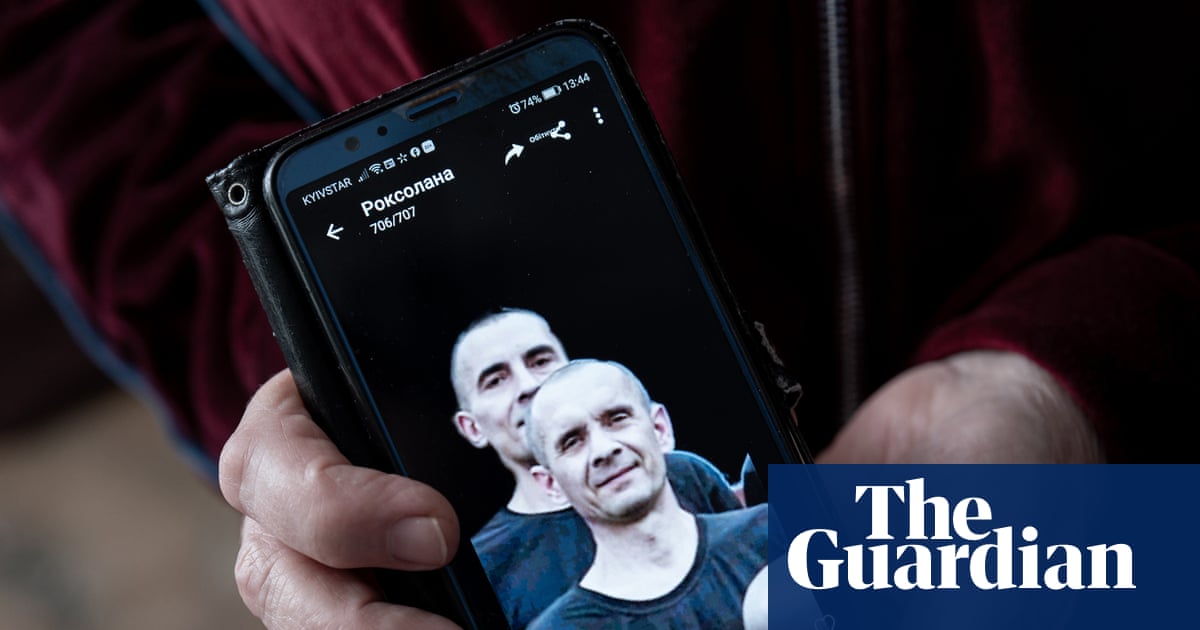
Nazar Daletskyi was declared dead in May 2023. The DNA match left no room for doubt, officials told his mother, Nataliia. A Ukrainian soldier who volunteered for the front in the early weeks of the war, Nazar had become one more casualty of Russia’s invasion.
Nazar’s remains were laid to rest in the cemetery of his home village. In the months after the funeral, Nataliia visited the grave at least once a week, at first to cry and later to stand in quiet contemplation, remembering her only son.
A few weeks ago, almost three years after the funeral, Nazar was freed from a Russian jail as part of a prisoner exchange. Soon after stepping off the bus and into Ukrainian territory, he was handed a mobile phone.
Nataliia Daletska speaks to her son Nazar for the first time since captivity – video
The moment Nataliia heard her son’s voice again was captured by a village official, in a grainy mobile-phone video of raw emotional power. “My God, how long I’ve waited for you, my precious child,” she said, wailing with a mix of shock and joy. “Do you have arms, legs; is everything in place?”
The video went viral in Ukraine, the unexpected happy ending touching a nerve in a country starved of good news. But the positive outcome came after a traumatic journey for both mother and son.
A month after that phone call, Nataliia welcomed the Guardian to her neat cottage in the village of Velykyi Doroshiv, close to the western city of Lviv. The walls were decorated with brightly coloured religious paintings; in the living room, a large headshot of Nazar, printed after the funeral, hung in pride of place. Over cups of cardamon-infused coffee, she recounted the story from the beginning.
A photograph of Nazar Daletskyi hanging on his mother’s wall
Born in 1979, she said, Nazar was a sweet boy who liked cuddles. But the “1990s were hard”, and he left school without qualifications. He married and had a daughter, but the relationship did not last and he returned to live with his parents. When Russian proxy forces launched a conflict in the Donbas in 2014, he signed up to fight, doing four rotations in the east over the subsequent years. In between, he did odd jobs, construction and renovation work.
In February 2022, after Russia’s full-scale invasion of Ukraine, he volunteered at the local military unit. Twice he was turned away, but the third time they accepted him despite some medical issues. On the Easter weekend he left Velykyi Doroshiv for the front in Donbas.
He called home every day; the conversation usually lasted just a few seconds. “Mum, I’m alive,” he’d say, without saying where he was. But at the end of the second week, she could tell things were getting hairy. He told her the incoming fire was so intense that he was pinned down in a trench with his comrades, unable to move.
The next day, a Sunday, Nazar didn’t call at the usual time. Nataliia paced the house, staring at her phone. It finally rang close to midnight, but when she answered it was not Nazar on the line.
“Your son has been taken prisoner,” a voice said.
“And who are you?” she asked.
“I’m the guy who took him.”
Then the line went dead.
Nataliia began an exhausting circuit that has been made by thousands of Ukrainian families over the past four years, shuttling between government offices and NGOs, filling out forms, answering questions, trying to get some information about where the Russians were holding her son. No one had any answers.
Nataliia Daletska in her house in Vylyki Doroshiv. Photograph: Jędrzej Nowicki/The Guardian
Finally, in May 2023, she received a call from a Ukrainian official in Kharkiv, who gave her the worst kind of news. Nazar was dead. He had died the previous September, on his 44th birthday. In a series of phone calls, the details emerged: a convoy of cars in Donetsk region had come under fire; Nazar had been one of several Ukrainian soldiers in one of the cars, disguised in civilian clothes.
It was not clear how Nazar had ended up in the convoy, and at first Nataliia told the woman she did not believe the story. Nazar was meant to be somewhere in a Russian prison, and none of this made sense. But the woman was adamant, presumably weary of handling relatives who refused to accept evidence that their loved ones were dead. “The DNA is a clear match,” she told Nataliia. “If you don’t want to take the remains, we can bury him here.”
The thought of her son’s grave being far away led Nataliia to start on the journey of acceptance: “I said: ‘OK, if it’s really my boy, if the DNA really matches, we’ll take him back.’”
The remains came back to Velykyi Doroshiv in two sacks. In the coffin, a military uniform was draped over them. Nataliia laid some of Nazar’s possessions inside too. “I put a tracksuit, a smart jacket and some nice shoes in there with him … and I gave him something to eat. I thought the poor boy was being held prisoner, he was probably hungry. I put biscuits, chocolates, things like that,” she said.
Of the funeral, held at the local cemetery, Nataliia retains only the blurriest of memories: a crowd of villagers there to pay their respects, eight priests intoning prayers, a military band striking up a funeral march. Nazar was laid to rest next to his father, who had died three years earlier.
The grave where remains, thought at the time to be those of Nazar Daletskyi were buried, next to his father’s body. Photograph: Jędrzej Nowicki/The Guardian
Nazar had not liked having his photo taken, but Nataliia found an old headshot from some official documents and enlarged it to put on the wall next to a painting of the infant Jesus. She gave away his clothes and possessions to friends and relatives, keeping just one grey jumper as a memento. In May 2024, she received a paper, signed by the Ukrainian army chief Oleksandr Syrksyi, awarding Nazar with a posthumous military honour.
The loss took an emotional and physical toll on Nataliia. She was exhausted by conversation, had frequent blood pressure spikes, and ended up in hospital several times. But slowly, she started coming to terms with it. She prayed for Nazar’s soul every Sunday in church, and visited the cemetery often.
One thing that kept bothering her, though, was that she never saw Nazar in her dreams. “In the three years and nine months that he was away, I never dreamed of him once. Can you imagine that? I was crying at the grave, saying: ‘Why won’t you come to me in my sleep?’ But he never came.”
One day last September, Nataliia’s niece came to visit and told her to sit down and prepare for some news. Two prisoners of war had come back from Russia, she said, and both of them said they had seen Nazar alive in the past year. Nataliia peppered her niece with questions. “I was crying from joy, I was screaming, but I thought that until I hear his voice, I’m not going to believe it,” she said.
Nataliia went to the police, where they took new DNA samples. They asked if, perhaps, she had given birth to another son, because there was no other explanation for the DNA match. She told them she had one son and one daughter and that was it. “I think I would remember giving birth to another child … If the DNA match was with the father, then anything could be possible, but it was with me,” she said.
In the new year, Ukraine’s coordination centre on prisoners of war contacted Nataliia to confirm Nazar was alive and still being held in Russia. In early February, she was told he was expected to be included in an exchange planned for the next day, but it was only when she was able to speak to him on the phone after his release that she was convinced her son really was still alive.
The military honour awarded to Nazar for bravery, issued posthumously before it was discovered he was still alive. Photograph: Jędrzej Nowicki/The Guardian
Nazar had no idea his family had spent the last three years thinking he was dead, and he misunderstood when the volunteers who met him off the exchange bus tried to explain the situation. At first, he thought they were trying to tell him his mother had died while he was in captivity. He had wanted to get a message out through a fellow prisoner who could arrange phone messages for money, he told Nataliia, but he could not remember her phone number.
A month later, Nazar is still living in a rehabilitation centre in another region of Ukraine, and has not yet been reunited with his mother. They video call at least once a day, and in these conversations, he does not dwell on what happened in prison, though he has alluded to frequent beatings. Most Ukrainian POWs have reported facing arbitrary violence, humiliation and torture while in Russian captivity.
“His legs hurt a lot and he is always hearing noises. But he’s OK in his head, I can see that when I talk to him,” said Nataliia.
She cannot wait for him to come home and is preparing a list of the things she will cook for his first meals: the milky zatyrka soup he always liked, stuffed cabbage leaves and potato pancakes. She thinks about the hug he gave her as a young man, when she returned home after two years working abroad in the early 2000s. “I tell him: ‘As soon as you get back, I’m going to hug you just as tightly as you hugged me back then.’”
One mystery endures: whose remains were wrongly identified as Nazar’s? Somewhere, perhaps, a family is clinging to hope about the fate of their missing relative, and may soon receive bad news. After Nazar’s reappearance, the remains were exhumed and sent to a laboratory for repeat testing. The results are due in the coming weeks.
In the Velykyi Doroshiv cemetery, the earth where Nazar’s grave had been still looks freshly churned. Nearby, discarded on the ground, is the splintered wooden cross that had stood by the grave, along with a metal board, painted yellow-blue like the Ukrainian flag. It bears a popular slogan used for those who have fallen in the war against Russia, meant as a testament to the enduring nature of memory: “Heroes do not die.”