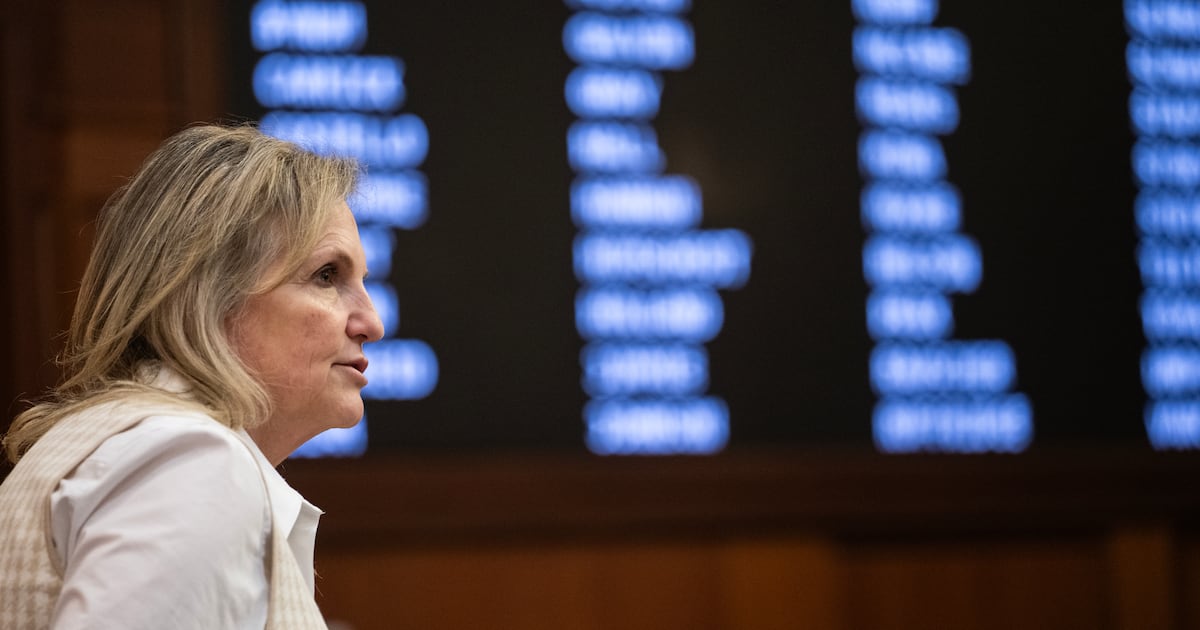
Rep. DeLena Johnson, R-Palmer, speaks on the floor of the House of Representatives at the Alaska State Capitol in Juneau on May 19, 2025. (Marc Lester / ADN)
Alaska House Republican minority members on Thursday refused to approve a draw of millions of dollars from state savings to pay for disaster relief and transportation projects, amid war-driven oil prices that are set to net the state tens of millions of dollars in unforeseen revenue.
Republicans reasoned that oil revenue driven by the war in Iran will eliminate the need for using savings to cover $373 million in expenses in the current fiscal year.
Thinking that oil prices are too volatile to be relied upon, majority members in the House had sought to draw from the Constitutional Budget Reserve to cover the added spending in the current fiscal year. Drawing from that account, which currently has roughly $3 billion in it, requires approval from three-quarters of the House and the Senate.
The Senate cleared that hurdle handily Wednesday, voting unanimously in favor of the draw from savings. But in the House on Thursday, the vote failed 22-18, with only one Republican minority member — Anchorage Rep. Mia Costello — joining all 21 members of the House bipartisan majority to vote in favor of the draw.
Leaders of the House minority caucus said that they were not interested in voting for the draw from savings until the Alaska Department of Revenue releases an updated revenue forecast, expected Friday.
That forecast, Republican minority members said, would likely show that unexpectedly high oil prices will yield enough funding to cover tens of millions of dollars for transportation projects, disaster relief and fire suppression, without drawing from savings.
The price per barrel of North Slope crude stood at $92 on Tuesday, compared to the fall forecast of $65 per barrel, on average.
But lawmakers in the majority said that oil prices are volatile and there is no guarantee that they remain at their current level through the remainder of the fiscal year, which ends in June. Even if they do remain at an average of $90 per barrel through June, that would only yield $300 million in unforeseen oil revenue to the state, below what is currently included in the supplemental budget bill, according to House Finance Co-Chair Andy Josephson, an Anchorage Democrat.
Lawmakers in the minority said they are not opposed to what was included in the budget bill — the bill passed the House unanimously Thursday before Republicans voted against the draw from savings to fund it. But majority members said it would be irresponsible to send a budget bill to the governor’s desk without approving a source of funding for the spending.
Minority Leader DeLena Johnson, a Palmer Republican, said that her caucus was “just practicing good fiscal reserve” in voting against the draw from savings. She said she would have preferred for the majority to let the bill land on the governor’s desk even without approval for a savings draw, under the hope that an updated oil revenue forecast would be sufficient to fund most — if not all — of it.
“Why not authorize the executive to make the expenditures?” asked Rep. Will Stapp, a Fairbanks Republican who serves on the Finance Committee. “There’s no harm in doing that. If the money’s not available, then request the money again, in another bill, another appropriation.”
But majority leaders voted instead to send the bill back to a committee, where it would remain, they said, until they were confident they could send a fully funded bill to the governor.
“We need to make sure that we do not send an unfunded bill to the governor,” said House Speaker Bryce Edgmon, a Dillingham independent.
He accused the House minority of “playing Russian roulette with oil prices.”
House Majority Leader Chuck Kopp, an Anchorage Republican, said that the majority remains “very motivated” to pass the bill but is concerned that the minority’s “goalposts keep moving.”
The House had originally passed the supplemental budget bill five days before the U.S. initiated strikes on Iran. Since then, the bill has shifted in the Senate and returned to the House amid conversations shaped by war-driven oil prices and their impact on the budget-making process.
But the revenue forecast that Republicans are banking on is “not realized money,” said Rep. Calvin Schrage, an Anchorage independent who co-chairs the Finance Committee. The minority, he said, was “suggesting today that we rely on a forecast — unrealized, unpredictable, uncertain money — to finance a budget, when industry and Alaskans are asking for certainty.”
After the Senate on Wednesday agreed to strip roughly $150 million from the bill — including about $80 million that had been needed from state savings to address last year’s projection of low oil prices — the bill contained funding for a scholarship account, transportation projections, fire suppression and disaster relief.
The bill would transfer $130 million back into the Higher Education Investment Fund after lawmakers agreed to raid it to cover a shortfall in last year’s budget; it would cover $70 million in transportation funding needed to secure hundreds of millions in federal matching funds; it would direct $98 million to cover already obligated fire suppression costs; and it would send up to $75 million for disaster relief, including funding to respond to devastating storms that occurred in Western Alaska in the fall.
The items included in the bill were requested earlier this year and late last year by Gov. Mike Dunleavy, who, according to Edgmon, has largely stayed silent on the Legislature’s process to meet his request.
Majority legislators have been pressing for the bill to pass on an expedited basis because contractors have been warning that the transportation funding is urgently needed for the coming summer construction season.
Lawmakers spoke openly Thursday about an uncomfortable truth: The war in Iran — despite its massive cost to the U.S. government, the havoc it has wreaked on the global economy and its death toll — has yielded the state unexpected revenue that could stave off the need to draw from its already-depleted savings.
“The thing that we’re not talking about here today is the fact that we have been blessed in this state,” said Rep. Justin Ruffridge, a Soldotna Republican, during Thursday’s floor debate on the budget bill.
This is not the first time that war has relieved the state from fiscal strain. When Russia invaded Ukraine four years ago, spiking oil prices transformed that year’s budget and drove higher-than-usual state spending.
“I appreciate the optimism in the building, and I understand that we’re all feeling awkward about the unfortunate reason for the optimism, which is that mankind can’t stop itself from fighting,” said Josephson.
Thursday’s contentious floor session culminated with dueling press conferences in which majority and minority members accused each other of misunderstanding the budget process. Lawmakers said the fundamental disagreements between the caucuses — which come halfway into the four-month session — could make it difficult to advance other legislation.
“I don’t know where we go from here. If we can’t agree on this, are we ever going to get to agreement? We’ve got a lot of tough decisions to make between now and the time we adjourn,” Schrage said on the House floor. “What I’m hearing here today really, really worries me about our ability to do what our constituents asked us to do when they sent us here.”
Daily News reporter Mari Kanagy contributed from Juneau.