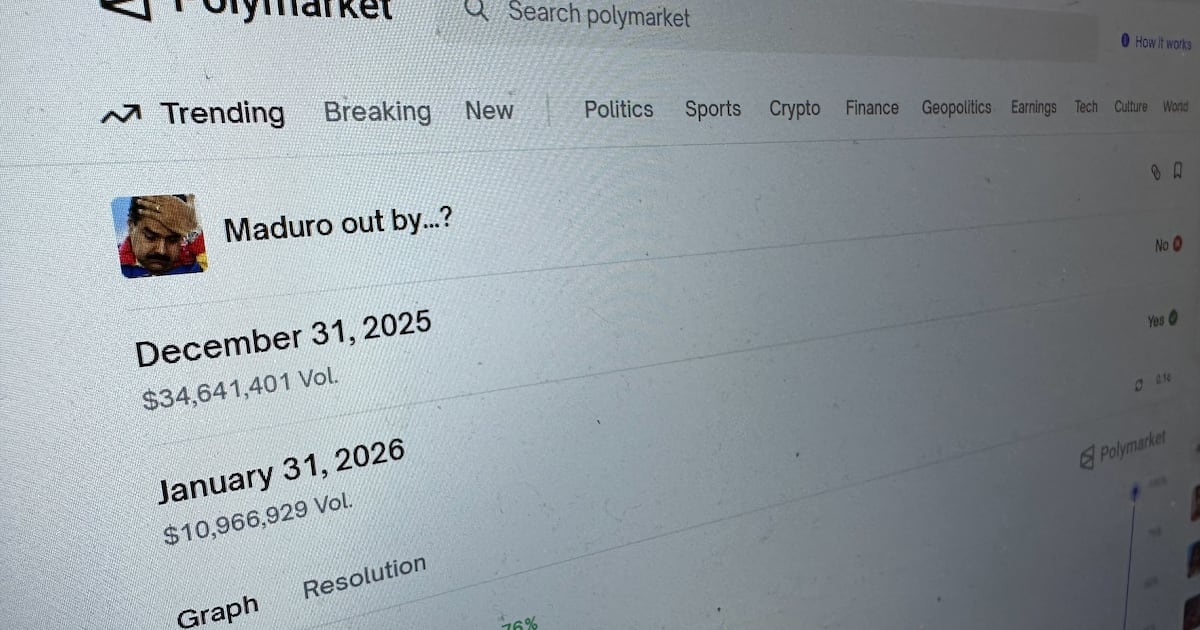
The Polymarket prediction market website shows bets taken on when Venezuelan President Nicolás Maduro would be out of office. (AP Photo/Wyatte Grantham-Philips)
Alaskans like to take chances, buy raffle tickets and place bets — whether trips to Vegas, time at their local bar playing pull-tabs, guessing where the sanitized and hardened moose “nuggets” will land when dropped from the air on a grid in Anchorage, or making it down an icy hill without chains.
Though the only prize for that last one is not hitting anything.
But like the rest of the world, Alaskans can now place bets on just about anything that might, could, possibly, perhaps happen in the world of sports, economics, culture, climate, technology, science — and lots of politics. You probably can even bet on whether all that betting is a good thing or a bad thing for society.
It’s called the prediction marketplace. Look at the online wager board, find something you think may or may not happen and place your bet. No roulette wheel, no cards to draw, no casino slot machine button to hit, just click and wait to see if you are right — or wrong.
Collect your winnings if you’re right — or forget about your losses if you were wrong and put more money into your account for your next prediction gamble. Even easier, you can use your credit card and run up a debt that charges more than 20% to place bets where you have a coin-flip 50% chance of winning.
Regardless, at last check Americans clicked and swiped their way to $50 billion in bets on prediction markets last year, with the number trending higher. It’s easy, it’s fast, you can do it without flying to Vegas, going to the bar, telling your spouse or even stopping to wonder why you are betting on an election outcome when you haven’t bothered to vote in years.
Alaskans like to say “we don’t give a damn how they do it Outside” as if that is a source of pride. If we really believe that, we should stop betting on boring things like the rest of the country and do it differently.
A quick look at Kalshi, the largest online prediction marketplace in the U.S., shows that you can bet on the usual assortment of political outcomes in Alaska: who will win this year’s U.S. Senate race; who will Sen. Lisa Murkowski endorse in the Senate race; who will win the governor’s race; whether Vermont democratic socialist Sen. Bernie Sanders will endorse Alaska Democratic candidate for Senate Mary Peltola in her race to unseat incumbent Republican Sen. Dan Sullivan.
All boring, as if we need more mundane political guesswork in our lives. Besides, it’s a sucker bet: Peltola, running in a Republican state, probably doesn’t even want Sanders’ endorsement.
Let’s Alaskanize prediction markets.
• Kalshi could start taking bets on the amount of this year’s Alaska Permanent Fund dividend.
• The date and name of the next Alaska state ferry to break down with an engine problem.
• The average number of Anchorage drivers ticketed for running red lights this year.
• How many boats in Southeast Alaska harbors will sink under heavy snow next year.
• Whether the first piece of steel pipe will go into the ground before the end of the year as claimed by the developer of the famed Alaska North Slope natural gas pipeline project.
• How many tons of dog poop will appear as the winter snow and ice melt away.
• And whether drivers who slid down a hill or into a ditch will admit it was their own fault for driving on summer tires.
The last one is the only sure thing to bet on.
Larry Persily is a longtime Alaska journalist, with breaks for federal, state and municipal public policy work in Alaska and Washington, D.C. He lives in Anchorage and is publisher of the Wrangell Sentinel weekly newspaper.
• • •
The Anchorage Daily News welcomes a broad range of viewpoints. To submit a piece for consideration, email commentary(at)adn.com. Send submissions shorter than 200 words to letters@adn.com or click here to submit via any web browser. Read our full guidelines for letters and commentaries here.