New research shows housing displacement and income loss were central drivers of psychological harm.
The deadly wildfires that devastated Maui in August 2023 triggered an island-wide mental health crisis, according to new research from the University of Hawaiʻi Economic Research Organization and the Maui Wildfire Exposure Study.
The study, published Wednesday in JAMA Psychiatry, found the fires were linked to significantly higher levels of depression and anxiety among residents — even those who did not live near the burn zones in Lahaina and Kula. More than half of the disaster’s impact on mental health could be traced to increased housing and job insecurity, suggesting the long-term burden of the fires is still unfolding, according to the study.
“It demonstrates that housing displacement and income loss were not side issues — they were central drivers of psychological harm,” said Ruben Juarez, a UHERO professor and the study’s lead author. “Recovery policy must treat stable housing, employment and mental health care as inseparable.”
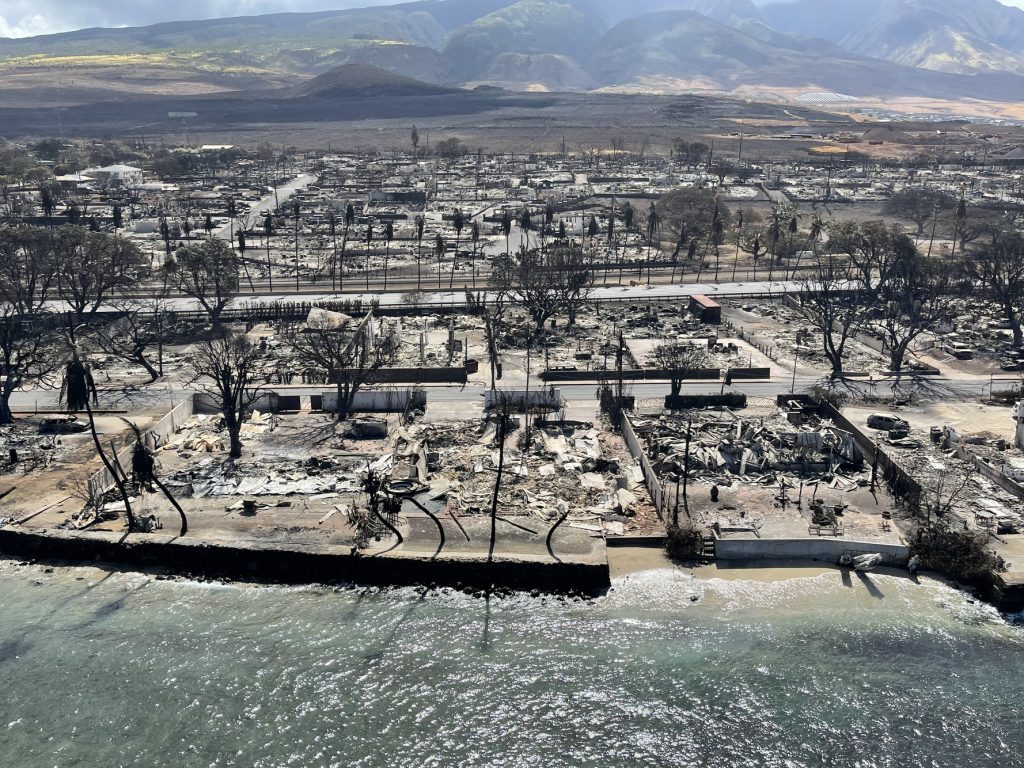
Lahaina, seen here three days after the Aug. 8, 2023, fires razed most of the town and killed 102 people. (Courtesy: DLNR)
People who lived inside the burn zones at the time of the fires had a 53% higher risk of depression and 67% higher risk of anxiety compared to unexposed residents, according to the study. However, other Maui residents also experienced significantly elevated mental health risks, including more than double the risk of suicidal thoughts, researchers said.
While trauma exposure negatively affected the mental health of many survivors, researchers found that increased depression and anxiety was primarily driven by social and economic instability.
For wildfire survivors, housing and job insecurity explained nearly 62% of the depressive symptoms caused by the disaster and 77% of the anxiety symptoms, according to the study. For other people on Maui, those factors were behind nearly 55% of reported signs of depression and 96% of anxiety.
“While disaster research often centers on post-traumatic stress disorder, our results suggest that depression, anxiety, and suicidality linked to socioeconomic disruption are more widespread, immediate, and modifiable and should be treated as core components of disaster recovery,” the study’s authors wrote. The lead authors included Juarez, Binh Le and Christopher Knightsbridge.
The researchers were surprised by the evidence showing that the fire caused a ripple effect of declining mental health across the state, according to Alika Maunakea, a co-author of the study and professor at the John A. Burns School of Medicine.
“Climate disasters affect biological, social and economic systems at the same time,” Maunakea said. “If we only rebuild structures and do not stabilize housing, employment and mental health services, we leave communities vulnerable long after the smoke clears.”
Christopher Knightsbridge, the head of the mental health research team for the MauiWES Study, said the study’s findings aligned with his experience working directly with fire survivors on Maui. Many people who lost loved ones, their home or their livelihood because of the fires have not been able to begin processing the trauma that they endured because they are so preoccupied dealing with the disaster’s secondary effects, he said.
“We can’t treat that trauma until the patient’s basic survival needs are met, and ever since the fires, everybody has been on constant survival mode,” Knightsbridge said. “Where am I going to live? Why is the insurance company screwing me over? Why is the contractor not doing what they said they were going to do?”
The disaster had a butterfly effect on housing, the local economy and other broad issues, he added, so everyone on the island has felt the consequen
Knightsbridge, who lives on O’ahu, did not think people living on other islands fully understand the extent of the ongoing mental health crisis on Maui.
“I guarantee they do not,” he said. “It’s — just based on my observations — a different type of stress on Maui, and in Lahaina especially. It’s real crisis levels of suicidality, of stress, of trauma, of always feeling on edge.”
‘A Warning And A Roadmap’
Study participants who were employed were significantly less likely to report signs of clinical depression, anxiety and suicidal ideation, while those who lived in temporary housing were much more likely to develop anxiety than those in stable housing, according to the researchers.
“This paper gives Maui both a warning and a roadmap,” Juarez said. “Real recovery requires investing in the social and mental well-being of the entire community, not just the burned areas.”
Alika Maunakea, co-lead of MauiWES, collects samples from a participant to track health impacts of the Maui wildfire. (Courtesy: MauiWES)
Researchers examined 2,453 adults, including 1,535 wildfire-exposed Maui residents and 918 unexposed people living in other Hawaiʻi counties, between January 2024 and February 2025. Just over 61% of study participants were women, and the average age was 50.8 years old.
The study’s findings expand on those of a previous study by MauiWES and UHERO that found wildfire survivors who had been living or working in the burn zone were more likely to show evidence of long-term exposure to harmful heavy metals and more likely to report signs of heart, lung and mental health issues than survivors who were not regularly returning to the area.
The Lahaina wildfire destroyed thousands of buildings and killed at least 102 people, making it the deadliest blaze in modern American history. It affected a racially diverse and geographically isolated community that has long been hit by socioeconomic and public health inequities. Still, the study was among the first to look at a wildfire’s population-wide impact on mental health, researchers said, and it could inform climate adaptation policy, trauma-informed disaster recovery, and equitable mental health response systems worldwide as climate-related disasters become more frequent.
Sign up for our FREE morning newsletter and face each day more informed.
Sign Up
Sorry. That’s an invalid e-mail.
Thanks! We’ll send you a confirmation e-mail shortly.