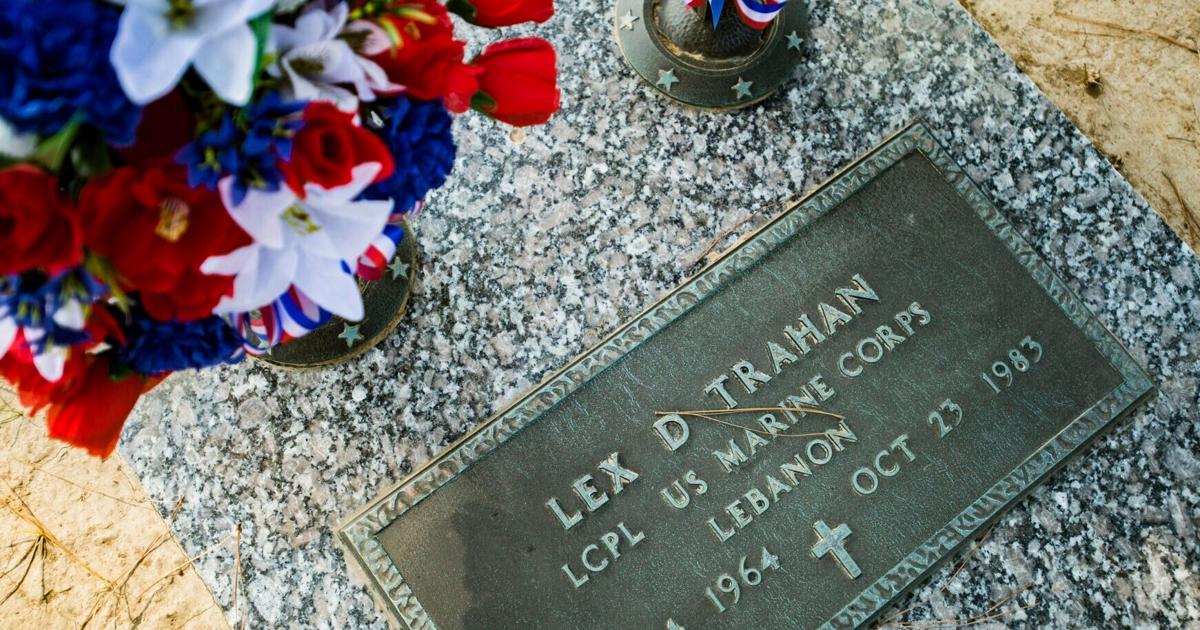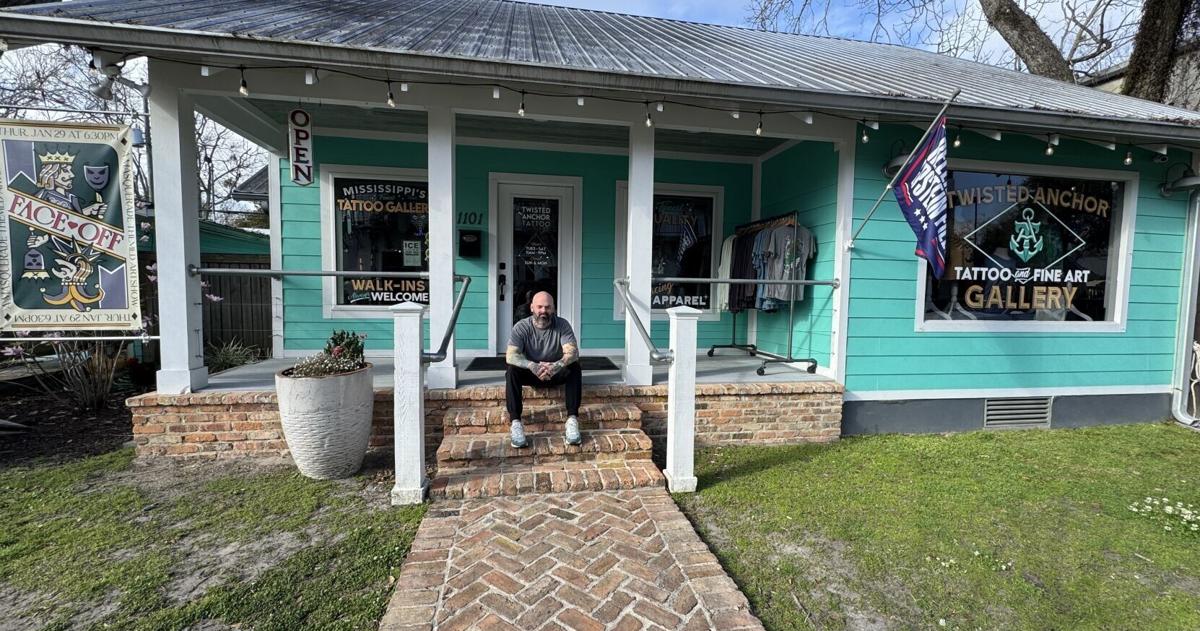
While inking a tattoo, the artist performs more than one role — breathing coach at one moment, therapist at another, Matt Stebly said minutes before the first client of the day walked into Twisted Anchor, his Ocean Springs tattoo shop and art gallery.
Over the years, Stebly has also settled into the role of a nonconformist in his Mississippi Gulf Coast hometown. Opening his shop in 2016 along Government Street — a quaint but busy downtown corridor of boutiques, restaurants and bakeries — didn’t come without a yearlong fight, in part because of the stigma surrounding tattoos, especially in a conservative town tucked into the corner of South Mississippi.
Today, tattoos are far more ubiquitous along the Mississippi Coast — a cultural shift that Stebly helped drive. Even 70-somethings lounge in his chairs, waiting for their first appointments. Nowadays, he adds, “there’s a lot less people without tattoos than there are with tattoos.”
Stebly has more than 100 tattoos stretching from the corner of his right eye to his ankles. He says there are 1,000 reasons people get inked — to look cool naked, to commemorate a moment, or just because. Many of his own date back to his early 20s, when he treated his body like a resume to prove he belonged in the trade.
He has nothing more to prove.
Now his defiance extends beyond ink and into politics. In recent months, Stebly hung flags from his shop window and flew them from his golf cart to signal his opposition to the Trump administration, including some that read in bold font, “F*** Trump” and “Release the Epstein Files.”
His efforts have exposed political tensions in a town deeply rooted in its history, as the Mississippi Coast’s political landscape evolves and its population rises and diversifies. The flags have drawn both support and backlash, highlighting divisions within the community.
His political stances
On a national scale, the political landscape of Jackson County, home to Ocean Springs, has remained consistently conservative over the last decade, with Trump winning a majority of votes there in 2016 and 2020, according to data from Politico.
Locally, it hasn’t been as straightforward. Connie Moran, a Democrat, served three terms as mayor between 2005 and 2017. During her tenure, she led the beachfront city through its post-Hurricane Katrina revitalization and helped champion a walking lane on the rebuilt Biloxi-Ocean Springs bridge.
Moran ran for a fourth term but was defeated by Republican Shea Dobson. Since then, the city’s mayors have been Republican as Ocean Springs grows and attracts more tourism and new residents.
And although the voting block in Ocean Springs has swung to the right, public opinion about Stebly’s public displays — which flew at his shop on private property — has drifted more to the middle of the road.
During this year’s Cruisin’ the Coast, a sprawling car show that spans multiple cities and is one of the largest events in the state of Mississippi, Stebly watched as some passersby stopped to proudly pose for photos beside the flags. It was during this week in October 2025 that locals also took more notice and began opining about the flags in the Ocean Springs Talk of the Town Facebook group.
While many said the language was foul and not family-friendly, others, including self-identified Trump voters, said he had a right to free speech.
But Stebly’s stances also faced backlash. He has no more flags left to hang, he said, after all six were ripped down. One incident led to the arrest of a man who was allegedly acting erratically while tearing a flag from his golf cart. Some callers have yelled at employees, he added, while others have urged the business to shut down on social media.
Stebly didn’t think his display would change anyone’s mind, nor did he care if it did.
“It’s more about the people that need that reassurance that there’s somebody else, and it’s not just like a bunch of red everywhere,” he said.
And the pushback hasn’t made him want to leave. Ocean Springs is home. But, Stebly said, it has changed in ways that, at times, make it feel unrecognizable from the town where he grew up.
The artistic roots of Ocean Springs
As noon approached, Stebly lounged in his chair near shelves lined with bottles of tattoo ink. He recalled stories from his childhood in Ocean Springs: how people once swam nude in marshes, how outlandish artists like George Ohr and his own great-grandfather, painter Walter Anderson, would roam the town and sell their work.
Those stories, along with the Walter Anderson flags that still ripple along downtown streets, are what Stebly believes represent the foundation of his hometown: art.
He feels like Ocean Springs sometimes forgets that, which is partly why he ran for alderman-at-large on the City Council in 2021. Stebly feared it was becoming “less of an artistic-driven community and more of a nightlife-driven community.” In recent years, new restaurants, bars, apartments, boutique hotels and even a food hall have opened up shop along Government Street. A public parking garage was built to help ease parking woes on the already-small two-lane roadway.
“I think we’ve lost a little bit of that kind of thing that made Ocean Springs special,” he said.
But Stebly hasn’t forgotten its roots. Neither, it seems, has his hometown.
Alderman Karen Stennis, whose ward includes downtown, has lived in Ocean Springs for more than 60 years and said Stebly’s family history “is Ocean Springs.” She pointed to local establishments that have kept their legacy alive, including the Walter Anderson Museum of Art and Shearwater Pottery, founded by his brother Peter Anderson in the 1920s.
“We love the Andersons,” Stennis said. “We love their family, and they’ve contributed a lot to this town.”
As for Stebly’s recent political stances at his own establishment, Stennis said she doesn’t agree with his opinions but added, “Let him do it.”
“What can you say? Artists are artists,” Stennis said. “They all step to the beat of a different drummer.”
‘The least permanent art form’
Stebly’s ancestry motivated him to start tattooing in the first place, though not for the reason one might expect. Rather than follow directly in the footsteps of his great-grandfather, he chose an art form that no one in his family had pursued before.
Growing up, Stebly was always drawing, though he gradually stopped near the end of high school. He attended Millsaps College, earning a scholarship for his art portfolio, and played football for two years. Eventually, he realized football wasn’t going to provide a living.
Stebly also didn’t know what he was going to do with an art degree. When he turned to his professors for guidance, they told him he didn’t necessarily need a degree to be an artist. He took their advice and began tattooing at 21.
What drew him into the craft, he said, was its impermanence. Sculptures can sit in museums for centuries, and murals can cover church walls without fading for generations. Tattoos, by contrast, last only as long as the person who wears them.
“It is the least permanent form of art I can think of, besides chalk art,” Stebly said, “Because it’s not going to be forever. It’s going to be your forever.”
Stebly admits now that while he was drawn to tattooing, he went into the career nearly blind. Information about the art form was scarce at the time, when having artwork etched across your skin was still widely taboo.
Over time, his designs carried more detail and depth. When asked to describe his style now, Stebly couldn’t give his own answer. Instead, he recalled how a journalist once described his work, likening it to stained glass and calling it illustrative.
“Let’s stick with that,” he said, “Illustrative.”
A draw to nature
Because his father was a charter boat captain, Stebly spent much of his childhood around animals and nature. Those remain common themes in both his work and on his own skin — an owl covers his right forearm and a crab is on his left.
Nature seems to be as drawn to him as he is to nature.
Outside his shop, a rooster crowed on the porch. Inside, a tattoo artist pressed the needle to a client’s right arm, etching the final touches of a hummingbird as she fought the urge to wince.
It was a matching tattoo with her mother, inspired by their shared love of birdwatching, she said over the buzz of the needle. Her left arm lay outstretched while her right partially covered her face, which tightened with every shift of the needle. By then, the artist working on her arm had settled into another role — conversationalist — guiding her through each detail until it was complete.
Stebly’s shop embodies the Ocean Springs he remembers as a child: artistic and natural, the one he wants to preserve and protect.
“I’ve been all over the world, tattooed in multiple countries, and I can’t remember how many states,” he said. “I never want to live anywhere else.”
Staff writer Justin Mitchell contributed to this report.