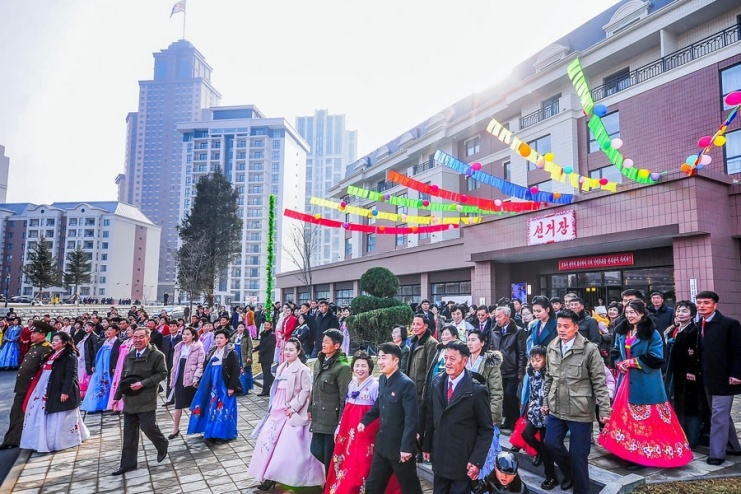
North Korea’s Rodong Sinmun newspaper reported on Oct. 8, 2024, that this year’s rice harvest was expected to exceed plans by more than a ton on average and that threshing began one week earlier than last year due to applying scientific farming techniques per the Juche farming method. (Rodong Sinmun, News1)
The Rodong Sinmun, the official newspaper of North Korea’s Workers’ Party of Korea (WPK), reported on Feb. 28 that participants of the Ninth Congress of the Workers’ Party of Korea had carried out various political and cultural activities.
1. Overview of the Ninth Party Congress
The Ninth Congress of the Workers’ Party of Korea was held in Pyongyang from Feb. 19 to 25. In the congress report, the gathering was described as expressing to the world the party’s political stance and will, with the ideological, technical, and cultural three revolutions serving as a lifeline for the strategic line of building an independent, self-reliant, and self-defensive state and constructing socialism.
The agenda items discussed at the Ninth Congress were the review of the work of the WPK Central Committee, revision of the WPK bylaws, and the election of the party’s central leadership organs. In the work review, a positive assessment was made, stating that the congress had become a launching pad for even greater transformation and success to advance to the next stage of building socialism with our own style, across the full spectrum of the party’s and state’s work in politics, the economy, culture, national defense, and foreign affairs as raised at the Eighth Congress.
The review report of the Eighth Central Committee work, covering Feb. 20 to 21, addressed achievements accomplished during the review period, the prosperity of the state and the welfare of the people, the expansion and strengthening of foreign relations, and the deepening and development of party building and party work.
The report assessed that, while the internal and external environment during the previous five-year plan period had been complex and harsh, the period had produced a breakthrough advance in the struggle for the prosperity and flourishing of the country and the welfare of the people.
2. Achievements of the Eighth Central Committee period
Pioneering a new trend of comprehensive socialist development
In his report, Kim Jong Un identified the most important achievement of the Eighth Central Committee period as pioneering a new trend of comprehensive socialist development. He stated that the simultaneous and balanced development of every sector and region of state building and every branch of the people’s economy is a fundamental principle and a task of the times for achieving the complete victory of socialism. He also reported that the party had formulated the New Rural Revolution Program for the new era and established a guidance system for its implementation, alongside organizing and balancing the overall branches of the national economy.
In addition, the report assessed that, as a result of technological restoration and development work across various branches of the people’s economy aimed at completing an independent production structure and modernizing backward sectors, a material and technological foundation for increasing productivity had been laid and begun to enter a normal trajectory, opening the possibility of activating the overall economy.
Fundamentally resolving the agricultural and rural problems
In the achievements report, it was assessed that various projects had been carried out to resolve rural problems, producing a transformation in the grain production structure, improving what had been weak agricultural productivity, and creating a trend in which backward rural villages were being renewed. At a national sub-work team leaders conference held in 2014, Kim Jong Un instructed the improvement of the agricultural production structure toward a grain-centered structure, saying that because resolving the food problem was urgent, the cultivation area for non-grain crops should be reduced and that for rice and corn should be increased.
However, at the Fifth Session of the 14th Supreme People’s Assembly in 2021, he stated that the grain production structure should be shifted to wheat and barley, yields per jongbo raised, and white rice and flour guaranteed to the people so as to improve their dietary life. This shift in agricultural production structure was a highly significant agricultural policy change with major implications for food security, farming methods, farming schedules, and farm management.
Launching a revolution to develop cities and counties
The report highlighted as particularly significant during the review period the launch of a vast revolution to develop cities and counties across the country, and addressed the motivation and goals behind the 20×10 Rural Development Policy as well as the achievements made over two years. This policy was described as aiming to rebuild local industrial factories in a completely new and advanced manner in order to develop the overall economy of backward localities. Through this, the report assessed that the policy had expanded and deepened into a wide-ranging rural development policy covering science, healthcare, and civilized life for the local population.
Kim Jong Un’s local development policy is to construct the three essential elements centered on food processing factories, daily necessities factories, and other light industrial factories, along with healthcare and cultural facilities and grain management centers, by utilizing local raw material sources taking into account regional characteristics. This is a Kim Jong Un-style local development policy unprecedented under his predecessors, with the political intention of ultimately activating local economies, realizing the people-first principle, improving living standards, and consolidating loyalty to the party.
Expanded implementation of socialist policies for improving the national economy and the welfare of the people
The report stated that the Central Committee had strengthened the cabinet responsibility and cabinet-centered systems to manage the overall economy in a unified manner and that, under the cabinet’s guidance, national self-sufficiency, planned self-sufficiency, and scientific self-sufficiency had been realized. It also noted that the party had set and concentrated on 12 major heights for developing the people’s economy (grain, power, coal, rolled steel, non-ferrous metals, nitrogen fertilizer, cement, timber, fabric, marine products, housing, and rail freight transport), contributing to the activation of the overall economy.
Following sweeping sanctions on North Korea in 2017, as the country found itself in a situation of global economic isolation, it adopted self-sufficiency as a political ideology. National self-sufficiency here can be understood as self-sufficiency pursued by the entire country in a total mobilization system, whereby all industrial sectors participate in an integrated manner under the guidance of the central party and cabinet, with the aim of concentrating national capacity in full under the conditions of anti-North Korean sanctions. Planned self-sufficiency is self-sufficiency pursued systematically in accordance with the state’s socialist economic plan, whereby the allocation of resources, production targets, and work priorities linked to the five-year strategy presented at party congresses are centrally determined and then realized by local cities and counties. Finally, scientific self-sufficiency is self-sufficiency that raises productivity not through simple labor input but through science and technology development, emphasizing technological innovation in information technology, automation, and energy efficiency. To this end, Kim Jong Un emphasized the transformation of all people into science and technology talent and concentrated on practical education and talent cultivation.
3. Goals to be achieved during the Ninth Central Committee period
Requirements of the era of comprehensive development
The congress identified the following as tasks of the era to be observed during the period of comprehensive development: continuing to deepen work to ensure unified action and strong discipline across all of socialist construction; breaking down old formulas, frameworks, conservatism, and empiricism, and ceaselessly creating and innovating new things; conducting work with scientific foresight and in a practical and beneficial manner while emphasizing professional competence; innovating the methods and means of leadership over production and construction and enhancing the command capacity of officials; and struggling against negative phenomena that conflict with the principle of resolving all matters with ideological power and the spiritual strength of the masses, and with the people-first principle.
The fundamental task of the new five-year plan period was set as consolidating the achievements made during the Eighth Central Committee period, building a development foundation capable of stably and sustainably growing the national economy, and tangibly improving the people’s living standards. To this end, the new five-year plan period was framed as a stage of stabilization and consolidation, and a stage of gradual qualitative development. This can be interpreted as meaning that, during the Ninth Central Committee period, new projects will not be expanded, and economic growth will be pursued through internal stabilization. The reasoning for this is presumed to reflect both internal factors, such as insufficient resources and capital due to the push to implement the 20×10 Rural Development Policy during the Eighth Central Committee period, and external factors including anti-North Korean sanctions and a complex international situation.
At the Eighth Congress, the failure of Seventh Congress policies was acknowledged and a five-year plan was implemented as a comprehensive reorganization and reinforcement system, whereas at this Ninth Congress, the strategy was revised to a stage of stabilization and consolidation and a stage of gradual qualitative development.
Sector-by-sector targets for the new five-year plan period
The congress set tasks for the metallurgy, chemical, power, coal, and machine industry sectors and for the resource development, extractive industry, forestry, and rail transport sectors during the new five-year plan period. This remains consistent with the 12 major heights set at the Sixth Plenary Session of the Eighth Central Committee in late 2022 (grain, power, coal, rolled steel, non-ferrous metals, nitrogen fertilizer, cement, timber, fabric, marine products, housing, and rail freight transport), confirming that the focus remains on realizing the stages of stabilization and consolidation and gradual qualitative development.
In the light industry sector, the goal was set to increase the production of consumer goods for the people by improving quality and developing new products, and to build a new industrial light industry foundation. This can be seen as a political means of emphasizing productivity and accountability at the local industrial factories built through the 20×10 Rural Development Policy during the Eighth Central Committee period, and in particular of inspiring the loyalty of the younger generation to the party through improvements in the quality of students’ school uniforms, bags, and the like.
It was also noted that socialist obligations should be accurately fulfilled without even minor deviations, serving once more as a reminder for county-level officials of the need to root out corruption and reinforce ideological party spirit.
Aquaculture and mariculture were designated as the fundamental direction for developing the fisheries sector, and their large-scale implementation was called for. Kim Jong Un completed construction of coastal aquaculture facilities in Sinpo city, South Hamgyong province, and in Ragwon county in 2024, which appears to have been the background for this emphasis. In 2015, Kim Jong Un stressed resolving the food problem with agriculture, livestock, and fisheries as three pillars. Fisheries achievements were not heavily highlighted, but it appears the intent was to breathe new life into the sector through the construction of coastal aquaculture facilities.
4. Grain production targets and tasks in the agricultural sector during the Ninth Central Committee period
Deepening grain production structure reform
In the agricultural sector, the congress called for continuing to deepen the work of changing the grain production structure and expanding wheat processing capacity.
At the Fifth Session of the 14th Supreme People’s Assembly in 2021, Kim Jong Un showed his intent to shift the production structure from rice and corn to rice and wheat-barley in order to improve the dietary structure of the people. As seen in Table 1, which shows the cultivated area and production volume of food crops in North Korea as announced by the Rural Development Administration (2025), the cultivated area and production volume of wheat and barley more than doubled compared with 2019.
On Sept. 18, 2025, the Rodong Sinmun reported that the organization in charge of constructing wheat processing bases and the Grain Management Ministry had steadily pushed forward work to build up processing capacity in line with increased wheat production, and that since the Fourth Plenary Session of the Eighth Central Committee, the country’s overall wheat processing capacity had increased by nearly double, contributing to improving the dietary life of the people. It also reported that the Kangryong wheat processing factory (South Hwanghae province) and the Singye wheat processing factory (North Hwanghae province) had been established; that wheat processing factories in Haeju, Nampo, and Songrim had been rebuilt and modernized at a high level; and that wheat processing factories had been built at grain management centers in various cities and counties in accordance with regional production volumes.
The reason North Korea shifted its agricultural structure toward wheat and barley farming is primarily that, in a situation where it became difficult to import farming inputs such as fertilizer following anti-North Korean sanctions and the COVID-19 pandemic, wheat requires less fertilizer than corn and has the advantage of being a double-cropping crop. In addition, the price of flour, which had been reliant on imports, skyrocketed due to sanctions, and in particular, changes in the dietary habits of North Korean people were among the causes. Kim Jong Un’s intent can be interpreted as resolving the food problem by increasing the production of grain crops such as wheat and barley, and providing the people with diverse foods through the processing of those crops.
Table 1. Cultivated area and production of food crops in North Korea (Units: 1,000 ha / 10,000 MT)
Year
Rice area
Rice output
Corn area
Corn output
Tubers area
Tubers output
Wheat & barley area
Wheat & barley output
Beans & misc. area
Beans & misc. output
2012
571
204
711
173
336
56
85
19
160
16
2013
571
210
711
176
336
58
85
18
159
19
2014
571
216
711
172
336
56
85
17
159
19
2015
571
202
711
164
343
50
85
16
159
18
2016
571
222
711
170
343
55
85
17
159
17
2017
571
219
711
167
343
53
85
15
159
17
2018
571
220
711
150
343
54
85
15
159
16
2019
502
224
757
152
348
57
80
15
175
16
2020
502
202
757
151
348
54
80
16
175
17
2021
502
216
757
159
348
57
80
16
175
21
2022
502
207
757
157
348
49
80
18
175
20
2023
502
211
739
170
349
58
119
22
156
19
2024
519
215
719
161
344
54
142
28
188
20
2025
536
225
693
152
344
55
173
36
160
22
Source: Rural Development Administration press releases (2012–2025), compiled by the author
Increasing agricultural productivity through the five elements of agricultural development
The five elements of agricultural development consist of two areas of agricultural technology and three areas of agricultural production base. In the agricultural technology field, these are seed revolution and science-first farming. In the agricultural production base field, they are expanding the production area through the new-land drive, increasing grain production on low-yield land, and strengthening party guidance over agricultural work.
The fundamental content of the grain production targets to be achieved during the Ninth Central Committee period is in line with the five elements of agricultural development identified at the Fifth Plenary Session of the Seventh Central Committee in 2019.
North Korea stated the background for presenting the five elements of agricultural development as follows: in a country where mountains cover most of the land and rivers and streams are numerous, arable land is limited; for various reasons, the country’s arable land area has diminished considerably compared with the past, while the population has grown significantly and demand for food continues to rise; and the machinations of hostile forces seeking to obstruct agricultural development are also intensifying daily. As noted, North Korea faces internal problems of population growth and insufficient arable land, and external problems including difficulties in increasing food production due to anti-North Korean sanctions. North Korea can therefore be seen as having presented the five elements of agricultural development as production improvement measures to address these problems.
Table 2. Main content of the five elements of agricultural development
Category
Element
Content
Agricultural technology
1. Seed revolution
Breed superior varieties with high yields, lower fertilizer needs, shorter growing seasons, and resistance to damage; improve seed distribution and the scientific level of seed production to disseminate researched superior varieties
2. Science-first farming: scientization, digitization, and mechanization of agriculture
Apply the principles of sowing the right crop in the right place at the right time, meeting the scientific and technological requirements of farming operations; improve variety placement, fertilizer management, land utilization, and farming intensification; solve technical problems for reducing seeds, water, energy, materials, and labor while raising yields; develop and introduce highly effective fertilizers, pesticides, and other farming products; establish precision farming technology; operate science and technology promotion centers; research and develop labor-saving farm machinery
Agricultural production base
3. New-land drive to expand grain-crop cultivation area
Secure planned paddy and corn cultivation areas without exception; reclaim 100,000 jongbo of tidal flats to find new land; carry out land readjustment and consolidate fragmented paddies and fields; restore lost arable land and identify land that has shrunk below cadastral records; plant more than 1,000 additional grain-crop seedlings per farm worker in non-arable areas
4. Measures to increase grain production on low-yield land
Develop farming technologies and acquire scientific farming methods to raise grain yields on low-yield land; improve cold and wet land, add soil, remove rocks, and enhance fertility on sloped, sandy, gravelly, and rocky low-yield fields; generalize technical experience sharing sessions for units and farm workers achieving high yields on low-yield land
Party guidance
5. Strengthening party guidance over agricultural work
Strengthen party guidance so that the wishes and interests of farm workers are respected and the requirements of socialist distribution principles are accurately realized; expand the ranks of high-yield units and farm workers producing more than 10 tons of grain per jongbo; raise the role of party organizations in the agricultural sector and among rural primary-level officials to fulfill agricultural production targets
Source: Compiled by the author based on the Fifth Plenary Session of the Seventh Central Committee of the Workers’ Party of Korea
Smart farm construction
The congress called for more vigorously pushing forward the construction of modern vegetable greenhouse farms and for raising the level of scientization, intensification, and industrialization of vegetable production.
Kim Jong Un promised to ensure that North Korean people could eat fresh vegetables throughout all four seasons. To this end, during the Eighth Central Committee period, he constructed large-scale greenhouse farms on a regional basis. The intent was to supply not only grain crops but also vegetables and fruit to North Korean people, enabling them to absorb vitamins and other nutrients, while politically, through the people-first principle, highlighting his love for the people. Greenhouses have the advantage of being unaffected by natural disasters from abnormal climate or the external environment. The greenhouses North Korea has built have introduced modern technologies such as automation, hydroponics, and LED lighting, aiming to increase agricultural productivity.
Kim Jong Un mobilized military units to construct large-scale greenhouse complexes and complete them in a short period, using them for internal propaganda to showcase his achievements and to consolidate cohesion within the system. The Jungpyong, Ryonpo, and Kangdong greenhouses built during the Kim Jong Un era utilized airfield sites, and the Sinuiju comprehensive greenhouse farm was built in the Wihwa Island area that suffered flood damage in the summer of 2025.
Table 3. Comparison of North Korea’s four major representative greenhouse farms
Category
Jungpyong vegetable greenhouse
Ryonpo greenhouse
Kangdong comprehensive greenhouse
Sinuiju comprehensive greenhouse
Location
Chongjin and North Hamgyong region
Hamhung and South Hamgyong region
Pyongyang and surrounding area
North Pyongan province and North Korea–China border area
Year completed
Dec. 14, 2019
Oct. 10, 2022
March 15, 2024
Feb. 1, 2026
Site area (jongbo)
200
280
260–300
450
Source: Chung Eun-yi (2026), “The Sinuiju comprehensive greenhouse farm, the largest in scale! Will it become the new era’s ideal farm city of local development on the North Korea–China border gateway?”
Livestock
Prior to the Ninth Congress, on Feb. 2, Kim Jong Un stated at the completion ceremony of the Samgwang livestock farm that it was incomparably superior to the livestock bases considered among the best in the country, with informatization, intelligentization, intensification, and industrialization realized at a high level, calling for it to serve as a model for livestock facilities.
An attempt at livestock development during the Kim Jong Un era was the Sepho district project, which broke ground in 2012 and was completed in 2017. At the Samgwang livestock facility completion ceremony, Kim Jong Un noted that North Korea had long promoted the goal of exchanging grass for meat after the war, and there had been much fanfare about immediately solving the problem of meat and eggs after constructing large-scale livestock facilities across the country, but nothing came of it in practice. He further noted that even though a livestock base had been established in the Sepho district for nearly 10 years, the situation was the same. He identified the causes of the Sepho district’s failure: the breeding system had not been properly established; the technology for breeding superior varieties was almost entirely a blank; work to preserve and expand the excellence of superior varieties had not been done properly; all that was heard were complaints about the difficulty of supplying grain feed and protein feed without actively tackling the feed problem; and although there were many livestock facilities across the provinces with no small capacity, even basic demand could not be met due to feed shortages. It is expected that future livestock facilities will be built following the Samgwang livestock farm as a model.
The second key requirement was grasping and advancing the five links of securing superior breeding stock, guaranteeing sufficient feed, scientific rearing management, thorough veterinary quarantine, and the informatization and intelligentization of production and management.
During the early period of his rule, Kim Jong Un pushed four key links as the priority policy for livestock development, but at this congress, the informatization and intelligentization of production and management was added, making five links. The five links of livestock are consistent with Kim Jong Un’s statement at the recently completed Samgwang livestock farm, where he said that in keeping with identifying those five elements as the links of livestock development, the farm must put great effort into optimizing and advancing technical, equipment, rearing, and feed management so as to lower production costs while raising product quality, so that the validity and vitality of the party’s livestock policy continues to be demonstrated in clear production outcomes.
The third key requirement was large-scale raising of grass-eating domestic animals. North Korea encourages grass-eating livestock primarily because of grain shortages. As a country with a chronic grain shortage, it is difficult to mass-raise livestock such as pigs and chickens that consume large amounts of grain feed. Grass-eating livestock such as rabbits and goats can be raised on natural grasslands in the mountains and fields without separate installation costs. There is also the aspect that, given the difficult economic conditions and limited imports of feed additives due to anti-North Korean sanctions, self-provisioning in rearing is being encouraged at each household, enterprise, and military unit, which is intended to reduce the budget burden on the central authorities and disperse production responsibility.
Agricultural production base
Along with further perfecting the country’s irrigation system, occupying the tidal flat reclamation targets, doing land readjustment well, and firmly building the material and technological base of agriculture, the mechanization level of agricultural work must be raised a step higher by pushing forward the agricultural machinery revolution.
Policy related to the agricultural production base during the Kim Jong Un era is included in the five elements of agricultural development mentioned above. North Korea also regards strengthening the response capacity of the irrigation system to catastrophic abnormal climate and ensuring a stable water supply as important policies. In particular, during the Kim Jong Un era, the intent can be glimpsed to manage irrigation systems at low cost and high efficiency by improving from energy-intensive pumping station irrigation systems to natural-flow waterways, reducing energy consumption.
North Korea’s farmland is 30% paddy fields and 70% dry fields, with an absolute shortage of land for rice farming. To address this problem, Kim Il Sung pursued a policy of reclaiming 300,000 hectares of tidal flats, centered on the west coast, from the 1980s onward. This continues as a directive during the Kim Jong Un era. However, given North Korea’s economic conditions, tidal flat reclamation is not easy, and even if developed, it is insufficient to rapidly increase agricultural productivity through farming due to salinization of farmland. For North Korea, increasing per-unit area rice production through sufficient agricultural input and scientific farming technology is more important than tidal flat reclamation. According to the Food and Agriculture Organization (FAO), post-harvest losses in North Korea amount to approximately 700,000 metric tons. Reducing such post-harvest losses is also one way to resolve the food problem.
To increase the share of agricultural machinery, Kim Jong Un distributed 5,500 units of agricultural machinery manufactured at munitions factories to South Hwanghae province, the plains region, in 2022. Agricultural machinery in North Korea is an indispensable piece of equipment for double-cropping and reducing post-harvest losses. To this end, Kim Jong Un has pushed forward the rebuilding and modernization of the Kumsung Tractor Factory and the Haeju Agricultural Machinery Parts Factory.
Local development and rural construction
The congress presented tasks and methods for further accelerating local development and rural construction during the new five-year plan period, bringing about notable changes to localities and rural areas each year, and bringing about a major transformation in the material and civilized life of the people across the country. Starting this year, local industrial factories, hospitals, and comprehensive service centers must be built in 20 cities and counties each year, while the way of fighting and pace of advance of starting construction at the beginning of the year and completing it by the end of the year must be firmly adhered to.
The congress cited as an achievement of the Eighth Central Committee period the 20×10 Rural Development Policy, whereby a revolution to develop cities and counties across the country had been launched. This policy was assessed as one for completely rebuilding local industrial factories in a new and advanced manner after analyzing and accumulating experience from past mistakes related to local economic development. This local development policy was reported to have expanded and deepened into a wide-ranging local development policy covering science, healthcare, and civilized life.
For example, the rural villages of Samjiyon city were transformed in a modern fashion, and as a result of pushing forward the construction of rural housing in all cities and counties across the country, more than 110,000 households of agricultural workers moved into new homes over the past five years.
At the Fourth Plenary Session of the Eighth Central Committee of the Workers’ Party of Korea in late December 2021, Kim Jong Un reported on immediate tasks for properly resolving the country’s socialist rural problems. In the report, he called for opening a great new era of socialist rural development, stating that at a time when the struggle for comprehensive socialist development has become a mature demand, revolutionarily transforming rural areas is raised as an important revolutionary task for reversing the difficult situation into a phase of strengthening national forces and achieving the revival and development of the state and the promotion of the welfare of the people. After that, Kim Jong Un legally codified the County Development Act (2021), the New Era Rural Construction Program (2021), and the Socialist Rural Development Act (2022), and strongly pushed forward policy implementation.
In the early period of his rule, Kim Jong Un sought to activate the economy through foreign capital via special economic zones and economic development zones, but seemed to set that dream aside after sweeping anti-North Korean sanctions and the failure of the Hanoi summit. However, the 20×10 Rural Development Policy can be seen as a substitute for local development through self-sufficiency. The core of local development is the construction of local industrial factories, specifically light industry producing food-processed goods and products necessary for the people’s daily life. For food processing to succeed, diverse agricultural products must be produced in large quantities. For example, wheat must be produced in order to process it into soybean paste, bread, noodles, and other food products.
5. Agricultural outlook during the Ninth Central Committee period
In July 2021, North Korea presented a voluntary national review report on its Sustainable Development Goals (SDGs) at the UN High-Level Political Forum. In the report, North Korea stated that grain production targets would be achieved through increases in per-hectare yields and expansion of crop cultivation areas via seed production, scientific farming, increased production on low-yield land, the new-land drive and tidal flat reclamation, irrigation, and agricultural mechanization, as well as through increased state assistance to the rural economy. It also stated that policies to produce results in livestock, fisheries, and vegetable and fruit cultivation were being pursued for sustainable development in agriculture.
In addition, it noted that an agricultural development strategy for developing agricultural science and technology should be revised and implemented on a sustainable basis, and that the industrialization of seed processing and quality management, improvement of wheat and barley strains as double-cropping crops, diversification of vegetable seeds, promotion of organic farming, industrialization of vegetable production, introduction of advanced cultivation methods, and construction of an agricultural information system would proceed. The agricultural policy presented at the Ninth Congress largely does not depart from the sustainable development goals North Korea has stated.
Prior to the Ninth Congress, Kim Jong Un widely promoted the completion of the Sinuiju comprehensive greenhouse farm and Samgwang livestock farm, greatly heightening the atmosphere leading up to the congress. No new task content in the agricultural sector emerged at the congress, and the focus appears to be on stably continuing existing agricultural policy. This is consistent with the emphasis at the congress on a stage of stabilization and consolidation and a stage of gradual qualitative development during the Ninth Central Committee period. In particular, Kim Jong Un is expected to concentrate on the 20×10 Rural Development Policy in order to resolve the agricultural and rural problems.
Read in Korean