European Parliament President Roberta Metsola is no stranger to online criticism. After more than two decades in politics, she has learned that public life often comes with a constant stream of commentary, much of it personal and sometimes harsh.
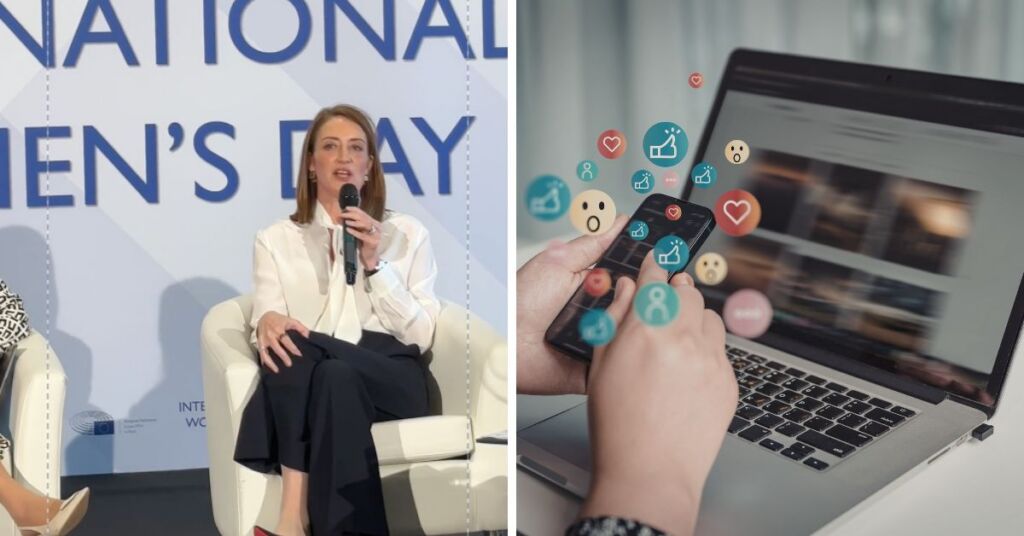
Speaking at an International Women’s Day event in Valletta, Metsola reflected candidly on her own experience of public scrutiny and the personal attacks that often accompany political life. She acknowledged that dealing with criticism, particularly online, remains one of the most difficult aspects of the role. “The most important thing is that when you are attacked you have to separate yourself from the commentators,” she said. “But that is the hardest thing, especially in Malta when you probably know who the people commenting are.”
She admitted that the instinct to read comments can be difficult to resist. Even after two decades in politics, she joked that members of her own family still keep track of what is written about her online.“My mum is here and she still reads everything,” Metsola said admitting, “I keep telling her that after 20 years maybe she should stop. It is getting worse.”
Despite this, Metsola stressed that fear cannot dictate how leaders behave or whether women choose to pursue public office. If people in positions of responsibility allow themselves to be intimidated, she warned, they may hesitate to take decisions that are necessary for the public good. “You cannot be afraid,” she said. “Because if you are going to be afraid, people who are in positions of responsibility might not be working for what is better for you.”
During the event, Metsola also spoke about her visits to schools across Malta. “My message to these kids when I see them is that at some point you are going to be online,” she said. “You might say something correct or incorrect, or maybe something you regret. Do not be scared when the reaction is very hard.”
“Building a thick skin is not something I am very good at,” she admitted. “People think that after 20 years of being at the receiving end of hostility you would have mastered it, but that is not always the case.”
Metsola also highlighted how online attacks against women often differ from those aimed at men. Female politicians, she said, are frequently targeted with personal comments about their appearance, clothing or how tired they look.
“With women it is worse,” she explained. “It becomes about your looks, what you are wearing, whether you look tired. These are things men simply do not get.” Her concern, she said, is that this type of criticism may discourage young women and girls from considering a career in politics.
“What I certainly would not like is for people to be discouraged from doing what I do because of the experiences that I face,” she said. “I want to combat that and overcome it.” “Every day is a new day,” she said. “I tend to dwell too much on mistakes I have made, but you have to learn to move forward.”
She also spoke candidly about the challenge of balancing public life with family life. Having grown up in schools that instilled a strong sense of discipline and responsibility, she said she had to learn not to carry unnecessary guilt. “I have learned to try to overcome the feeling that I should feel guilty,” she said. “I do not feel guilty today that I am away from my children, and I will not feel guilty tomorrow that I am away from my work.”
Still, she admitted that maintaining boundaries with technology remains a challenge. One habit she continues to struggle with is checking her phone during the night. “That is something I still need to master,” she said. “Not waking up and looking at my phone. I am not very successful at that.”
One exception, she added, is Sunday afternoon, when she deliberately puts her phone aside to spend time with her children after a busy week. Experience has taught her that this is often when online criticism peaks. “Sunday afternoon is the worst period,” she said. “That is the day when you receive the most comments. I have diagnosed this myself after years of criticism.” Even so, Metsola said she has learned to approach the scrutiny with perspective. Her mornings often begin with a glance at the newspapers to see how she is portrayed, including the occasional caricature.
Her message for young women considering politics remains clear. Do not allow fear or hostility to dictate your ambitions.