Guwahati: In a significant scientific breakthrough from Northeast India, researchers have described two new species of freshwater fish from Nagaland, naming them after the son and daughter of a late collaborator, fulfilling what was among his final wishes.
The discoveries, published in the international journal Zootaxa, were made by J. Praveenraj of the Indian Council of Agricultural Research – Central Island Agricultural Research Institute (Andaman & Nicobar Islands) and independent researcher Balaji Vijayakrishnan of Mumbai.
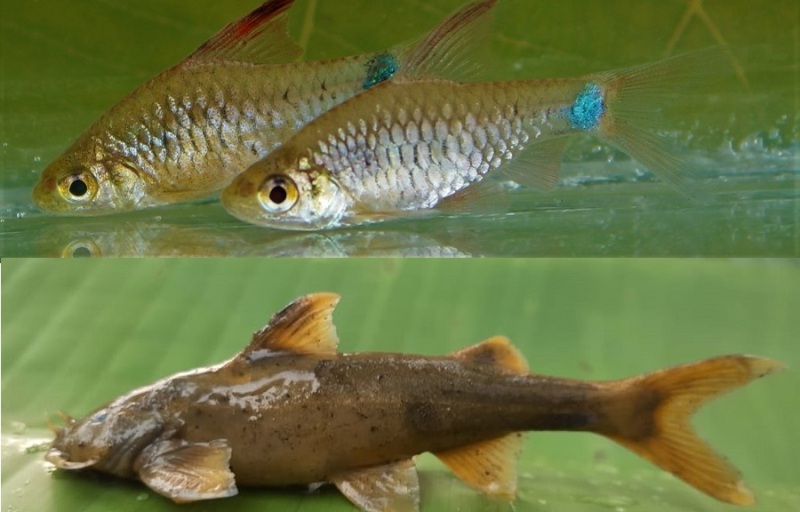
The two species — Glyptothorax sentimereni and Oreichthys elianae — were discovered during ichthyological surveys in tributaries of the Brahmaputra River in Mokokchung district, adding to growing evidence that Nagaland’s river systems remain vastly understudied and biologically rich.
A Personal Tribute Through Science
J. Praveenraj said the newly described species were named in honour of the daughter and son of his late collaborator, Limakum, an assistant professor from Nagaland.
“This was his last wish,” Praveenraj recalled. “He wanted his children’s names to live on in science.”
The newly described species were named in honour of the daughter and son of his late collaborator, Limakum, an assistant professor from Nagaland.
“These species are especially close to my heart,” he added. “They were named after the beloved son and daughter of my late collaborator. Before he passed away, it was his wish that a species be named in their honour. Fulfilling that wish was more than taxonomy — it was a tribute to friendship, dedication, and the passion he had for science and his family.”
Esther Watinaro, wife of the late Limakum, said the discoveries reflected his lifelong commitment to zoological research.
“Limakum’s passion for seeking new knowledge in zoology led him to discover new species time and again along with Praveenraj — these being his fourth and fifth discoveries. Tireless hours of work and patience culminated in these exciting findings. I am very proud of his work, and I hope it encourages young scholars to pursue new knowledge with the same zeal he always wished for,” she said.
The Species
Glyptothorax sentimereni, discovered in the rocky Dikhu River, belongs to a group of torrent-dwelling catfishes known for their ability to cling to fast-flowing streams.
The species is distinguished by a rhomboidal thoracic adhesive apparatus completely encircled by keratinised striae — essentially a natural suction mechanism that enables it to anchor itself to rocks in strong currents. It also possesses serrations on its dorsal-fin spine and a plicate (folded) ventral surface on its pectoral and pelvic fins — features that separate it from closely related species across the Ganges–Brahmaputra–Meghna basin.
So far, the species is known only from shallow (about 0.5 metres deep), boulder-strewn stretches of clear water in the Dikhu River in Mokokchung.
The second species, Oreichthys elianae, was found in a small tributary of the Tsurang River. Unlike the cryptic catfish, this tiny cyprinid stands out for its vivid coloration — bright red dorsal, pelvic, anal, and caudal fins, along with a striking black blotch at the base of the tail.
Measuring just over 2.5 cm in standard length, the fish has an incomplete lateral line with only five pored scales and 14–15 pores on the cheek — a combination of traits that clearly distinguishes it from related species across India and Southeast Asia.
The species is named after Eliana, daughter of the late Limakum.
A Biodiversity Frontier
The authors note that Nagaland lies at the confluence of the Eastern Himalaya and Indo-Burma biodiversity hotspots — a region shaped by tectonic shifts, river capture events, and a complex geological history.
While orchids, amphibians, butterflies, and beetles have received increasing scientific attention, freshwater fish diversity in Nagaland remains poorly documented. The earliest ichthyological surveys date back to the 1930s, and only in recent years have systematic studies begun to accelerate.
The discovery of these two endemic species underscores how much of Northeast India’s aquatic biodiversity remains hidden — even within river systems connected to the mighty Brahmaputra.
Beyond taxonomy, the findings carry a deeper message: local collaboration, dedication, and personal bonds continue to shape scientific discovery in India’s remote landscapes.
Related
!function(f,b,e,v,n,t,s)
{if(f.fbq)return;n=f.fbq=function(){n.callMethod?
n.callMethod.apply(n,arguments):n.queue.push(arguments)};
if(!f._fbq)f._fbq=n;n.push=n;n.loaded=!0;n.version=’2.0′;
n.queue=[];t=b.createElement(e);t.async=!0;
t.src=v;s=b.getElementsByTagName(e)[0];
s.parentNode.insertBefore(t,s)}(window, document,’script’,
‘https://connect.facebook.net/en_US/fbevents.js’);
fbq(‘init’, ‘609578899588292’);
fbq(‘track’, ‘PageView’);