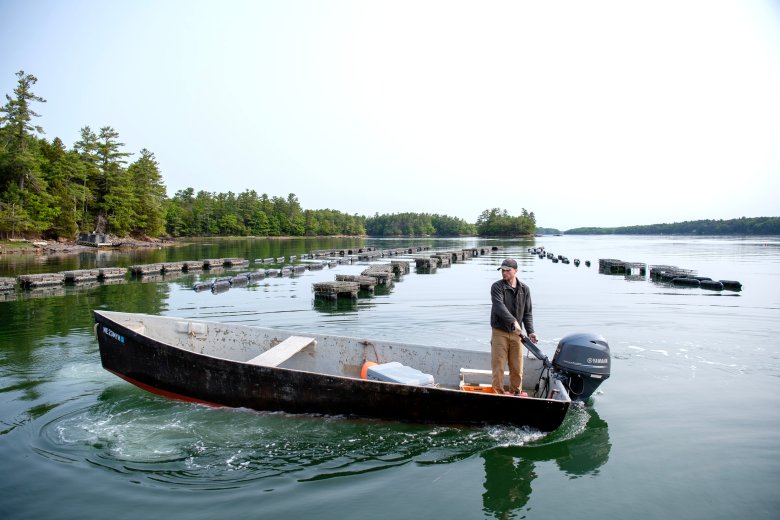
Max Burtis, co-owner of Bombazine Oyster Company, pulls up to the work float at his oyster farm on the New Meadows River in Brunswick in June. (Daryn Slover/Staff Photographer)
The University of Maine is rolling out a free satellite-driven model to help oyster farmers predict when their crop will reach market size, bringing high-tech precision to the hunt for the best tidal sites along the state’s coast.
Using satellite data from NASA, the U.S. Geological Survey and the European Space Agency, the model is the foundation of a January research study in the journal Aquaculture. The accuracy was verified by testing it against oyster growth rates at five Maine oyster farms.
The online dashboard is coming out at a time when Maine’s oyster sector is booming.
Between 2015 and 2024, the value of Maine’s wild and farmed oysters jumped from $4.5 to $14.9 million, according to the Maine Department of Marine Resources. According to the department’s most recent landings data, oysters are now Maine’s third-most valuable fishery, behind lobsters and soft-shell clams. Ninety-five percent of those landings are farmed oysters; wild oysters make up the rest.
The new model relies on a trio of biological indicators: sea surface temperature, chlorophyll levels and water cloudiness, according to project researcher Tom Kiffney, a postdoctoral researcher at UMaine’s Aquaculture Research Institute and lead author of the journal study.
In the world of the eastern oyster, hotter is better, Kiffney said. In the warm, nutrient-rich waters of the upper Damariscotta River, which produces most of Maine’s oysters, an oyster can reach market size of 2 inches in just one year, he said. In cooler areas, that process can take four years.
Aquatic animals do not regulate their own body temperature, said Sebastian Belle, the executive director of the Maine Aquaculture Association. That means that every degree of warmth acts like a “turbo reactor” for their metabolism, he said.
“The growth rate of the animals and plants on your farm is a compound interest rate on your largest asset,” Belle said. “If you have two different bank accounts, and one has a 1 percent growth rate and the other has 2 percent, you’re essentially doubling the value of that asset.”
Maine’s 3,500-mile-long coast is a labyrinth of drowned valleys and estuaries. The UMaine tool allows growers to click on a coastal map to check a site’s temperature and food supply — data that was previously available through an earlier university model — and estimated time-to-market.
Projections are based on a formula that considers how oysters divide their energy among growth, survival and reproduction, Kiffney said. Using satellite data on sea temperature and chlorophyll, which tells you how much food is in the water, the model can predict how fast oysters will grow.
The leap to satellite data marks a technological evolution for the industry. A decade ago, farmers had to go out in boats to manually measure water parameters every week, Belle said.
That is hard to do when two tidal sites just 500 feet apart can behave differently. One might be warmed by a nearby tidal mud flat that acts as a solar water heater, where high tide water warmed by sunbaked mud provides a localized temperature boost as the tide recedes, Belle said. Another site might be chilled by deep-water currents or underwater springs.
“The characteristics of a site determine whether or not you’ll have a successful farm,” Belle said.
The research team at UMaine verified the model by comparing its projections against seven years of actual oyster growth at three commercial farms and two research sites in Maine, from Casco Bay up to Penobscot Bay, Kiffney said. Estimated and actual growth rates were a few weeks apart, he said.
Max Burtis, co-owner of Bombazine Oyster Company, said lenders want detailed production projections.
“They want to know oyster production by month,” Burtis said. “They want to know how many oysters I can expect to bring to market in August as opposed to September. They want that growth data as close as we can get it to close that loan.”
Banks have started writing more loans for aquaculture as the industry matures and the data becomes more reliable, according to both Belle and Burtis.
They say the easy, free access to the UMaine data dashboard is the tool’s greatest strength.
“It distills this really complex biological and oceanographic system into something that anyone can use,” Burtis said. “It will give people the confidence, financial or otherwise, to start farming.”
The researchers aren’t stopping at oysters. Kiffney said he hopes to use observations from a NASA satellite launched in 2024 to identify what kind of plankton is present at individual sites, not just how much. That will allow him to expand the model to scallops and mussels, he said.