While questions remain about why a 23-year-old New York law student crashed his rental car through a gate at a power substation near Boulder City last month, terrorism experts seem agree on a disturbing outlook.
It’s likely that more such events will be planned for targets in Southern Nevada.
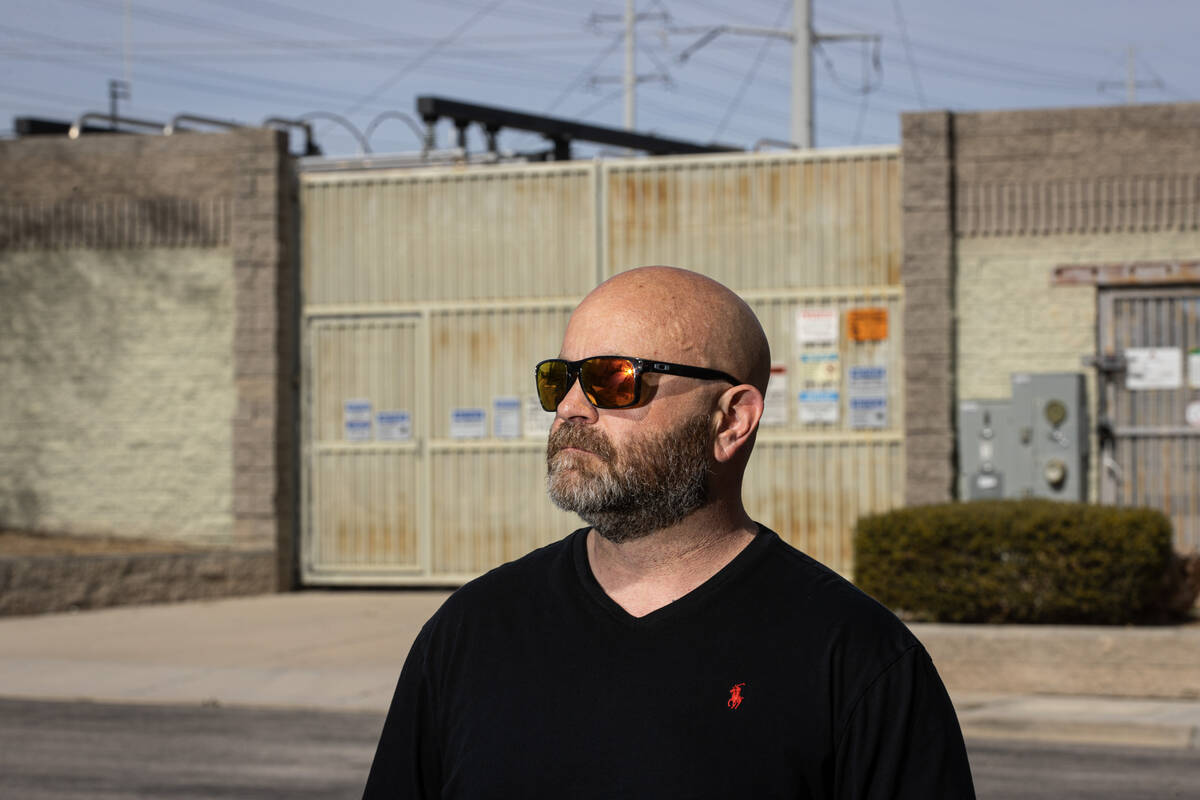
“People come from all over the world to see this amazing place, Las Vegas,” said Ashton Packe, a former counterterrorism investigator for the Metropolitan Police Department who retired in 2021. “You kind of get to be part of the story when you come here because of the glamour, the limelight, the glitz. Bad guys see that, too, and I think that’s attractive to them.”
On the morning of Feb. 19, just outside Boulder City, police said Dawson Maloney, a student at Albany Law School in upstate New York, attempted to ram the Nissan Sentra he was driving into a substation.
His motives, according to law enforcement, still aren’t fully known, though his plan appeared to be thwarted when he slammed into a set of industrial wire wheels. Police said he then shot and killed himself.
What he packed in the car — police said he had multiple guns, a trove of ammunition, two flame-throwers and other explosive materials — and what was found in the Boulder City motel room he had rented would get the attention of any terrorism expert, Packe said.
‘The threat they see gets worse day by day’
If there’s one thing that any counterterrorism expert will probably always say, it’s that it would be impossible to stop all terrorist events. Packe, a former detective sergeant for Metro’s Counter Terrorism Section, is no different.
“Unless you’re in a police state like a North Korea, you can never get the number to 100 percent when you talk about prevention,” Packe said. “Look, we got lucky on this one. I think that air bag hit (Maloney) in the face and shook him back to reality and he ended up killing himself. It could have been much worse.”
Clark County Sheriff Kevin McMahill, Metro’s top cop, recently announced that the department will beef up its Counter Terrorism Section through an initiative called The Meridian Project, which will be rolled out through the end of the year.
McMahill talked about the project the day after the Boulder City attack, at Metro’s annual State of the Department address.
“Our counterterrorism teams are working harder than ever before, they’re overwhelmed, and I need to give them some additional resources to be able to continue to keep our community safe,” McMahill said. “The threat they see gets worse day by day.”
Las Vegas has long been seen as being vulnerable to terror attacks. In 2007, a Rand Corporation study ranked Las Vegas as ninth among American cities most likely to suffer a major terrorist strike.
McMahill is known to be a proponent of technology and how advances in certain areas — like artificial intelligence, drone usage, facial recognition, and license plate readers — can help policing efforts.
The enhancement, McMahill said, will feature a staff of seven analysts, who will work around the clock from the department’s “Fusion Watch” surveillance center to monitor any possible threats. McMahill said the department will shift manpower resources to staff the project.
“At Metro, we all feel like we’re going to continue to be a target (in Las Vegas),” McMahill said. “We need to do something about it. We’re going to protect Las Vegas like never before. When something happens anywhere in the world that could impact Las Vegas, we will not wait days or weeks for a report. The team will assess it immediately.”
McMahill said there will also be a boots-on-the-ground aspect in places other than Las Vegas, including international locations, which McMahill called “liaison posts.”
“Yes, that means LVMPD personnel stationed in other cities,” McMahill said. “They will travel to connect with other partner agencies that experience terrorist attacks. Privately funded, Project Meridian will ensure that we have the global goal of connectivity to match the global threats our community faces.”
Terror events in Southern Nevada
Since the Oct. 1, 2017, mass shooting at the Route 91 Harvest festival, the Las Vegas area has had multiple run-ins with terrorism.
On New Year’s Day 2025, a decorated Army soldier fatally shot himself in a Tesla Cybertruck just before it blew up outside the Trump International Hotel in Las Vegas.
Investigators said the troubled veteran from Colorado, a former Green Beret named Matthew Livelsberger, wanted the event to serve as a “wake-up call” for the country’s ills.
In 2023, Metro and FBI officials said they foiled a possible lone-wolf terror attack in Las Vegas when a 16-year-old was arrested after explosive materials were found in his home. The teen had expressed support of ISIS, officials said.
On Jan. 3, 2023, a man named Mohammed Mesmarian was found to have set a Toyota Camry on fire at the MGM Mega Solar Array, which encompasses hundreds of acres in a remote desert area about 30 miles northeast of Las Vegas.
He told an arresting officer that he did it for “the greater good” of clean energy, according to a report. He was ordered to spend up to 10 years in prison, but has since been paroled, according to Nevada Department of Corrections records.
At the news conference to announce the Boulder City terrorism event on Feb. 20, McMahill noted that Maloney seemed to have an ideological view that mixed several different extremist sentiments from the left and the right.
When they searched Maloney’s car and motel room, police said they found eight books, including a novel called “Gothic Violence,” which is about a group of terrorists who work to disable the power grid in Florida.
Its prequel is a book called “Harassment Architecture,” which includes graphic depictions of violence against minorities, transgender people and homosexuals.
The books, which are available for purchase on Amazon, were self-published by far-right author and social media influencer Mike Ma.
Email messages to several Albany Law School professors asking for information about Maloney were not returned in time for publication of this story.
“From the literature I saw, it looks like (Maloney) had a little bit of a neo-Nazi accelerationist mindset,” Packe said. “We have to wait for the after-action report to come out to find out more. The bottom line is that you can’t put a cop on every corner; we don’t live in a police state.”
Neo-Nazi accelerationism, Packe said, is an ideology that seeks to help cause the collapse of modern society. The goal, he said, is to push the reset button on society to start fresh with whites in full control.
‘Tempo’ changes
As for what could have happened had Maloney been more successful with his attack, a spokeswoman for the L.A. Department of Water and Power, which controls the substation near Boulder City, did not return messages for this story.
Meghin Delaney, a spokeswoman for NV Energy, said in an email that the utility is aware of what happened outside Boulder City and that it takes security of its equipment seriously.
“We work closely with local, state and federal law enforcement on a regular basis,” Delaney said. “Recent events impacting energy infrastructure in the United States are top of mind for us as we work to enhance the security of our energy infrastructure.”
According to NV Energy’s website, a power substation is a crucial facility that steps voltage up or down for efficient transmission and distribution of electricity, essentially acting as a connector between power plants and customers.
In August, according to the Department of Justice, a man named Brandon Clint Russell from Florida was sentenced to serve two decades in a federal prison after investigators said he conspired in 2022 and 2023 to destroy electrical facilities in Maryland.
Federal officials said Russell, a known neo-Nazi, planned attacks on transformers located within electrical substations.
Kris Goldsmith, a former U.S. Army sergeant who studies extremism and hosts a podcast called “On Offense,” pointed to Russell’s plans to attack the city of Baltimore’s power grid was racially motivated because there’s a large Black population there.
It’s an example, he said, of a motivated person with “hundreds of dollars worth of equipment” that can cause a lot of damage, even with the various local, national and global efforts to identify and stop terrorist attacks.
‘A big priority over the next several years’
Goldsmith also said the likelihood of more organized attacks has grown because of destabilization in certain parts of the world, including the Middle East, Cuba, Africa, Venezuela, Iran and Mexico.
“A person doesn’t have to have much to kill people and destroy buildings from relative safety,” Goldsmith said. “These white supremacists, you can’t predict what they’ll do. They’re going to grow more common. I wouldn’t be as afraid of a 23-year-old driving from Albany to Las Vegas. I’d be much more afraid of cartels or Iranians engaging in much more destructive and violent actions.”
During an interview Thursday, Metro Assistant Sheriff Dori Koren said there has been a shift lately in what counterterrorism experts have noticed.
Koren, like Packe, previously served as a detective sergeant for Metro’s Counter Terrorism Section. He also served as deputy chief for the department’s Homeland Security unit.
“There’s a lot of concern with the tempo that we’re dealing with and the gravity of these types of events,” Koren said. “We have an elite counterterrorism unit, one of the best in the world. That also means you need to continually invest in those types of programs to stay ahead of the threat and maintain the success we’ve had. It’s going to be a big priority over the next several years.”
Contact Bryan Horwath at bhorwath@reviewjournal.com. Follow @BryanHorwath on X.