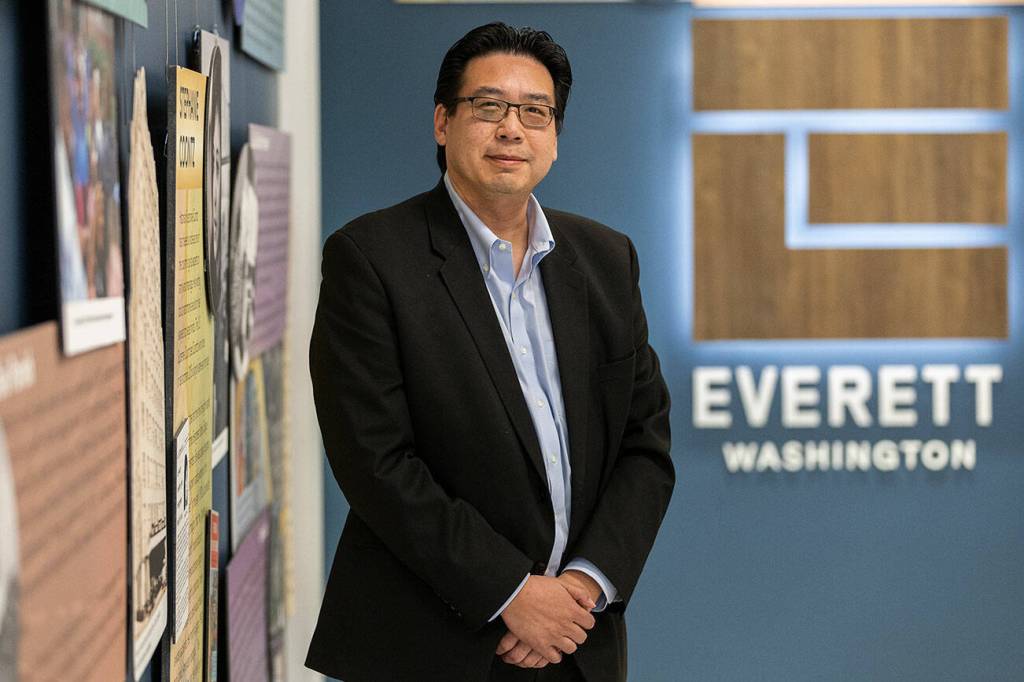
EVERETT — Mike Fong, the city of Everett’s newly hired deputy mayor, will try to bring multiple departments of the government together in an attempt to sustainably grow the city’s economy, he told The Daily Herald in an interview Friday.
Fong’s official title is senior executive director, one of the highest-paid positions at the city with a salary ranging from about $183,000 to $239,000 per year. A previous city press release referred to Fong as the city’s senior executive director for economic development and opportunity. He joined the city of Everett in February to serve as senior executive director following the retirement of longtime city employee Lori Cummings.
He brings a lot of experience to the role. Born in Spokane and now living in Seattle, Fong began his career in local government in 2001, working as a staffer at the Seattle City Council, according to The Seattle Times. He eventually rose through the ranks to become the deputy mayor there.
In 2021, he spent a few months overseeing Snohomish County’s pandemic response and recovery before taking on a job in the Biden administration, overseeing the Small Business Administration’s Region 10, which includes Washington, Oregon, Idaho and Alaska.
After his federal work, he spent time as the director of the Washington State Department of Commerce before returning to Snohomish County to serve as its executive director for economic development.
“Mike very humbly stated his background,” said Dan Eernissee, Everett’s director of economic development, in an interview Friday. “But I don’t think there’s hardly anybody in the state that is better qualified to move levers as well as he.”
With a lengthy resume that includes government work at the local, state and federal levels, Fong said he hoped to take a “whole government approach” to catalyzing economic growth in the city, one of his key roles in the new job, the city has said.
“Where we can identify how a parks or infrastructure project can impact the opportunity to create jobs, we should be thinking about whether we have good foundational services around public safety and a social service safety net. They’re critical to employers that are looking at moving their operations or expanding their operations in Everett,” Fong said. “… If we don’t apply that lens to our thinking and our day-to-day work, it’s hard to get the outcome we want for folks that live here and the folks that are going to be living here in the next 20 years.”
Fong joined Everett at a time of rapid change in the city. Sound Transit’s Link light rail is set to arrive at Paine Field by 2037, an airport that will likely expand significantly in the coming years, he said. Combine that with other growth set to come to the city in the coming decades — tens of thousands of new residents, housing units and jobs — and it means properly planning for the increases is vital, he said.
“This organized urgency around this work is really important,” Fong said in an interview Friday. “… A 10-year horizon is really not that far when it comes to planning and development timelines. So what we do now really has the chance to shape this city, this region, for decades to come.”
But Fong thinks the city will be able to meet the challenge. During his time working in the COVID-19 pandemic, he said he saw firsthand how government was able to “do big things and help people” on an accelerated timeline, and that could serve as a reminder that government could move with expediency and efficiency if it puts its mind to it.
“We don’t want to miss this opportunity,” Fong said. “But that’s going to require us to put our shoulder into it and get some stuff done.”
Eernissee said Friday he will work together with Fong to support existing businesses in the city. Ways to do so could include improving permitting predictability, finding available industrial land for expansion, and improving connectivity to the region and beyond through better transportation infrastructure. He also said that to take advantage of regional growth, Everett would need to invest in projects like its proposed downtown stadium, known as the Outdoor Event Center.
“Creating these assets for the community is really one of the things that we feel like we have a window of opportunity to do right now,” Eernissee said.
Fong said south Everett, a fast-growing region of the city with a high risk of displacement, is a unique area with “tremendous opportunity,” he said. But the city must be proactive in planning for the coming growth in that region, he said, as displacement pressure from light rail could lead to people currently living there being priced out.
“It’s the kind of challenge that keeps our team up at night,” Fong said. “Because of the rapid pace for which that change is coming, we really have to match that.”
Everett hopes to maintain both the affordability of the south Everett region and the opportunities it gives for economic mobility, said Tyler Chism, the city’s placemaking program manager.
To address the challenges coming to south Everett, Fong said the city will look to ways to incentivize affordable housing development and opportunities for affordable homeownership. (Everett’s planning department will begin working on a subarea plan for the Casino Road neighborhood this year, a plan that will take about a year to complete). The city is also in initial discussions about possibly annexing territory around the south Everett area.
Fong also said that he would look to find strategies that could help infuse capital or provide technical assistance to small businesses. After Link light rail arrives, the city could also work with Sound Transit to leverage any potential surplus property that may be left over after construction, he said.
“Multiple interventions are going to be necessary, and none of that can be achieved without collaboration and partnership,” Fong said. “And none of it will mean anything if we don’t center community in the heart of that conversation.”
Herald reporter Jenna Millikan contributed to this report.
Will Geschke: 425-339-3443; william.geschke@heraldnet.com; X: @willgeschke.