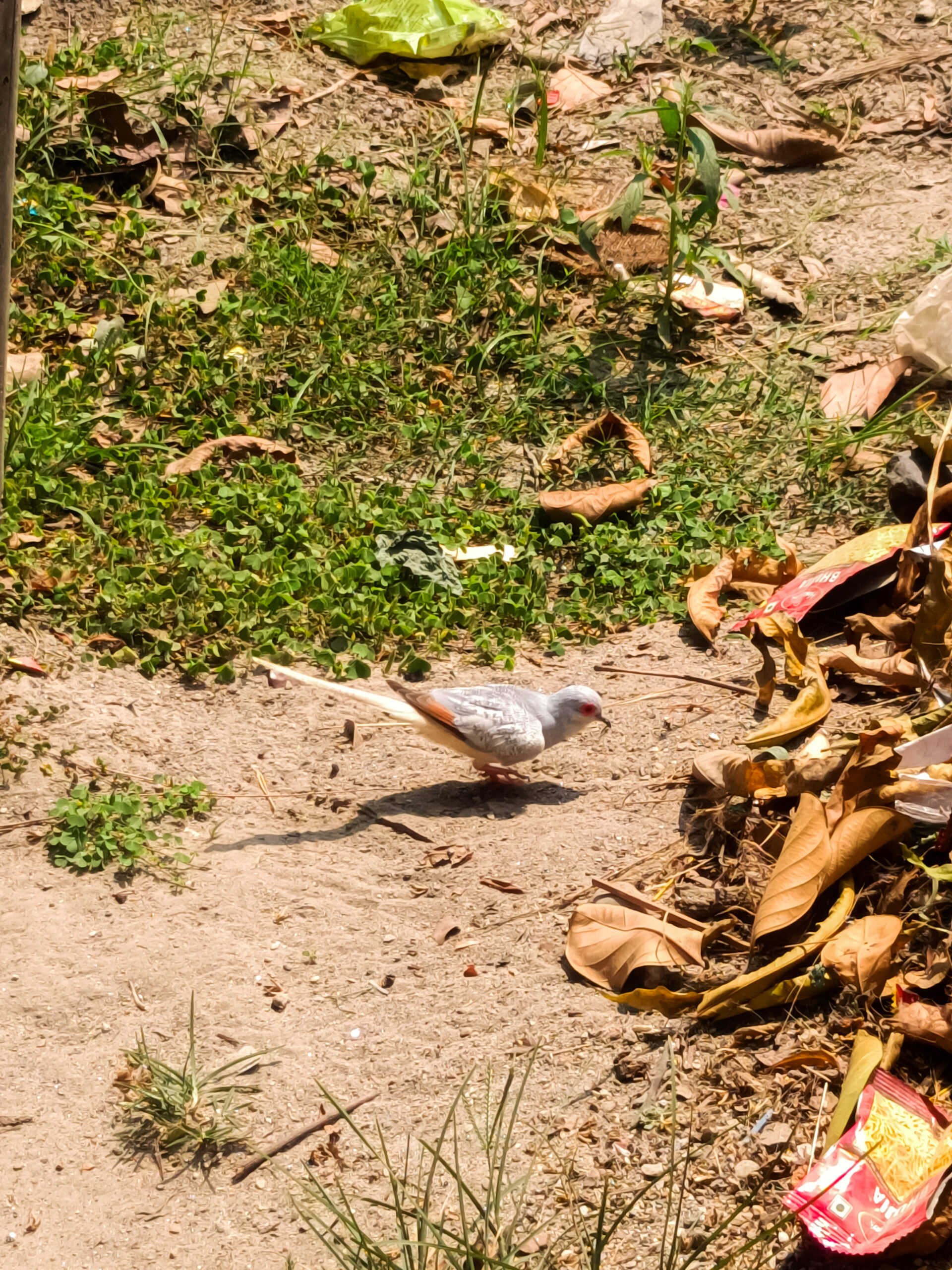
Guwahati: In a surprising bird sighting, researchers have recorded the Diamond Dove (Geopelia cuneata) — a species native to Australia — in Assam for the first time, raising fresh concerns about exotic bird introductions in India.
The sighting, published in the Journal of Threatened Taxa, documents two individuals observed on April 4, 2025, in the Runikhata Range of Sikhna Jwhwlao National Park in Kokrajhar district.
The Diamond Dove is endemic to the arid and semi-arid regions of Australia and is globally listed as “Least Concern” by the International Union for Conservation of Nature. It does not naturally occur in South Asia.
The delicate dove is characterised by a long, pointed tail and sexually dimorphic plumage. Males are pale blue-grey with spotted scapulars, a chestnut wing panel, white underparts, a black-and-white tail, a scarlet iris and pink legs, while females are browner with a duller orbital ring, and juveniles are overall duller, with fine barring, fewer spots, a lighter bill and paler eyes and legs.
Researchers Bibhash Sarkar, Bijay Basfore, Leons Mathew Abraham and Dr. Anjana Singha Naorem report that the two birds were seen foraging on the ground about 200 metres from a dried stream. Given the species’ restricted natural range, the team concludes that the birds were almost certainly escapees or deliberate releases from captivity.
The Diamond Dove is widely bred and traded in the global cage-bird industry due to its small size, ease of maintenance and ornamental plumage.
A review of citizen science platforms such as eBird and Global Biodiversity Information Facility revealed earlier Indian records from Delhi, Karnataka, Kerala and Punjab — all considered escapee sightings. However, this is the first confirmed record for Northeast India from Assam, making the observation particularly significant.
The study also notes that India has reported escapees of several other exotic bird species, including the Blue-bellied Roller, Mute Swan, Japanese Quail and Black Vulture in different states.
While many escaped birds fail to survive in the wild, some species adapt and establish feral populations under favourable conditions. The authors warn that repeated introductions increase the risk of competition with native bird species, transmission of zoonotic diseases, crop damage and economic impacts, and long-term ecological imbalance.
“One needs to advocate stricter regulation of the exotic bird trade and vigilant monitoring of non-native species,” Bijay Basfore, one of the authors of the study, said.
The researchers stress that even isolated sightings should not be ignored. If escapees repeatedly enter natural ecosystems, they may eventually establish breeding populations, complicating conservation efforts in biodiversity-rich regions like Assam.
With Sikhna Jwhwlao recently declared a national park, the unexpected appearance of an Australian dove underscores a growing conservation challenge: the silent spread of exotic species through the pet trade.
Also Read: How one network is equipping Northeast youth to confront racism
Related
Latest Stories