Summary:
- A flagship case for Liberia’s new anti-corruption drive centers on 25,000 bags of Saudi-donated rice that prosecutors say were diverted while flood victims went hungry.
- Transparency activists say the eight-month delay in the case, which accuses senior government officials of theft and conspiracy, going to trial is undermining confidence in the president’s anti-corruption push.
- Flood survivors in River Cess and Margibi say they have received no help, even as Liberia’s new Asset Recovery Taskforce says it has traced millions in stolen assets.
By Joyclyn Wea and Nemenlah Cyrus Harmon with New Narratives
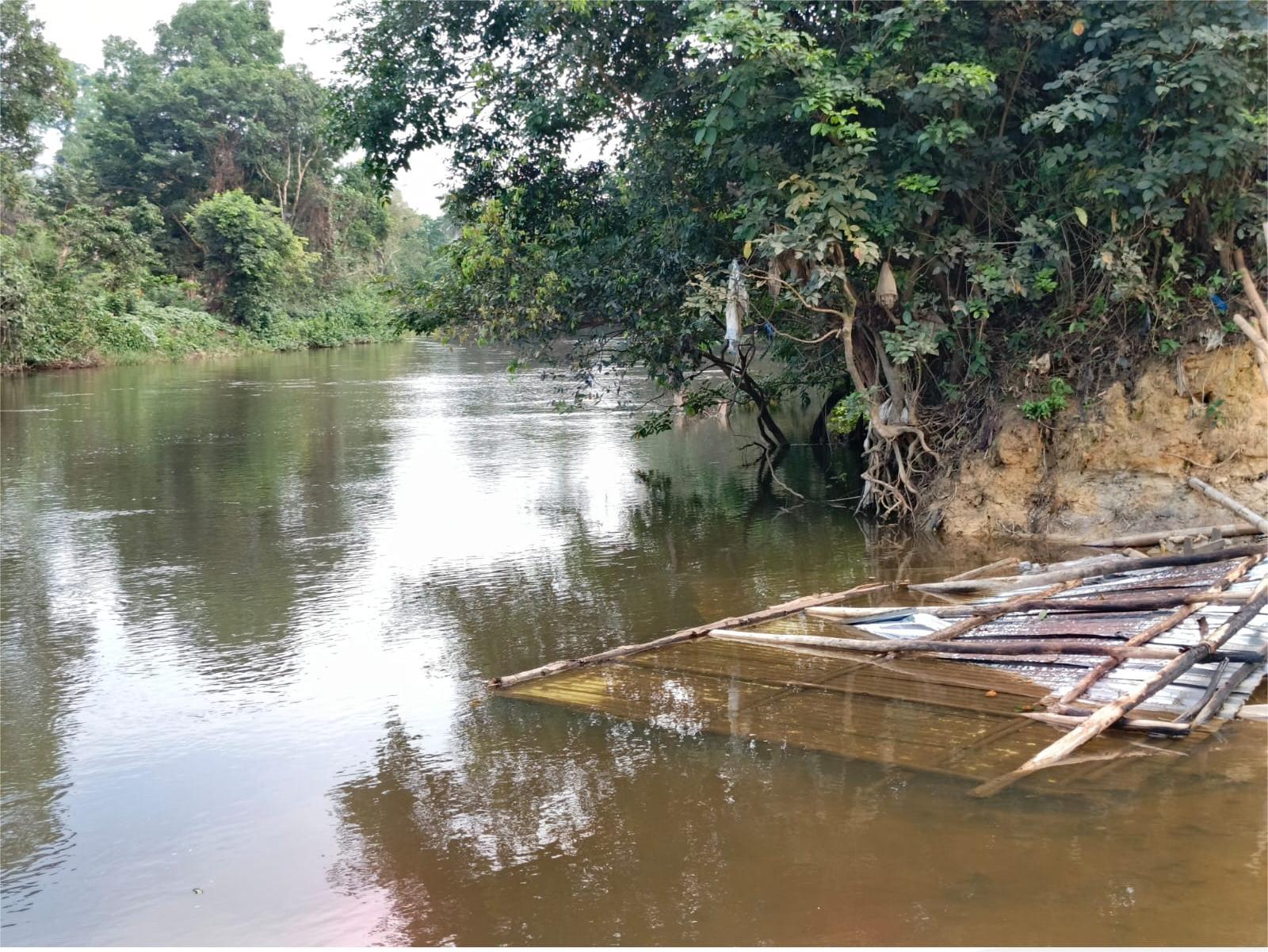
ITI VILLAGE, River Cess County -When the rain came hard in 2024, residents here in this village in the southern part of the county described a disaster: floodwaters swallowed roads, farms, and homes, stranding people and pushing families into makeshift shelters. In the same rainy season, in Kokoville, in Dolo’s Town, Margibi County, a similar disaster saw floodwater wipe away houses and knock down kitchens.
In the aftermath, government officials came to take photos. They made grand promises of help. But the promised relief never arrived. Villagers remember the hunger that followed and the heartbreaking sense that the government had abandoned them. While they heard from radio broadcasts that assistance had been delivered, they saw “not… a cup of rice,” said one.
“I feel bad because imagine your whole things left in the water, you’re sleeping outside, then they mean you with food,” said Fatu Joe, 60, a resident of Kokoville.
Ma Fatu has been forced into a three-room house where she stays with nine other family members after her own house was washed away. Credit: Joyclyn Wea
Those stories of disaster, hunger, and neglect now sit at the center of what transparency watchdogs said is one of the most politically sensitive corruption investigations Liberia has seen in years, and as a test of President Joseph Boakai’s signature pledge: that the state will no longer protect powerful people accused of stealing public goods.
When Boakai took office in January 2024, he promised Liberians something experts said they had been denied for decades: a government that goes after corruption instead of accommodating it. Nearly two years on, Boakai’s newly created Asset Recovery and Property Retrieval Taskforce, established to identify, investigate and recover stolen public assets and properties, has launched investigations and issued indictments, which taskforce officials said are already tracing millions of dollars’ worth of stolen public assets.
The ITI bridge flooded, making it impossible for people to leave the international Timba Industry Community in River Cess and other surrounding counties. Credit: Joyclyn Wea
Edwin Kla Martin, the Taskforce chairman, said the taskforce has identified about $US11 million in alleged stolen assets and that its caseload has grown from roughly 40 to 60–70 cases, with more arriving. He promised this push differs from past anti-graft efforts because investigators are being allowed to work through cases.
“We have not experienced any telephone call from anywhere to say, ‘Hey, I have an interest in that case,’” he said in an interview in his Paynesville office. “No, it has not happened.”
But accountability advocates said the case has become the test that may define the task force in the public’s mind.
“This seems to be a real societal issue… in my view, it has become a canker,” said Harold Aidoo, who heads Integrity Watch Liberia, a leading civil society transparency watchdog.
A house in Dolo’s Town, Margibi, affected by the flood, with residents seeking help to rebuild. Credit: Joyclyn Wea
Aidoo is one of several anti-corruption actors who have applauded Boakai’s actions in the last two years. In February 2025, Boakai suspended 457 officials for failing to file legally required asset declarations, ordering them off the payroll until they complied. Aidoo said the Boakai administration has sent “a strong signal” by suspending officials, including Eugene Fahngon, director general of the Liberia Broadcasting System, Jarso Jallah, Minister of Education, Dr. Louise Kpoto, Minister of Health, Mohamed Maladho Bah, Presidential Special Envoy on Investment, and Christopher Hages Onanuga, Ambassador-at-Large for Tourism, who failed to declare assets.
Boakai also directed the General Auditing Commission to conduct an audit of the Central Bank of Liberia, the National Security Agency, and the Executive Protection Service. He called for the Bank audit after highlighting what he said was a nearly $20 million discrepancy in the Central Bank’s financial reporting.
But Aidoo also flagged potential problems with the President’s approach. He warned that the Taskforce overlapped with the Liberia Anti-Corruption Commission, set up in 2008, also with a mandate to chase corruption in government officials are refer cases for prosecution.
Aidoo said the Taskforce risked duplicating mandates while scarce resources were spread “very thinly.”
Maxwell Kemayah, former foreign minister, accompanied by his lawyer and court sheriff, after his June arrest.
Now the long delay in prosecuting the Saudi rice case risks undermining that early praise.
The indictment at the heart of the case focuses on 25,000 bags of 25-kilogram rice donated by the government of Saudi Arabia in April 2023, valued at $552,000. The rice was given to Liberia’s National Disaster Management Agency for distribution when disaster struck. When the flooding crisis hit in 2024, it should have been quickly disbursed to victims. But then, prosecutors allege, a series of transfers by officials meant large numbers of the bags were diverted, mishandled, or unaccounted for.
The indictment names some of Liberia’s most powerful leaders, including Dee-Maxwell Saah Kemayah, Liberia’s former minister of foreign affairs; Mary Broh, director general of the General Services Agency; Varney A. Sirleaf, a former minister of internal affairs; and senior and mid-level officials linked to the disaster agency and related institutions.
It lays out alleged acts that prosecutors said turned emergency aid into private opportunity: transferring rice to warehouses, moving it between agencies, distributing portions “for personal interest,” and failing to produce lawful records. Prosecutors allege that 13,895 bags – more than half – were not properly accounted for.
Keita lives now in squalid conditions, lacking basic shelter and furniture, including the mattress he once used: Photo by Eric Opa Doue
The charges include theft of property, economic sabotage, misapplication of entrusted property, abuse of office, and criminal conspiracy. The officials were arrested and promptly released from the Monrovia Central Prison on June 26, 2025, after securing a human surety bail.
Defendants have been out on bail since June 2025. The taskforce says the trial was originally set for November, but co-defendant Thelma Duncan Sawyer, former deputy minister for administration at the Foreign Ministry, filed a writ before the Supreme Court Chamber Justice to prevent the lower court from proceeding claiming she had no link to the case. The case is now with the Supreme Court with no word on when it will be heard.
Accountability advocates say the delay is exactly the sort of thing that has eroded public trust: “Citizens are not seeing… prosecution and seeing a finality,” Aidoo said.
“The delay in the court proceeding is a key challenge in the fight against corruption,” Joseph Daniel, the Taskforce spokesperson, said in a telephone call.
Kemayah and Sirleaf did not respond to direct calls or WhatsApp messages seeking comment. Mary Broh, former General Services Agency director general, declined comment via WhatsApp and instead referred our reporter to the indictment.
In 2024, New Narratives/FrontPage Africa reported that nearly six months after floods devastated River Cess County, residents in ITI and Glanyah were still living in ruined homes with crops and small businesses destroyed, and said government aid never arrived despite public assurances that it was on the way.
The report also found that local officials publicly announced specific relief items (including 450 bags of rice and vegetable oil) had been turned over to the Disaster Agency and were being transported to River Cess, but residents said the truck never reached them. Instead, community leaders alleged the relief was unloaded and sold along the route (including at Nimba Junction and Oldpa Village) by local agents linked to the Disaster agency. At the time, Ansu Dulleh, the agency’s head, said an investigation was underway.
The heavy rain of September 2024 brought torrential floods, submerging homes, farms, and livelihoods along the Cestos and Teekpor rivers (Glanyah Community): Photo by Eric Opa Doue
In River Cess County, Abel Omaskey Jaye, a youth leader and advocate in ITI, said the failure of relief to arrive undermined people’s confidence in Boakai’s promises on corruption.
For Jaye, it reinforced a lesson that he said has become corrosive in Liberia’s development: There is nothing to stop people stealing. “People don’t have fear. I feel bad in the sense that if people find themselves in difficulty, especially the citizens, we expect the government to come to our aid.”
In Kokoville, Margibi, Martha Comby, 70, said water broke down her kitchen and damaged her home. Officials came, she said, took pictures, promised help — and then nothing followed. “Rice,” she said, “nothing comes here.” She, her husband, and children are now squeezed into one room and are fearful that the structure will fall.
Ma Martha Comby points at the damage of the 2024 flood on her house, as she begs for help to rebuild it. Credit: Joyclyn Wea
Peter B. Bono, a gardener and father of eight, said he rebuilt his damaged home with friends and sticks from the bush — not from government or aid organizations. “I was expecting assistance like that,” he said, “but I never got anything.”
Accountability advocates said these accounts help explain why the “Saudi rice” case has landed with such force: it is not only about alleged wrongdoing by officials, but about what that wrongdoing meant for families who were hungry and displaced, searching for a government they could trust.
Taskforce boss Edward Kla Martin said that this is precisely the kind of case the asset recovery team was designed to confront: public goods diverted into private gain, in a culture where impunity has become routine. “Corruption has damaged the fabric of our country,” he said.
For now it seems, the Taskforce and Boakai’s anti-corruption push have run into an obstacle they can’t move; another institution with a deep trust problem in the country: the judiciary. Flood victims and the public are watching.
This story was a collaboration with New Narratives as part of the “Investigating Liberia” project. The Swedish Embassy provided funding, but the funder had no say in the story’s content.