By Hans Ngala
This February 24 will mark exactly four years since Russia invaded Ukraine. While the war drew immediate condemnation from world leaders and stole the attention of the world, it has become a war of attrition on Russia’s part. Russia has recorded heavy losses militarily – and so too has Ukraine. US President Donald Trump campaigned in 2024 on promises of ending the war “within 24 hours”, but a year later in office, he hasn’t done much beyond rhetorics and symbolic meetings with the leaders of both countries.
As Russia refuses to back down, fighting to take over more Ukrainian territory, it finds itself increasingly in an awkward position and in need of manpower on the frontlines. Reports say even Russian prisoners are being conscripted. A lesser-known part which has only begun being talked about, is the sheer number of Africans signing up to join the Russian army.
While Russia is being accused of using covert recruitment tactics, veteran Cameroonian journalist and political analyst, Franklin Sone Bayen argues that “Russia does not come to take any Cameroonians to fight in Russia. They go to Russia of their own accord”. However, he explains that these young Cameroonians go to Russia in the first place because of the poor economy back home in Cameroon. Cameroon’s president Paul Biya is 93 years old and has been in power for more than 40 years. He seems incapable of proffering solutions to the litany of problems confronting today’s Cameroon – which is starkly different to the Cameroon of the early 1980s when he came to power.
What are the Facts and Figures Regarding Cameroonians Fighting for Russia?
Cameroon is one of the main countries of origin of African fighters serving in the Russian army in Ukraine, according to findings from an investigation by the collective All Eyes on Wagner. All Eyes on Wagner is a project of the French organization, INPACT. INPACT’s research indicate that of the 1,417 African contract soldiers in Russia, 335 are Cameroonians. Cameroon ranks second after Egypt and ahead of Ghana in terms of the number of recruits, but first in terms of deaths, with 94 fatalities recorded. The number of wounded and prisoners remains unknown.
In photos of an advertisement circulating on social media, the men appear white and smiling: a Russian company, whose name is not specified, says it is seeking Cameroonian carpenters. It promises free housing, health insurance, and two meals per day. Starting salary: $1,200. The contact number is in Russia.
According to several sources, Cameroon is a target country because of its political, economic, and social situation. Several testimonies from our previous reporting here at CNA, show that most desperate or unemployed Cameroonians join the Russian army due to lack of economic opportunities.
While previous reporting has focused only the Africans recruited by Russia from Africa, including Cameroon – African Digital Democracy Observatory (ADDO) has now revealed that Ukraine is also hiring foreign fighters and more than 13,000 “foreign mercenaries had moved to fight for Ukraine (including 249 from Africa), out of which 6,000 had died in battle”.
The nine-page ADDO report states that: “Ukraine’s programme has been marred by allegations of controversial hires, subordinate abuse, substance abuse and difficulty in receiving injury payments. The recruitment exercise is, however, done through transparent Ukraine government channels. Inexperienced foreign fighters who join the International Legion also undergo a much longer military training course”.
Africans Face Racism from Both Ukraine and Russia
According to the African Digital Democracy Observatory, “Africans living in Ukraine – predominantly international students – faced a dual crisis when Russia invaded in February 2022: the immediate danger of the military assault, and systemic racial discrimination while attempting to reach safety”. Some cases of such discrimination from Ukrainians according to the report, include African and South Asian nationals being blocked from boarding trains and buses in cities like Kyiv and Lviv. Authorities are said to have prioritized white Ukrainian citizens, including men, while forcing African women and children to wait for days in freezing conditions.
White Ukrainians were also prioritized and not treated equally to Africans and other non-whites especially at Western border crossings like the Polish border, the report states. It also notes that Africans were placed on more crowded queues while Ukrainians got preferential treatment into Europe in the early days of the war.
On the Russian side, Ukraine said African soldiers on the frontlines were being used as bait by Russians. “Recruits and survivors have reported that they were used as bait for Ukrainian drones, treated as expendable, and exposed to great danger to improve Russian soldiers’ survival odds” the ADDO report explains.
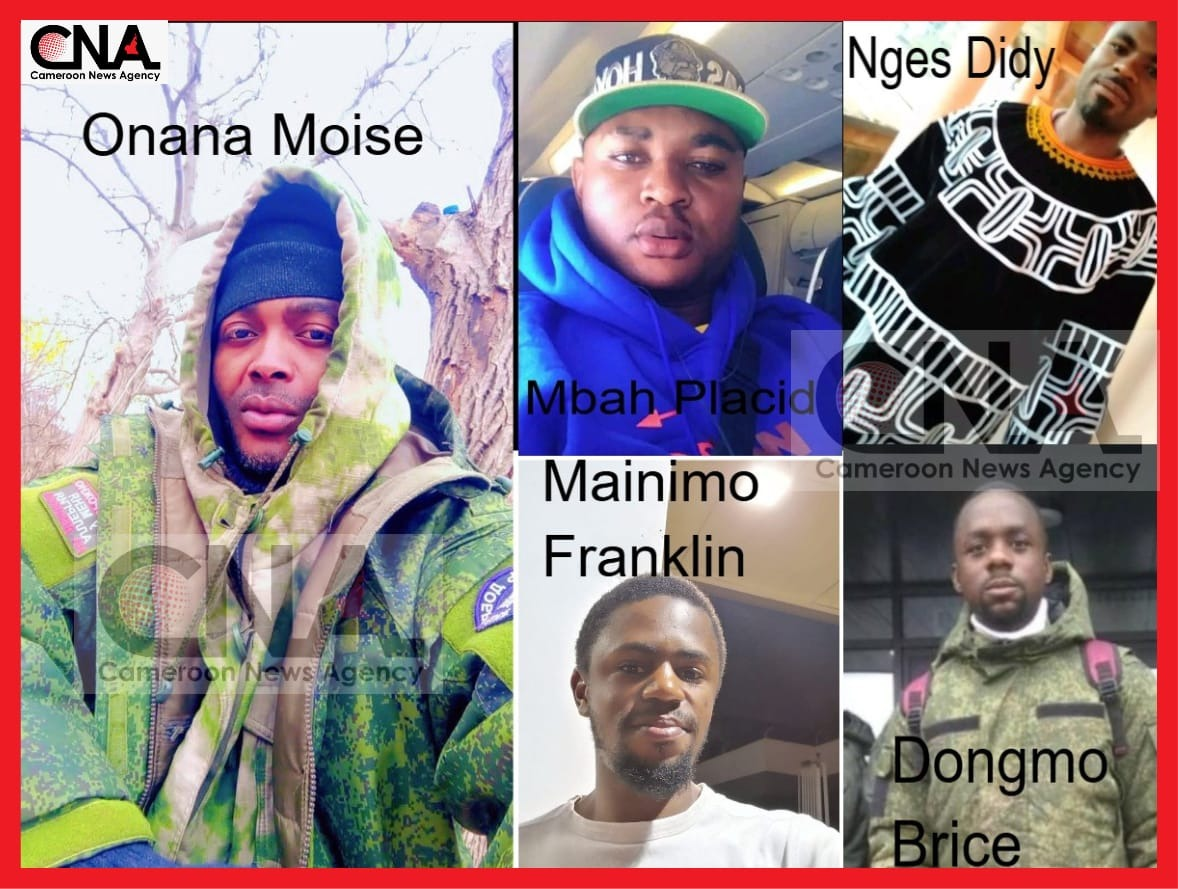
At CNA, we have reported on the stories of five Cameroonian recruits who died fighting for Russia.
Here are highlights of their stories:
• Dongmo Bris : We first reported on Bris’ story in August 2025. His sister told us that Bris left Cameroon on a study visa in 2024. However, once he got to Russia, he was convinced by some friends that he would get better pay if he served in the Russian army.
“He had to borrow the money for his flight from friends and some family,” Brice’s junior sister Nancy tells us. “The visa that they issued to him said ‘Study Visa’ so he knew that he was going for studies,” Nancy said “But when he got to Russia another Cameroonian friend who was already there told him that it is a good opportunity to work as a security guard and make some extra income” his sister told CNA. But this was never the case.
Nancy says that when Brice signed up for the new job, communication via telephone with his family back in Cameroon became less and less frequent. “At times, he would come back and message us for a day or two, and then we’d only hear from him a month later again. Then, around April, the family stopped hearing from him, only to later receive a call from his Cameroonian friend that Brice had been killed. In December 2025, his family made the difficult decision to hold a funeral for him in the village, without a corpse – just a symbolic gesture to get closure. He was 38.
• Onana Moise Roger: Roger was an only child to his mother who is now in her mid-sixties. Mama Regine as she is fondly called, wept when we interviewed her at her home in Douala, the economic hub of Cameroon.
Roger who would have turned 40 this year, initially planned to travel to South Africa, but a travel agent convinced him that Russia had better-paying jobs. It is not clear what jobs the agent meant but shortly after his arrival in Russia, Roger called his mother and told her he was in the army. Months later, his number was no longer reachable and she soon found out that her son was dead. In 2025, the local Catholic church where Regine and her family worship, held a requiem Mass (service for the dead) in memory of her son. Regine was too shaken to attend and was admitted to hospital the very moment the church service was taking place. He left behind three kids and a wife who now have to be taken care of by his retired and ailing mother and his unemployed wife who is drowning in debt from all the loans the family took out to enable Roger to travel.
• Mainimo Franklin: Frankline had been working for a while in the capital city of Cameroon, Yaounde as a taxi driver. He later learned of the recruitment in Russia (possibly online) and signed up to join. Sometime in mid-2026, his family was no longer able to reach him telephonically – their only means of communication. Later on, they found out that their son had been killed in Russia when INPACT published its list of 94 Cameroonians killed on the frontlines in Ukraine. Franklin had three kids who will have to grow up without a father.
• Nges Didymus: Nges Didymus was described as a vibrant Baptist Christian by his friends and family. He was also a well-established businessman who supplied stationaries to offices in Bamenda – the largest Anglophone city in Cameroon. However, Nges chose to join the Russian army – likely drawn by promises of better pay. Like the other cases above, his family stopped hearing from him several months ago and had no idea how else to reach him. He leaves behind a wife and two kids, CNA learned.
• Mbah Placid : Mbah was a soldier in the Cameroonian army. He defected from the Cameroonian army and joined the Russian army, likely lured by promises of better pay too. He would have turned 30 this year but his life was cut short on the frontlines in Ukraine. His family like the other families above, was left in the dark as to what had happened to him when his number abruptly stopped going through in February 2025. One year later, they would learn that their son had been killed in Ukraine.
According to French broadcaster RFI, Cameroon has numerous agencies offering visas in less than a month. Influencers and businesspeople also promote programs such as Alabuga Start, which aims to recruit young women for a drone manufacturing plant.
Cameroonian soldiers, who can significantly increase their pay, are also being targeted, the Paris-based outlet reported. In March 2025, the Ministry of Defence referred to “clandestine departures” and prohibited them from leaving the country without direct authorization, the outlet states.
Until now, Cameroonian authorities have not officially spoken on the matter. “Detecting the networks is not an easy task,” a source close to the government told RFI. “This report will be examined; we will not abandon the families,” the source promised. “This is handled within the framework of relations between states, and not through the media.” The source urges families without news to contact the Consular Department of the Ministry of External Relations. CNA reached out to the Ministry but was told to address our enquiry to the Minister himself.
What this Means for Cameroon as the War Enters Its Fourth Year
The Cameroonians fighting on behalf of Russia are not doing so because they love Russia. They are not doing so because they hate Ukraine. In fact, investigations we are working on, seem to suggest that there are some Africans (including Cameroonians), who have fought on the side of Ukraine and have since left and returned to other countries in Europe. We have just not been able to get in touch with any of them. To frame the involvement of Africans on either side of this war as being solely because of Russian propaganda or “hatred” for Ukraine, is to miss the complex economic and personal factors that incentivize these young Africans to travel to Russia in the first place.
It is vital for Cameroonians to understand that signing up to fight for Russia (or even Ukraine) is almost a sure death sentence. A travel agency mentioned by the INPACT report is Rhema Group. Cameroonians should be careful not to get into any dealings with any travel agencies promising them jobs in Russia and those who travel there for studies should remain strictly as students and not get lured by promises of better pay.
We contacted the Russian embassy in Yaounde for comment and were yet to get any response at the time of publishing this report.