Ireatha Leona Woods can’t help but relish in the power of establishing her sewing shop in a place her ancestors could not do the same.
Woods runs her business, Leona’s Sewing Studio, out of the Historic Savage Mill, engulfed in the history of the building, a former textile mill which sits in a once renowned “white-only” company town.
“Sometimes I have to pinch myself that I’m actually standing in [this] space … my ancestors are happy because I’m doing it in a better way, another way,” Woods said. “I’m a steward over the heritage of my people sitting inside a cotton mill, and they could not, they would not, in a million years, probably think that they would be able to curate what I’m doing right now in that space.”
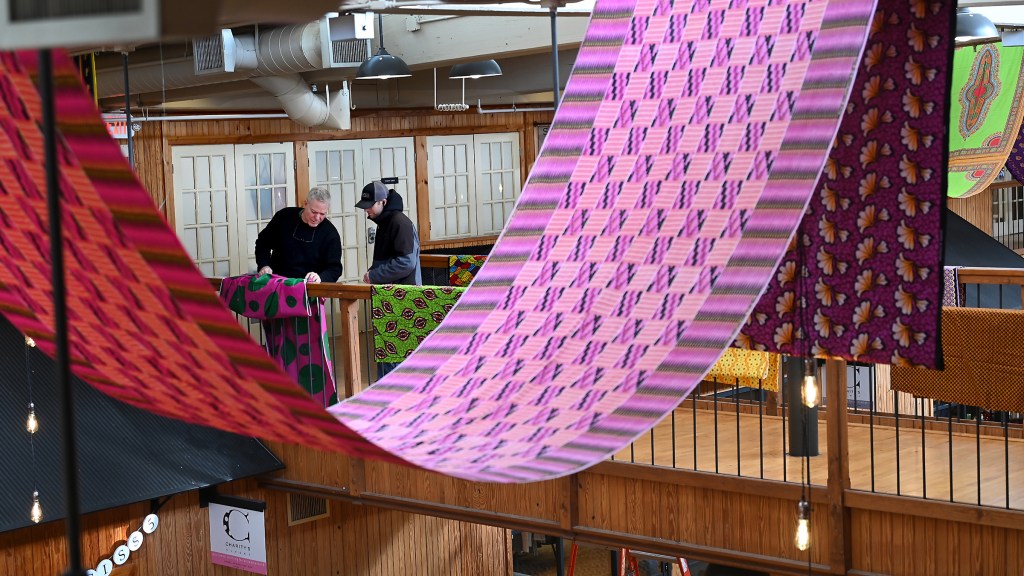
On Feb. 12, the mill unveiled Woods’ fabric exhibition, “Threads of Heritage: African Print Fabrics and the Stories They Carry,” the first of its kind for the space. The display features multicolored and patterned fabrics, specifically curated by Woods with a focus on traditions from Nigeria, Ghana, Mali and Guinea.
“In this exhibit; we’re really honoring their legacy, the legacy of our ancestors and those that have come before us, through textiles in a place where they were not allowed,” she said.
Mike Foster, facilities manager for the Savage Mill, set up the display days before it opened with maintenance technicians Tom Matthews and Matt Shuck. They draped fabrics across ceiling pillars and fastened others to railings, alternating similar patterns and colors.
Foster said the fabrics were stapled in place so they could be reused after the exhibit is taken down in April.
- The exhibit, African Print Fabrics and the Stories They Carry: A Fabric Exhibition by Leona’s Sewing Studio, will be up from Thursday to April 3, in Savage Mill’s New Weave building. (Jeffrey F. Bill/Staff)
- Tom Matthews, Maintenance Technician, left, and Mike Foster, Facilities Manager at Savage Mill, right, finish hanging tapestry for an exhibit on the second floor. The exhibit, African Print Fabrics and the Stories They Carry: A Fabric Exhibition by Leona’s Sewing Studio, will be up from Thursday to April 3, in Savage Mill’s New Weave building. (Jeffrey F. Bill/Staff)
- Mike Foster, Facilities Manager, left, and Tom Matthews, Maintenance Technician, right, at Savage Mill, right, finish hanging tapestry for an exhibit on the second floor. The exhibit, African Print Fabrics and the Stories They Carry: A Fabric Exhibition by Leona’s Sewing Studio, will be up from Thursday to April 3, in Savage Mill’s New Weave building. (Jeffrey F. Bill/Staff)
- The exhibit, African Print Fabrics and the Stories They Carry: A Fabric Exhibition by Leona’s Sewing Studio, will be up from Thursday to April 3, in Savage Mill’s New Weave building. (Jeffrey F. Bill/Staff)
- Tom Matthews, Maintenance Technician, left, and Mike Foster, Facilities Manager at Savage Mill, right, finish hanging tapestry for an exhibit on the second floor. The exhibit, African Print Fabrics and the Stories They Carry: A Fabric Exhibition by Leona’s Sewing Studio, will be up from Thursday to April 3, in Savage Mill’s New Weave building. (Jeffrey F. Bill/Staff)
- Savage Mill Maintenance Technicians, Matt Shuck, left, and Tom Matthews, right, right, finish hanging tapestry for an exhibit on the second floor. The exhibit, African Print Fabrics and the Stories They Carry: A Fabric Exhibition by Leona’s Sewing Studio, will be up from Thursday to April 3, in Savage Mill’s New Weave building. (Jeffrey F. Bill/Staff)
- The exhibit, African Print Fabrics and the Stories They Carry: A Fabric Exhibition by Leona’s Sewing Studio, will be up from Thursday to April 3, in Savage Mill’s New Weave building. (Jeffrey F. Bill/Staff)
- The exhibit, African Print Fabrics and the Stories They Carry: A Fabric Exhibition by Leona’s Sewing Studio, will be up from Thursday to April 3. (Jeffrey F. Bill/Staff)
Show Caption1 of 8The exhibit, African Print Fabrics and the Stories They Carry: A Fabric Exhibition by Leona’s Sewing Studio, will be up from Thursday to April 3, in Savage Mill’s New Weave building. (Jeffrey F. Bill/Staff)
Expand
History of Savage Mill
The mill complex began in 1822 as part of a broader trend of industrial-focused living, according to the Savage Mill website.
Savage was a company town — dominated by one industry and owned by one company — where only white residents were permitted to live, research by the Sundown Towns Project shows.
Stephen Berrey, associate professor of American culture and history at the University of Michigan, said the research first began in the late 1990s when sociologist and historian James Loewen wrote a book about sundown towns and wanted to create a public-facing database. Despite his death in 2021, a team of researchers and volunteers keeps the website updated and verifies any newly received information.
Howard County Council Vice Chair Christiana Rigby, who represents District 3, including Savage, said the location of the exhibit reflects the community’s growth. It represents “intentionally inclusive outreach” compared with the exclusion of the past, she said.
The once “whites-only” community of Savage now has near-equal Black and white populations, according to 2020 census racial demographic data. District 3 has the largest Black population of any district in the county, Rigby said.
Savage’s racist history makes the modern-day exhibit even more “sacred” to Woods, who emphasized the significance of “bringing cotton” to the mill that once produced it.
“[Textiles] tell stories,” Woods said. “They tell stories of heritage. They tell they tell stories of journeys. They tell stories of people and community. They tell stories of celebrations.”
Have a news tip? Contact April Santana at asantana@baltsun.com or at 443-834-7525.