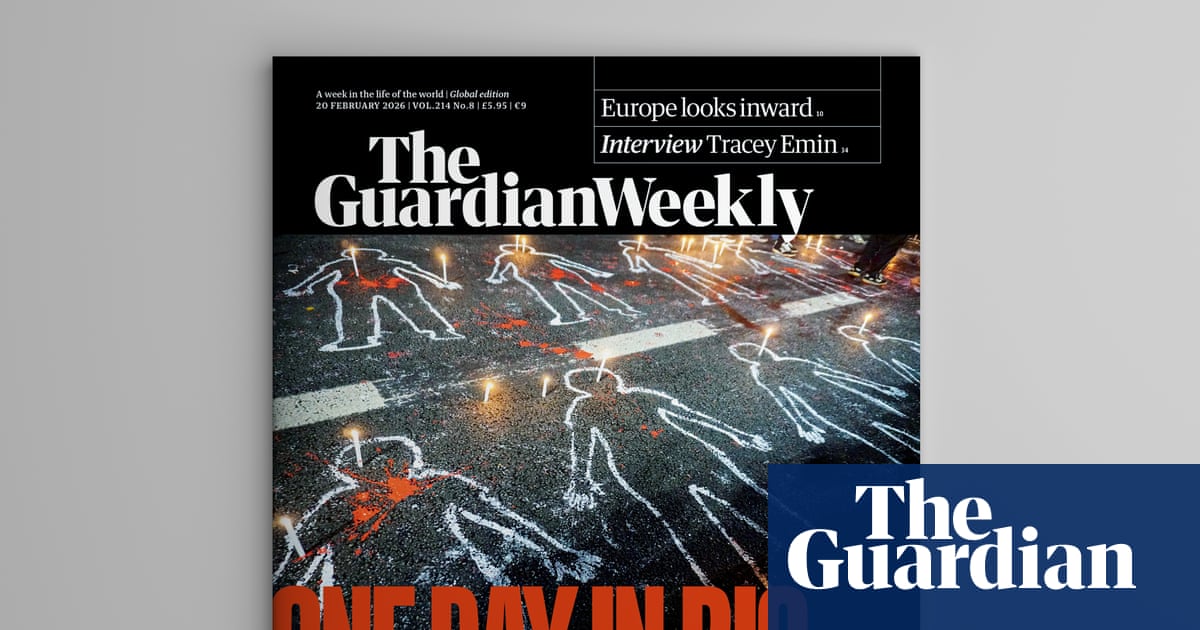
The first shots of an infamous day were fired in Rio’s Complexo da Penha favela at 4.30am. It was 28 October 2025 and the deadliest police raid in Brazil’s history had just begun. By the end of the day, 122 people, including five police, were dead.
The raid, nicknamed Operation Containment, was intended to apprehend members of one of the country’s most powerful organised crime groups, the Red Command – and in particular its kingpin, Edgar Alves de Andrade, who is also known as “the Bear”.
But the list of 100 arrest warrants justifying the operation featured none of the 117 people killed, and at least one of the dead was not involved in organised crime at all. The Bear, meanwhile, remains at large. Activists, security experts and even Brazil’s president, Luiz Inácio Lula da Silva, have described the operation as a futile massacre.
Now, in a forensic investigation encompassing interviews with community leaders, lawyers, security specialists and bereaved relatives, the Guardian’s South America correspondents Tom Phillips and Thiago Rogero have pieced together the full, previously untold story of what happened.
Get the Guardian Weekly delivered to your home address
Five essential reads in this week’s edition
US secretary of state Marco Rubio, left, and German chancellor Friedrich Merz shake hands at the Munich Security Conference. Photograph: Alex Brandon/AP
The big story | Continental drift in Munich
Europe’s leaders met to discuss the continent’s future safety at the Munich Security Conference, a gathering characterised by mistrust of the US Trump administration and divisions over Ukraine. Patrick Wintour was there
Spotlight | Pressure mounts for Andrew to talk to police
As calls for the former prince to cooperate with the investigation become deafening, this may be the reckoning the British king’s brother cannot escape. Caroline Davies and Alexandra Topping investigate
Interview | Tracey Emin on reputation and radical honesty
She scandalised the art world in the 1990s with her unmade bed, partied hard in the 2000s – then a brush with death turned the artist’s life upside down. Now Tracey Emin is as frank as ever, as Charlotte Higgins discovered
Opinion | Iran’s 1979 revolution offers some present-day pointers
The similarities between Iran’s current crisis and events preceding the shah’s exile are striking. The radical clerics benefited then – but, asks Jason Burke, who would prevail this time?
Culture | Thundercat on funk, lost friends and being fired by Snoop Dogg
The genre-hopping bass virtuoso has backed Ariana Grande and Herbie Hancock, appeared in Star Wars and become a boxer. Stephen Bruner explains his polymath mindset to Alexis Petridis
What else we’ve been reading
Kamel Daoud is being sued by Saâda Arbane. Composite: Guardian Design/AP/Reuters/AFP/Getty/Hans Lucas
I was fascinated about this story of literary ethics from France, where a rare, fictionalised account of Algeria’s civil war of the 1990s scooped the country’s most prestigious literary prize. Now one woman has accused author Kamel Daoud of stealing her story. Neil Willis, production editor
Would you buy a pair of brick-shaped red Lego Crocs for £199? Admit it, you’re intrigued – if perhaps not quite mad enough to follow through. Fortunately our brave reporter road tested them, so you don’t have to. Graham Snowdon, editor
Other highlights from the Guardian website
Audio | The crisis whisperer: how Adam Tooze makes sense of our bewildering age
Video | The Epstein files: Trump wants to move on
Gallery | The distance between us: are these people together or apart?
Get in touch
We’d love to hear your thoughts on the magazine: for submissions to our letters page, please email weekly.letters@theguardian.com. For anything else, it’s editorial.feedback@theguardian.com
Follow us
Get the Guardian Weekly magazine delivered to your home address